
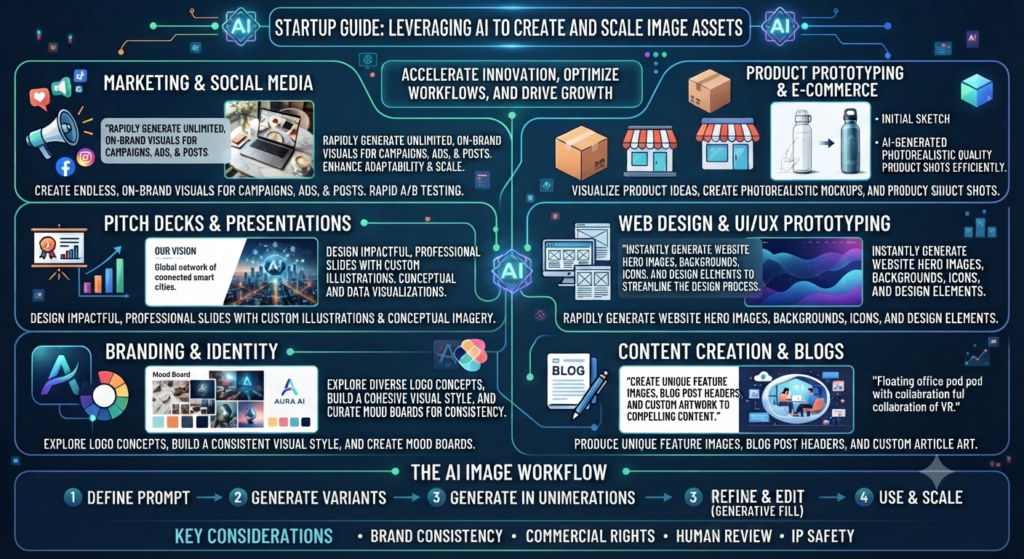
How Startups Can Use AI: Introduction
Starting a business is exciting, but managing it isn’t always easy. Most startups work with limited budgets, small teams, and tight deadlines. Founders must handle marketing, sales, customer support, finance, hiring, and daily operations. Managing all these activities can take a lot of time and money.
This is where artificial intelligence (AI) can make a real difference.
Today, AI is changing how businesses work. It helps teams complete tasks faster, manage information, and make better decisions. Startups can use AI to reduce manual work without hiring a large team. They can also improve service quality and focus more on business growth.
AI for startups isn’t just about using advanced technology. It’s about finding simple ways to save time, reduce costs, and improve everyday work.
For example, a small startup can use an AI chatbot to answer customer questions. It can use AI tools to write marketing content, analyze sales data, prepare reports, and manage daily tasks. These solutions can help a small team handle work that once required several people.
The best part is that startups don’t need to build their own AI systems. Many affordable tools are already available.
In this guide, we’ll explore 12 practical ways startups can use AI to reduce operational costs and improve productivity. We’ll also discuss useful tools, implementation steps, common mistakes, and future opportunities.
Know More: AI Image Generators: How Effectively They Work and How Effectively to Use Them in 2026
Why AI Is Important for Startups
Startups need to make the best use of every resource. Unlike large companies, they may not have separate teams for every business activity. One employee might manage several responsibilities. This can slow down work and increase pressure on the team.
AI helps startups manage these challenges. It can automate routine work, organize information, and support employees in completing tasks. Let’s understand why AI has become important for new businesses.
1. Limited Budgets and Small Teams
Most startups begin with limited financial resources. They must control spending while building products and attracting customers. Hiring employees for every task isn’t always possible. However, leaving important tasks unfinished can also affect growth.
AI offers another option.
For example, a startup can use an AI writing assistant to prepare blog outlines, product descriptions, and email drafts. A customer support chatbot can answer common questions. An accounting tool can help organize invoices and expenses.
These tools don’t replace every employee. Instead, they help existing employees complete more work.
This approach supports resource optimization and helps startups use their budgets wisely.
2. Growing Operational Demands
As a startup grows, its daily workload increases. More customers mean more support requests. More sales mean more records to manage. More employees create additional communication and reporting needs.
Manual processes can become difficult to manage.
AI workflow automation helps businesses handle these growing demands. For example, a startup can automatically send welcome emails after customer registration. It can also assign support requests, update records, and prepare daily reports.
This reduces repetitive work and makes operations easier to manage.
3. Better Decisions Through Data
Startups collect information from websites, customers, marketing campaigns, and sales activities. However, collecting data isn’t enough. Teams must understand it and use it to make decisions.
AI-powered data analysis can help identify patterns, customer preferences, and business opportunities.For example, an online startup can analyze customer activity to understand which products receive the most attention. A marketing team can compare campaign performance and identify areas that need improvement.
These insights support better business decisions.
4. The Role of AI in Startup Growth
AI can support almost every business department.
|
Business Area |
How AI Helps |
|
Marketing |
Content creation and campaign analysis |
|
Sales |
Lead scoring and customer follow-ups |
|
Customer Support |
Chatbots and automated responses |
|
Finance |
Expense tracking and reporting |
|
Human Resources |
Resume screening and recruitment support |
|
Operations |
Workflow automation |
|
Development |
Code assistance and testing |
|
Management |
Data analysis and business reporting |
AI also helps startups become more flexible. Teams can test new ideas, improve processes, and respond to customer needs faster. This makes AI an important part of modern startup operations management.
12 Ways AI Helps Startups Reduce Costs and Improve Productivity
AI can improve productivity in many ways. However, startups should focus on practical applications that solve real business problems.
Here are 12 useful ways to introduce AI into daily operations.
1. Automate Repetitive Tasks
Repetitive tasks take time but don’t always require human decision-making.
Examples include:
- Sending routine emails.
- Updating customer records.
- Preparing daily reports.
- Organizing documents.
- Scheduling meetings.
- Entering information into business systems.
These activities can be automated with AI and business automation tools.
For example, a startup can connect its website forms with a customer relationship management (CRM) system. When someone submits a form, the system can save their information, assign a sales representative, and send an automatic confirmation email.
This reduces manual work and lowers the chance of human error.
How it reduces costs: Employees spend less time on routine activities and more time on important business tasks.
2. Improve Customer Support With AI Chatbots
Customer support is important for every startup. However, hiring a large support team can be expensive.
AI chatbots provide a useful alternative for handling common questions.
A chatbot can answer questions about:
- Product features.
- Pricing and payment methods.
- Account registration.
- Order status.
- Business hours.
- Frequently asked questions.
For example, a software startup can add a chatbot to its website. Customers can ask questions at any time and receive instant answers to common queries. If a question requires human attention, the chatbot can transfer the conversation to a support employee.
This creates a better customer experience while reducing repetitive support work.
How it improves productivity: Support employees can focus on complex problems instead of answering the same questions repeatedly.
3. Simplify Marketing and Content Creation
Marketing is another area where startups can benefit from AI.
Creating content for websites, blogs, social media, and email campaigns requires time and planning. Small marketing teams may struggle to manage all these activities.
AI content generation tools can help with:
- Blog topic research.
- Content outlines.
- Social media captions.
- Email drafts.
- Product descriptions.
- Advertising copy.
- Content summaries.
For example, a startup can use ChatGPT to generate blog ideas based on customer questions. A marketing employee can review the suggestions, add business knowledge, and prepare the final article.
AI can also help analyze campaign performance and suggest improvements.
However, AI-generated content should always be reviewed before publishing. Businesses must check facts, originality, tone, and usefulness.
How it reduces costs: Startups can manage more content activities without outsourcing every small task.
4. Improve Sales Operations
Sales teams spend a lot of time finding leads, updating records, sending emails, and following up with potential customers.
AI can simplify these activities.
AI-powered CRM systems can help businesses:
- Organize customer information.
- Identify promising leads.
- Suggest follow-up actions.
- Summarize sales conversations.
- Track customer interactions.
- Prepare sales reports.
For example, an AI system can analyze customer activity and identify leads who have shown interest in a product.
The sales team can then focus on those leads instead of manually reviewing every record.
This improves sales productivity and supports better customer relationships.
5. Automate Financial Tasks
Financial management is essential for startups. Founders must track expenses, manage invoices, monitor cash flow, and prepare financial reports.
Manual financial work can become difficult as a business grows.
AI-powered financial software can help with:
- Invoice organization.
- Expense categorization.
- Payment reminders.
- Financial reporting.
- Cash flow analysis.
- Transaction monitoring.
For example, a startup can use accounting software to organize business expenses automatically. The finance team can review the records instead of entering every transaction manually.
AI can also help identify unusual spending patterns.
However, financial information should be checked by qualified employees. AI recommendations shouldn’t replace professional accounting or tax advice.
How it reduces costs: Better expense visibility helps founders identify unnecessary spending and improve budget management.
6. Improve Project and Task Management
Poor task management can waste time and create confusion.
Employees may not know who is responsible for a task, when it needs to be completed, or which activity should receive priority.
AI-powered project management tools can help teams:
- Assign tasks.
- Track deadlines.
- Summarize project updates.
- Identify delayed activities.
- Organize team communication.
- Create project reports.
For example, a startup developing a mobile application can use an AI assistant to summarize project discussions and prepare task lists.
Team members can quickly understand what needs to be done.
This supports better workflow management and improves communication.
7. Use AI for Data Analysis and Reporting
Data analysis can help startups understand their business performance.
However, many founders don’t have dedicated data analysts. As a result, useful information may remain unused.
AI tools can help analyze data from spreadsheets, CRM systems, websites, and marketing platforms.
They can support:
- Sales performance analysis.
- Customer behavior analysis.
- Marketing campaign reporting.
- Revenue tracking.
- Website traffic analysis.
- Business trend identification.
For example, a startup can use an AI assistant to analyze monthly sales data and identify products with declining performance.
It can also prepare summaries that help managers understand business results.
Automated reporting saves time and supports data-driven decisions.
Always verify calculations and conclusions before making important business decisions.
8. Reduce Recruitment and Training Costs
Hiring employees takes time. Startups must review applications, schedule interviews, communicate with candidates, and manage onboarding.
AI can help simplify several recruitment activities.
For example, AI recruitment software can:
- Organize resumes.
- Identify relevant skills.
- Help prepare job descriptions.
- Schedule interviews.
- Answer basic candidate questions.
- Prepare onboarding documents.
AI can also support employee training.
A startup can use AI assistants to explain internal processes, summarize training documents, and answer common employee questions.
However, recruitment decisions should remain under human supervision. AI systems may produce biased or incorrect recommendations, so candidates should always receive fair consideration.
9. Optimize Inventory and Resource Management
Startups that sell physical products must manage inventory carefully.
Too much inventory can increase storage costs. Too little inventory can result in missed sales.
AI-based inventory systems can analyze sales patterns, past demand, and stock levels.
They can help businesses:
- Monitor stock levels.
- Identify popular products.
- Estimate future demand.
- Reduce excess inventory.
- Improve purchasing decisions.
For example, an online retail startup can analyze previous sales to estimate which products may receive higher demand during a seasonal campaign.
These insights can help the business plan purchases more effectively.
AI recommendations should be checked against supplier conditions and real market demand.
10. Improve Software Development With AI Copilots
Technology startups often spend significant time building, testing, and maintaining software.
AI coding assistants can help developers work more efficiently.
They can support:
- Code suggestions.
- Code explanations.
- Debugging.
- Test case generation.
- Documentation.
- Code reviews.
- Repetitive programming tasks.
For example, a developer can use an AI copilot to understand an unfamiliar function or generate a basic unit test.
This can reduce development time and help developers focus on complex problems.
However, AI-generated code must be reviewed and tested. Security, performance, and software quality should never be ignored.
11. Automate Routine Human Resource Activities
Managing employee information and internal communication can take time.
AI tools can help HR teams organize routine activities such as:
- Employee onboarding.
- Leave request management.
- Internal FAQs.
- Training schedules.
- Employee document organization.
- Policy summaries.
For example, an AI assistant can answer common questions about company policies by referring to approved internal documents.
This allows HR employees to focus on recruitment, employee development, and workplace planning.
Sensitive employee information must be handled carefully. Companies should follow applicable privacy and employment laws.
12. Improve Cybersecurity and Risk Monitoring
Security problems can create serious financial and operational losses for startups.
Many new businesses don’t have large cybersecurity teams. However, they still need to protect customer information, employee accounts, and business systems.
AI-based security solutions can help identify unusual activities.
They may support:
- Suspicious login detection.
- Unusual network activity monitoring.
- Spam and phishing detection.
- Security alert prioritization.
- Threat analysis.
- Automated incident reporting.
For example, a security system can flag an unusual login attempt from an unfamiliar location.
The IT team can investigate the alert and take appropriate action.
AI doesn’t guarantee complete security. Startups should also use strong passwords, multi-factor authentication, regular backups, and access controls.
Best AI Tools for Startup Productivity
Choosing the right tools is an important part of successful AI adoption.
Startups shouldn’t purchase every available AI product. Instead, they should select tools that solve specific operational problems.
Here are some popular options.
|
AI Tool |
Main Purpose |
How Startups Can Use It |
|
ChatGPT |
AI assistant and content generation |
Research, writing, summaries, brainstorming, and data analysis |
|
Google Gemini |
AI assistant |
Research support, content creation, and productivity |
|
Claude |
AI assistant |
Document analysis, writing, and long-form content support |
|
Zapier |
Workflow automation |
Connect applications and automate repetitive tasks |
|
Make |
Process automation |
Build automated business workflows |
|
Notion AI |
Productivity and knowledge management |
Organize notes, documents, and project information |
|
HubSpot |
CRM and marketing |
Manage customer relationships and sales activities |
|
Canva AI |
Design and content creation |
Prepare marketing graphics and presentations |
|
GitHub Copilot |
Software development |
Support coding and debugging |
|
Intercom |
Customer communication |
Manage customer support and AI-assisted conversations |
How to Choose the Right AI Software for Startups
Before selecting any software, consider these factors:
- Business needs: Identify the problem you want to solve.
- Pricing: Compare subscription costs and available plans.
- Ease of use: Select tools that employees can learn quickly.
- Integration: Check whether the software works with existing systems.
- Security: Understand how the provider stores and uses business data.
- Scalability: Choose solutions that can support future business growth.
Start with one or two tools. Measure their results before adding more software.
How to Implement AI in Startup Operations
Buying AI software doesn’t automatically improve business performance. Startups need a clear implementation plan. The goal should be to solve real problems, not simply introduce new technology.
Here are six practical steps.
Step 1: Identify Expensive and Time-Consuming Tasks
Start by reviewing daily business activities. Ask employees which tasks take the most time. Identify activities that involve repeated data entry, manual reporting, or routine communication.
Create a list of tasks that could benefit from automation.
For example:
|
Task |
Current Problem |
Possible AI Solution |
|
Customer support |
Repeated questions |
AI chatbot |
|
Marketing |
Slow content production |
AI writing assistant |
|
Reporting |
Manual data collection |
Automated reporting |
|
Sales |
Missed follow-ups |
CRM automation |
|
Recruitment |
Resume organization |
AI recruitment software |
This helps founders select the right starting point.
Step 2: Set Clear Business Goals
Every AI project should have a measurable goal.
For example:
- Reduce time spent on manual reporting.
- Improve customer response time.
- Reduce repetitive data entry.
- Increase the number of leads handled by each sales employee.
- Improve content production speed.
Avoid vague goals such as “use more AI.”
Clear targets make it easier to measure results.
Step 3: Start With Small Automation Projects
Don’t automate every business process at once.
Choose one activity that has a clear problem and a simple solution.
For example, start by automating customer welcome emails.
Once the workflow works correctly, introduce additional automation.
This approach reduces implementation risks and helps employees become comfortable with AI.
Step 4: Train Employees
Employees should understand how AI tools work and where they can help.
Provide basic training on:
- Writing effective AI prompts.
- Reviewing AI-generated information.
- Protecting confidential data.
- Using automation tools.
- Identifying inaccurate results.
AI employee productivity improves when employees know how to use these tools properly.
Step 5: Measure Cost Savings and Productivity
Track results before and after implementing AI.
Useful performance indicators include:
|
KPI |
What It Measures |
|
Time saved |
Reduction in time spent on tasks |
|
Cost per task |
Average cost of completing an activity |
|
Customer response time |
Speed of customer support |
|
Lead conversion rate |
Effectiveness of sales activities |
|
Employee productivity |
Work completed within a given period |
|
Error rate |
Frequency of mistakes |
|
Automation success rate |
Percentage of workflows completed correctly |
For example, if a task previously required five hours each week and automation reduces it to two hours, the business saves three hours weekly. However, time saved doesn’t always mean immediate cash savings. Founders should also consider software costs, implementation expenses, training, and maintenance.
Step 6: Improve and Expand Gradually
AI adoption should be an ongoing process. Review automated workflows regularly. Check whether they are producing accurate results and delivering business value.
Remove unnecessary tools and improve processes that aren’t working well.
Once one department achieves positive results, consider applying similar solutions elsewhere.
This creates a practical foundation for long-term startup digital transformation.
Common Mistakes Startups Should Avoid When Using AI
AI offers many opportunities, but poor implementation can increase expenses instead of reducing them.
Here are some mistakes founders should avoid.
1. Using Too Many AI Tools
Subscribing to multiple tools can create unnecessary expenses.
Employees may also struggle to manage different platforms.
Solution: Select tools based on actual business requirements. Review subscriptions regularly.
2. Depending Completely on AI
AI can make mistakes, provide outdated information, and misunderstand instructions.
Solution: Keep human review in important activities such as finance, recruitment, customer communication, and software development.
3. Ignoring Data Security
Uploading confidential information to an unsuitable AI platform can create privacy risks.
Solution: Review privacy policies, access permissions, and data handling practices before using a tool.
4. Automating Poor Business Processes
Automating an inefficient process doesn’t necessarily make it better.
Solution: Improve the existing process before introducing automation.
5. Ignoring Employee Training
Employees may avoid new tools if they don’t understand how to use them.
Solution: Provide practical training and explain how AI can make their work easier.
6. Failing to Measure Results
Without proper measurement, startups may continue paying for tools that offer little value.
Solution: Track time savings, costs, accuracy, and productivity improvements.
Future of AI for Startups
AI technology is developing quickly. New tools are making advanced capabilities more accessible to small businesses.
In the coming years, startups may use AI in more areas of business management.
AI Copilots for Startups
AI copilots for startups can help employees complete daily tasks through simple conversations.
Founders may use AI assistants to prepare reports, summarize meetings, organize plans, and review business information.
These systems can act as digital assistants that support everyday decision-making.
Generative AI for Startup Growth
Generative AI can create text, images, summaries, and other digital content.
Startups can use it for marketing campaigns, product descriptions, presentations, customer communication, and research support.
It can help small teams produce more content while keeping production costs under control.
AI-Powered Business Workflows
Future AI systems may handle multiple connected tasks.
For example, an AI-powered workflow could collect a customer inquiry, organize the information, assign a sales representative, prepare a response, and update the CRM.
This type of intelligent process automation can improve startup operational efficiency.
More Accessible AI Business Solutions
AI tools are becoming easier to use.
Startups may be able to introduce advanced automation without building complex systems or hiring large technical teams.
This can create new opportunities for small businesses to compete with established companies.
However, successful adoption will still depend on good data, responsible use, employee skills, and proper business planning.
Artificial intelligence is creating new opportunities for startups
Artificial intelligence is creating new opportunities for startups to work smarter and manage their resources more effectively. From customer support and marketing to finance, recruitment, and software development, AI can simplify many business activities. It helps small teams handle repetitive work, improve decision-making, and focus on important business goals.
However, successful AI adoption doesn’t require expensive technology or complex systems. Startups should begin with simple solutions that address real operational problems. They should choose affordable tools, train employees, protect business information, and measure results regularly.
”FAQs”
1. How can startups reduce costs using AI?
Startups can reduce costs using AI by automating repetitive tasks, improving customer support, simplifying marketing, organizing financial records, and analyzing business data. These activities help employees save time and allow businesses to use existing resources more effectively.
2. What are the best AI tools for startup productivity?
Popular options include ChatGPT, Google Gemini, Claude, Zapier, Make, Notion AI, HubSpot, Canva AI, and GitHub Copilot. The best tool depends on the startup's needs, budget, team size, and existing software.
3. Can AI help startups grow without hiring more employees?
Yes. AI can help existing employees manage more tasks by automating routine activities and simplifying workflows. However, AI cannot replace every human responsibility. Startups may still need additional employees as their customer base and business requirements grow.
4. Is AI expensive for small startups?
Not necessarily. Many AI platforms offer free plans or affordable entry-level subscriptions. Startups can begin with basic tools and upgrade when their requirements increase. They should compare the total cost of subscriptions, training, integration, and maintenance before making a decision.
5. How does AI improve startup operational efficiency?
AI improves startup operational efficiency by reducing manual work, organizing information, automating workflows, and supporting faster decisions. It also helps teams manage customer communication, reporting, sales activities, and internal processes.
6. How can startup founders use ChatGPT for business growth?
Founders can use ChatGPT for startups to brainstorm business ideas, research markets, prepare business plans, draft emails, generate content outlines, summarize documents, and analyze information. Important facts and business decisions should always be reviewed by humans.
7. What are the risks of using AI in startups?
Common risks include inaccurate information, data privacy issues, security problems, biased outputs, and overdependence on automation. Startups should use trusted tools, protect confidential information, and maintain human supervision.
8. How should a startup begin its AI transformation?
A startup should begin by identifying time-consuming tasks, setting measurable goals, and selecting one suitable AI tool. It should train employees, test the solution, measure results, and expand automation gradually.


