AI vs Traditional Learning: Which Approach Is Better for Modern Students?
Education has changed a lot over the past few years. Students no longer depend only on books, notebooks, and classroom lectures. They can now use digital tools to understand difficult topics, practice new skills, and improve their knowledge.
Artificial intelligence has made this change even more important.
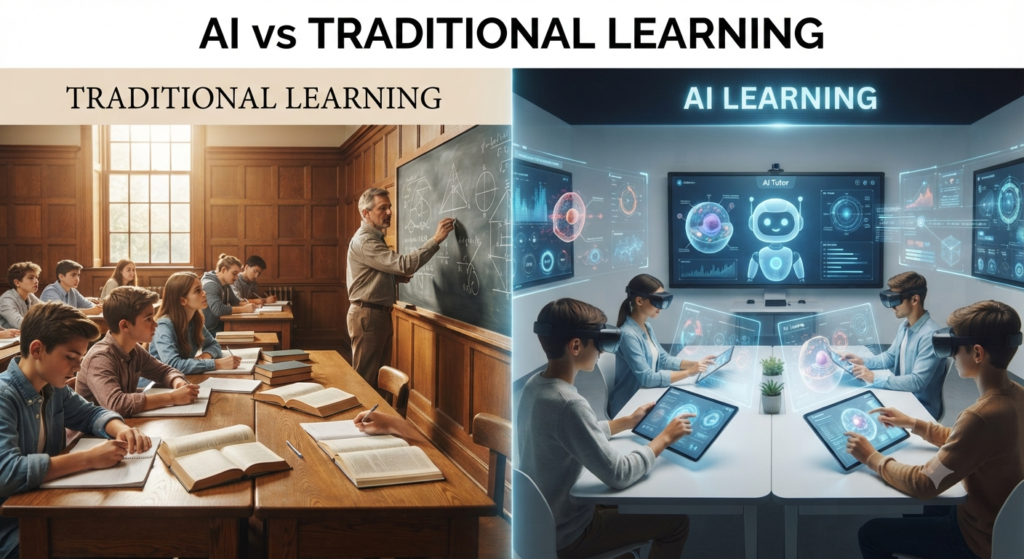
Today, AI-powered learning tools can explain complex ideas, create practice questions, check answers, and provide personal feedback. At the same time, traditional education methods continue to help students develop communication skills, discipline, teamwork, and critical thinking.
This creates an important question: AI vs traditional learning: which approach is better for modern students?
Both methods have clear benefits. However, they also have some limitations.
AI learning offers speed, flexibility, and personalized support. Traditional classroom learning offers human connection, direct guidance, and social development.
The best choice depends on a student’s goals, learning style, age, and educational needs.
In this guide, we’ll compare both approaches, explore their advantages and disadvantages, and explain how students can benefit from combining them.
Know More: AI Ethics: What Are the Top 10 Biggest Ethical Challenges of Artificial Intelligence?
1. AI vs Traditional Learning: Understanding
AI-powered learning uses artificial intelligence to support the teaching and learning process.
These systems can study how students interact with lessons. They can also identify learning gaps and suggest suitable study materials.
For example, a student may struggle with algebra. An AI learning assistant can explain the topic in simple language, show examples, and create additional questions for practice.
This makes learning more flexible.
Unlike a fixed classroom lesson, many AI-based education systems can adjust their support based on a student’s progress.
How AI Learning Tools Work
AI learning tools use data, algorithms, and language models to provide learning support.
Here’s how they commonly work:
- Understand student questions: Students enter a question or learning request.
- Process information: The AI system analyzes the request and generates a response.
- Provide explanations: It presents information, examples, or learning materials.
- Check progress: Some platforms track answers and learning activities.
- Suggest improvements: The system may recommend topics that need more practice.
These features support personalized education and self-paced learning.
However, AI responses aren’t always correct. Students should verify important information using textbooks, teachers, and trusted educational sources.
Examples of AI Learning Tools
Several AI learning tools are changing how students study.
- ChatGPT
Students can use ChatGPT to understand difficult topics, summarize study materials, generate practice questions, and explore new ideas.
It can act as a learning assistant, but students should use it to understand concepts rather than simply copy answers.
- Khan Academy
Khan Academy provides lessons, exercises, and educational resources. Its AI-supported learning features can offer additional guidance to students.
- Duolingo
Duolingo uses technology to support language practice through interactive exercises and personalized learning experiences.
- Quizlet
Quizlet helps students revise subjects through flashcards, practice tests, and study activities.
These examples show how AI learning tools for students can support different learning needs.
2. Understanding Traditional Learning
Traditional learning is the familiar method of education that takes place in schools, colleges, and other educational institutions.
It usually involves teachers, classrooms, textbooks, assignments, discussions, and examinations.
In this model, teachers explain lessons and guide students through different subjects. Students attend classes, complete homework, ask questions, and take part in group activities.
Traditional education methods focus on structured learning.
Students usually follow a fixed timetable and study according to a planned curriculum.
Key Features of Traditional Education
Traditional classroom learning offers several important features.
- Direct teacher guidance
Students can ask questions and receive explanations from teachers. Teachers can also notice when students need extra support.
- Classroom interaction
Students discuss topics, share ideas, and learn from their classmates.
- Fixed learning structure
Schools and colleges follow timetables, lesson plans, and academic schedules.
- Group activities
Students participate in debates, presentations, projects, and classroom discussions.
- Regular assessment
Teachers evaluate student progress through tests, assignments, and examinations.
These activities help students develop academic knowledge and important life skills.
Why Traditional Education Still Matters
Technology can provide information quickly, but education involves much more than information.
Students also need guidance, discipline, emotional support, and opportunities to work with others.
Teachers help students understand different viewpoints. They can encourage curiosity, identify personal challenges, and support students during difficult situations.
This human connection remains one of the strongest benefits of traditional education.
3. AI vs Traditional Learning: 7 Key Differences
Both learning methods aim to improve knowledge and student learning outcomes. However, they use different approaches.
Let’s compare their most important differences.
3.1 Learning Speed and Flexibility
AI-powered learning gives students more control over their study time.
Students can study at home, during travel, or whenever they have free time. They can also repeat lessons as many times as needed.
For example, a college student preparing for an exam can ask an AI assistant to explain a difficult topic. The student can then request more examples until the concept becomes clear.
Traditional learning usually follows a fixed timetable. Students attend classes at specific times and complete lessons according to the teacher’s schedule.
This structure helps students build discipline. However, it may not suit everyone.
3.2 Personalization and Student Support
Every student learns differently.
Some students understand concepts through diagrams. Others prefer written explanations, videos, or practical examples.
AI-based education systems can adjust learning materials to suit different needs. Some tools can identify weak areas and suggest extra exercises.
Traditional education also supports individual learning. Teachers can understand student behavior, notice learning difficulties, and offer personal guidance.
However, one teacher may have to support many students at the same time.
3.3 Teacher Interaction and Human Guidance
Human interaction is a major part of education.
Teachers do more than explain lessons. They encourage students, solve doubts, manage classrooms, and help students build confidence.
AI teaching tools can answer questions, but they don’t have the same human understanding or real-life teaching experience.
In traditional classrooms, students can discuss ideas directly with teachers and classmates.
These conversations help students develop communication and teamwork skills.
3.4 Cost and Accessibility
The cost of education is another important factor.
Traditional education may involve:
- School or college fees.
- Travel expenses.
- Books and study materials.
- Accommodation costs.
- Other academic expenses.
Digital learning can reduce some of these costs. Many online courses and educational resources are available at low prices or free of charge.
However, AI learning also has costs. Some platforms require paid subscriptions, and students need suitable devices and internet access.
This creates a digital divide between students who have access to technology and those who don’t.
3.5 Student Engagement and Motivation
Student engagement affects learning effectiveness.
AI tools use quizzes, interactive lessons, instant feedback, and personalized activities to keep students interested.
Some platforms also use progress tracking and rewards to encourage regular practice.
Traditional classrooms use group discussions, classroom activities, presentations, and teacher interaction.
These activities help students stay connected with others.
However, both approaches can become boring if lessons aren’t engaging.
3.6 Assessment and Feedback
Feedback helps students understand their mistakes.
AI-powered tools can check answers, generate practice tests, and provide quick explanations.
For example, a student learning English can use an AI assistant to identify grammar mistakes and improve sentence structure.
Traditional teachers can evaluate more than correct answers. They can consider creativity, effort, presentation, practical skills, and individual progress.
3.7 Practical Skills and Social Development
Education isn’t only about passing exams.
Students also need teamwork, leadership, communication, creativity, and problem-solving skills.
Traditional classroom learning provides opportunities to develop these skills through group projects, sports, laboratory work, debates, and presentations.
AI can support practical learning through simulations, coding exercises, and guided activities.
However, digital interaction cannot fully replace real-world experiences.
Winner: Traditional education has an advantage in social development and direct practical experience. AI works best as additional support.
AI Learning vs Conventional Learning: Comparison Table
|
Comparison Factor |
AI-Powered Learning |
Traditional Learning |
|
Learning speed |
Flexible |
Fixed schedule |
|
Personalization |
High potential |
Teacher-dependent |
|
Teacher interaction |
Limited or indirect |
Direct |
|
Cost |
Can be affordable |
Varies by institution |
|
Feedback |
Often instant |
Depends on teacher |
|
Social interaction |
Limited in solo use |
Strong classroom interaction |
|
Accessibility |
Needs technology |
Depends on location |
|
Learning structure |
Flexible |
Organized |
|
Practical experience |
Simulations and digital tasks |
Real-world activities |
|
Assessment |
Automated support |
Human evaluation |
The comparison shows that neither method is perfect. Each has strengths that can support different learning needs.
4. Advantages of AI-Powered Learning
AI is changing the way students access educational information.
Here are some major benefits of AI learning.
4.1 Personalized Education
AI tools can adjust explanations and practice activities based on student needs.
A student who struggles with mathematics can request simple explanations and additional questions.
Another student who understands the basics can explore advanced topics.
This makes learning more suitable for different skill levels.
4.2 Self-Paced Learning
Students don’t always learn at the same speed.
Some understand a lesson quickly, while others need more time.
AI learning assistants allow students to repeat lessons, ask questions, and practice without waiting for the next classroom session.
This supports independent learning.
4.3 Instant Feedback
Students can receive quick feedback on quizzes, writing exercises, and practice questions.
They can identify mistakes and work on weak areas without waiting for the next class.
However, students should verify important answers because AI tools can sometimes provide incorrect information.
4.4 Access to Learning Resources
Digital learning makes educational resources available beyond the classroom.
Students can access online lessons, educational videos, digital books, and virtual classrooms.
This can be especially useful for students who live far from educational institutions.
4.5 Improved Study Planning
AI tools can help students create study schedules, organize subjects, and prepare revision plans.
For example, students can ask an AI assistant to create a seven-day revision plan before an examination.
The student can then adjust the plan according to available time and personal priorities.
4.6 Support for Different Learning Needs
AI can help present information in different formats.
Students may use text explanations, speech features, translations, and other accessibility tools.
These features can support learners with different language and learning needs, although the quality of support depends on the tool.
5. Disadvantages of AI Learning
Despite its benefits, AI learning has some limitations.
Students should understand these challenges before depending heavily on AI tools.
5.1 Incorrect Information
AI systems can generate incorrect answers.
Sometimes, these answers sound convincing even when the information is wrong.
Students should compare AI-generated explanations with reliable textbooks, academic sources, and teacher guidance.
5.2 Overdependence on Technology
Some students may start using AI for every assignment.
They may copy answers without understanding the topic.
Over time, this habit can reduce independent thinking, writing practice, and problem-solving ability.
AI should support learning, not replace it.
5.3 Limited Human Connection
Students need social interaction to develop confidence and communication skills.
Learning only through digital platforms can reduce opportunities for classroom discussion and direct interaction.
5.4 Privacy and Data Security
Some AI platforms collect information about users and their activities.
Students should avoid sharing sensitive personal details, passwords, private documents, or confidential academic information.
Schools and colleges should also choose educational platforms with suitable privacy and safety standards.
5.5 Unequal Access to Technology
Not every student has a laptop, smartphone, or reliable internet connection.
This can create differences in learning opportunities.
Educational institutions must consider these challenges before making AI tools a compulsory part of education.
6. Advantages of Traditional Education
Traditional education continues to play an important role in student development.
Here are its major advantages.
6.1 Direct Teacher Support
Teachers can explain difficult concepts, answer questions, and provide personal guidance.
They can also change their teaching approach when students struggle with a topic.
6.2 Better Social Interaction
Classroom learning encourages students to interact with others.
They learn how to share ideas, respect different opinions, and work as a team.
These skills are important in higher education and professional life.
6.3 Discipline and Routine
Fixed class schedules help students develop regular study habits.
They learn to manage time, complete assignments, and follow academic responsibilities.
6.4 Practical Learning Opportunities
Schools and colleges offer laboratories, workshops, sports, group projects, and other practical activities.
These experiences help students apply theoretical knowledge in real situations.
6.5 Emotional and Personal Development
Teachers can motivate students during challenging situations.
They can also help students build confidence and develop a positive attitude toward learning.
7. Disadvantages of Traditional Education
Traditional learning also faces several challenges.
7.1 Limited Personalization
Teachers often work with large groups of students.
It may be difficult to provide individual attention to everyone during every lesson.
7.2 Fixed Learning Speed
A classroom lesson usually follows a common schedule.
Students who need extra time may struggle to keep up. Students who learn quickly may feel that some lessons move too slowly.
7.3 Location and Time Restrictions
Students generally need to travel to schools or colleges.
This can create problems for learners who live far away or have limited transportation options.
7.4 Limited Access to Additional Resources
Some institutions may have limited libraries, laboratory facilities, or digital resources.
This can affect the learning experience.
7.5 Higher Overall Expenses
Depending on the institution, students may need to pay for tuition, transportation, accommodation, books, and other academic needs.
8. AI vs Traditional Learning for College Students
College students have different learning needs from school students.
They often need to understand complex subjects, complete research projects, develop professional skills, and prepare for employment.
This is where AI-assisted learning can be useful.
For example, a computer science student can use AI tools to understand programming concepts and practice coding.
A business student can use AI to explore case studies, understand marketing concepts, and organize research.
An engineering student can use digital simulations to understand technical processes.
However, students must still develop independent knowledge.
How College Students Can Use AI Effectively
Here are some practical examples:
|
Academic Activity |
How AI Can Help |
Role of Traditional Learning |
|
Exam preparation |
Create revision questions |
Teacher guidance |
|
Research |
Generate topic ideas |
Academic verification |
|
Writing |
Improve grammar |
Original writing skills |
|
Coding |
Explain errors |
Practical programming |
|
Presentations |
Organize ideas |
Communication practice |
|
Career planning |
Explore career options |
Mentoring and networking |
AI learning vs conventional learning isn’t simply about choosing one method.
College students can use both to improve their academic performance and career readiness.
9. Role of Generative AI in Education
Generative AI is one of the most important developments in modern education.
It can create text, explanations, summaries, examples, questions, and other learning materials based on user instructions.
Tools powered by large language models (LLMs) are making educational support more accessible.
9.1 ChatGPT vs Traditional Learning Methods
ChatGPT can support students in several ways.
For example, students can ask it to:
- Explain difficult concepts in simple language.
- Create practice questions.
- Summarize study materials.
- Suggest research topics.
- Explain grammar rules.
- Help organize revision schedules.
Traditional teachers provide a different kind of support.
They can understand classroom situations, encourage students, and evaluate their progress through direct interaction.
Therefore, ChatGPT and traditional learning methods serve different purposes.
9.2 AI Tutoring Platforms
AI tutoring platforms can provide guided practice and personalized feedback.
Students can use them to improve mathematics, languages, science, and other subjects.
However, an AI tutor shouldn’t be treated as a complete replacement for a qualified teacher.
9.3 LLM-Powered Learning Tools
Large language models can make it easier to interact with educational information.
Students can ask questions in natural language instead of searching through many pages.
Still, they must check facts and understand the answers independently.
For responsible use, UNESCO recommends a human-centred approach that protects student agency and keeps educational decisions under meaningful human control.
UNESCO+1
For more guidance, visit the UNESCO Guide to Generative AI in Education and Research.
10. Is AI Learning Better Than Classroom Learning?
The answer depends on what a student wants to achieve.
AI learning can be more useful when students need:
- Flexible study schedules.
- Quick explanations.
- Additional practice.
- Personalized learning support.
- Access to online educational resources.
Traditional classroom learning can be more useful when students need:
- Direct teacher guidance.
- Group discussions.
- Practical activities.
- Social development.
- Regular academic supervision.
Neither method is automatically better in every situation.
A student preparing for a competitive examination may benefit from AI-powered practice questions and teacher-led coaching.
Similarly, a college student learning programming may use AI to understand code while attending practical classes to develop real coding skills.
Which Method Is More Effective for Students?
Learning effectiveness depends on several factors:
- The quality of learning materials.
- The student’s interest and motivation.
- The teaching method.
- Regular practice.
- Feedback and assessment.
- The ability to apply knowledge.
The best approach is the one that helps students understand, remember, and apply what they learn.
11. Future of AI and Traditional Education
The future of education will likely combine artificial intelligence with traditional teaching methods.
Schools and colleges are already exploring digital learning platforms, virtual classrooms, online assessments, and AI-supported educational resources.
Instead of removing teachers, these technologies can help teachers manage learning activities and provide additional support.
11.1 The Growth of Blended Learning
Blended learning combines classroom teaching with online education.
For example:
- Teachers explain important concepts in the classroom.
- Students use AI tools for additional practice.
- Online platforms provide revision materials.
- Teachers review student progress.
- Students complete practical and group activities.
This approach gives students the benefits of both learning methods.
11.2 AI as a Teaching Assistant
AI can help teachers with several daily tasks.
These include:
- Preparing lesson plans.
- Creating quizzes and practice exercises.
- Organizing study materials.
- Explaining difficult topics in different ways.
- Supporting basic assessment activities.
Teachers can use the extra time to focus on student interaction, classroom activities, and personal guidance.
11.3 More Personalized Education
Future AI-based education systems may offer better learning recommendations.
They may help teachers identify learning gaps and suggest suitable resources for individual students.
However, human review will remain important.
AI recommendations should support teachers rather than make important educational decisions without human supervision.
12. How Students Can Choose the Right Learning Method
Choosing between AI and traditional education depends on individual needs.
Students should consider their learning goals, available resources, study habits, and academic requirements.
Here are five practical steps.
Step 1: Understand your learning style
Identify whether you learn better through reading, listening, practical activities, classroom discussions, or interactive exercises.
Step 2: Identify your weak areas
Find the subjects or topics where you need additional support.
Step 3: Use AI for additional practice
Try AI learning assistants to understand difficult concepts, create revision questions, and explore new topics.
Step 4: Stay connected with teachers
Discuss doubts with teachers and participate in classroom activities.
Step 5: Measure your progress
Check your understanding through tests, assignments, projects, and practical activities.
Remember, using more technology doesn’t automatically mean learning more. What matters is how effectively you use the available resources.
AI vs Traditional Learning – Which Approach Is Better?
The debate around AI vs traditional learning isn’t about choosing technology over teachers. It’s about finding better ways to educate students.
AI-powered learning offers flexibility, personalized support, quick feedback, and easy access to educational resources.
Traditional education offers human guidance, social interaction, practical experience, and structured learning.
Both approaches have limitations, but they can also complement each other.
For modern students, the most effective approach is often a combination of AI learning and traditional classroom education.
Students can use AI to understand difficult concepts, practice new skills, and prepare for examinations. At the same time, they can learn from teachers, participate in group activities, and develop real-world skills.
Educational institutions should also focus on responsible technology use, student privacy, and equal access to learning opportunities.
”FAQs”
Q1. What is the difference between AI learning and traditional learning?
AI learning uses artificial intelligence and digital tools to support education. It offers flexible study options, personalized explanations, and quick feedback.
Traditional learning uses classroom teaching, textbooks, teacher guidance, and group activities.
The main difference is the way students receive information and educational support.
Q2. Is AI learning better than classroom learning?
AI learning isn't always better than classroom learning.
AI is useful for self-paced study, quick explanations, and additional practice. Classroom learning provides direct teacher interaction, social development, and practical experiences.
Combining both methods can create a more complete learning experience.
Q3. What are the advantages and disadvantages of AI learning?
Advantages:
Personalized learning support.
Flexible study schedules.
Quick feedback.
Access to digital resources.
Self-paced practice.
Disadvantages:
Incorrect AI-generated information.
Risk of overdependence.
Privacy concerns.
Limited human interaction.
Unequal access to technology.
Students should use AI carefully and verify important information.
Q4. How does AI affect modern student learning?
AI affects modern student learning by changing how students access information, practice subjects, and receive feedback.
It can support independent study and make educational resources easier to access.
However, students must continue developing critical thinking, creativity, communication, and problem-solving skills.
Q5. Can AI replace teachers in the future?
AI can support many teaching activities, but it cannot fully replace the human role of teachers.
Teachers provide emotional support, personal guidance, classroom management, and real-world experience.
AI is better viewed as an educational assistant that helps teachers and students.
Q6. Is AI-assisted learning useful for college students?
Yes. AI-assisted learning can help college students understand complex subjects, prepare for examinations, organize research, practice coding, and improve writing skills.
However, students should follow academic rules and avoid submitting AI-generated work as their own.
Q7. What is blended learning, and why is it important?
Blended learning combines traditional classroom education with digital learning tools.
Students receive direct teacher guidance while also using online resources for additional practice.
This approach supports flexibility, classroom interaction, and personalized learning.
Q8. What is the future of AI and traditional education?
The future of education will likely involve greater cooperation between teachers and AI systems.
Schools and colleges may use AI for personalized learning, educational planning, practice activities, and feedback.
Traditional teaching will continue to support human interaction, practical learning, and personal development.


