AI Robotics: 7 Powerful Ways How Artificial Intelligence Is Making Robots Smarter

AI Robotics: How Artificial Intelligence Makes Robots Smarter

AI Robotics: 7 Powerful Ways How Artificial Intelligence Is Making Robots Smarter

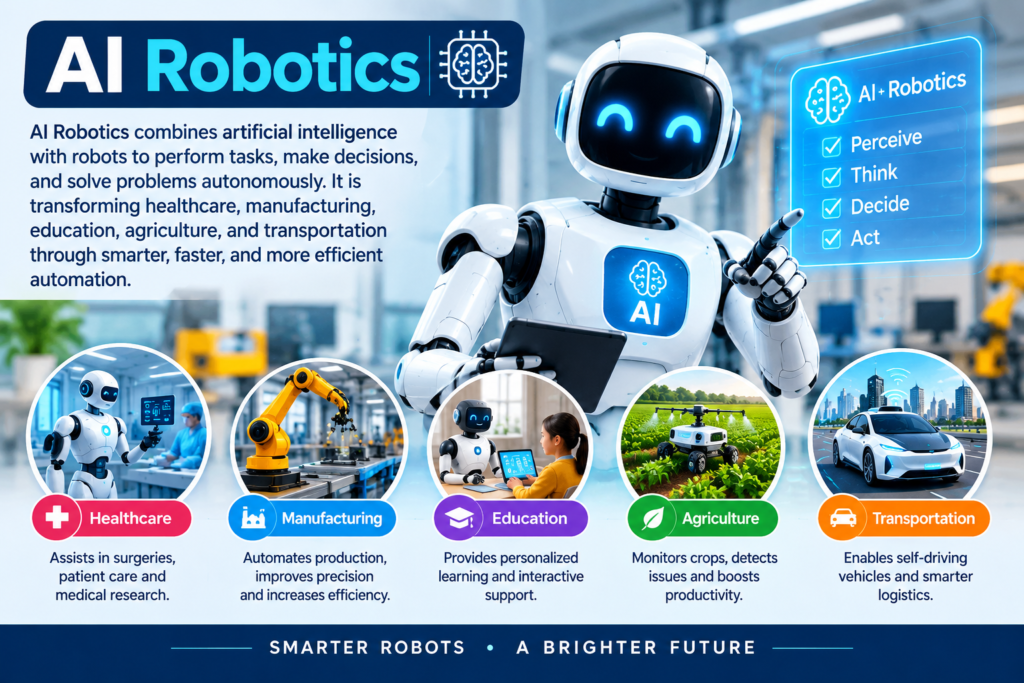
AI robotics is changing how robots work, learn, and interact with people. In the past, robots mainly followed fixed instructions. Today, artificial intelligence helps robots understand their surroundings, recognize objects, solve problems, and make decisions. From factories and hospitals to schools and homes, AI-powered robotics is opening new possibilities. Smart robots can help workers, support doctors, assist students, and perform tasks that once needed human attention. But how does AI make robots smarter? What is the difference between AI robotics and traditional robotics? And how can students begin learning this technology?  This guide explains AI robotics in simple English. It covers how intelligent robots work, their key technologies, real-world uses, benefits, challenges, student projects, and future trends.

What Is AI Robotics?

AI robotics is the combination of artificial intelligence and robotics. It helps robots understand information, learn from data, and choose actions based on their goals and surroundings. Traditional robots often follow a fixed set of commands. An AI-powered robot can use cameras, sensors, and AI models to respond to changes around it. For example, a basic robot may move along a fixed path. A smart robot can use cameras to detect an obstacle and find another route.

AI robotics brings together two important fields:

  • Artificial intelligence (AI): Helps machines learn, recognize patterns, understand language, and make decisions.
  • Robotics: Deals with designing, building, controlling, and operating robots.

When these fields work together, they create intelligent robots that can perform more flexible tasks.

What Is AI Robotics for Beginners?

For beginners, think of a robot as a machine with a body. It may have wheels, arms, cameras, sensors, or other parts.  AI acts like a decision-making system. It processes information from the robot’s surroundings and helps it choose what to do next.

For example, a home-cleaning robot may use sensors to detect walls and furniture. A more advanced model can map rooms, recognize certain objects, and plan a cleaning route. The robot uses its physical parts to move. AI helps it decide how and where to move.

Not every robot needs AI, and not every AI system controls a physical robot. AI robotics combines both to solve real-world problems.

How AI Makes Robots Smarter

AI makes robots smarter by helping them process information, recognize patterns, learn from experience, and respond to new situations.

Here are the main ways artificial intelligence improves robots.

1. AI Helps Robots See and Understand Objects

Robots need information about their surroundings before they can act. Computer vision allows them to analyze images and video from cameras.

With computer vision in robotics, a robot may be able to:

  • Recognize objects on a table.
  • Identify people in its working area.
  • Find products on a conveyor belt.
  • Detect obstacles in its path.
  • Read labels and visual markers.

For example, an AI-powered warehouse robot can use cameras to locate a package. It can then move toward the package and help transport it.

The quality of this process depends on the camera, lighting, training data, and AI model. A robot may still make mistakes when objects are hidden or conditions change.

2. Machine Learning Helps Robots Learn

Machine learning is an important part of modern AI robotics. It allows computer systems to learn patterns from data instead of relying only on manually written rules.

Engineers can train a robot using examples of objects, movements, or tasks. The robot’s AI model can then use what it learned to handle similar situations.

For example, a robot arm can learn to identify different shapes of products. It may then sort those products into separate containers.

The role of machine learning in robotics includes:

  • Recognizing objects and patterns.
  • Improving movement accuracy.
  • Predicting the result of an action.
  • Detecting unusual behavior.
  • Supporting decisions in changing environments.

However, learning does not mean a robot understands the world like a human. It means its model has learned patterns that help it perform a task.

3. AI Helps Robots Make Decisions

A robot must often choose between several possible actions. AI can help it compare options and select an action based on its goals, rules, and available information.

Imagine a delivery robot moving along a footpath. It detects a person ahead. Instead of continuing forward, it may slow down, stop, or choose another route.

AI can help the robot interpret sensor information and select a suitable response.

Robots still need reliable control systems and safety rules. AI decisions should not replace essential safety mechanisms, especially when people are nearby.

4. AI Helps Robots Understand Human Language

Natural language processing (NLP) helps computers work with human language. When connected to speech recognition and language models, it can help robots respond to spoken or written instructions.

For example, a person might tell a service robot, “Please take this box to the storage room.”

The system may need to recognize the words, identify the requested task, locate the destination, and plan a safe route.

Natural language processing in robots can support:

  • Voice-based commands.
  • Customer assistance.
  • Educational activities.
  • Basic question answering.
  • Communication with workers.

Generative AI can make these interactions more flexible. However, a language model may misunderstand a request or produce an incorrect answer. Robots need ways to verify instructions before carrying out actions that could cause harm.

5. AI Helps Robots Adapt to Changes

Traditional robots are often designed for predictable conditions. AI can help robots respond when their surroundings change.

For example, an industrial robot may need to handle products that arrive in slightly different positions. A vision system can help it locate each product before picking it up.

An autonomous mobile robot may also need to adjust its route when a corridor is blocked.

This ability to adapt is one reason AI-powered robotics is useful in factories, warehouses, hospitals, and other changing environments.

However, adaptation has limits. A robot trained for one task may struggle with unfamiliar objects, unusual lighting, or unexpected situations.

AI Robotics vs. Traditional Robotics

AI robotics and traditional robotics share many basic components, but they differ in how they handle information and make decisions.

Feature Traditional robotics AI robotics
Main approach Follows programmed rules Can use learned patterns and AI models
Decision-making Usually fixed and predictable Can adapt decisions to available information
Learning Does not usually learn from experience Can improve through training or feedback
Object recognition May use fixed sensors and rules Can use AI-based vision systems
Flexibility Best for stable, repeated tasks Can support more varied tasks
Example Robot welding the same part Robot identifying different parts before welding

Traditional robotics is still very useful. A machine that performs the same task thousands of times may not need advanced AI.  AI robotics is most helpful when a task requires perception, changing decisions, language understanding, or adaptation.

What Is the Difference Between AI Robotics and Automation?

Automation means using technology to perform tasks with less human effort. It does not always require artificial intelligence. For example, a conveyor belt that moves products at a fixed speed is automated. A robot that uses computer vision to identify different products and sort them into suitable boxes combines automation with AI.

The main difference is that automation follows a process, while AI can help a system interpret information and choose how to carry out that process. In real workplaces, both technologies often work together. Automation provides reliable execution, while AI supports tasks that require recognition, prediction, or flexible decisions.

Key Technologies Behind AI-Powered Robotics

Several technologies work together to create intelligent robots. Each one has a different role.

1. Computer Vision

Computer vision allows robots to analyze images and video. It helps them recognize objects, estimate positions, inspect products, and understand parts of their environment. For example, industrial robots can use computer vision to identify defective products on a production line.

2. Machine Learning

Machine learning helps robots identify patterns in data. It can support object recognition, motion planning, quality inspection, and predictive maintenance. The robot’s performance depends on its training data, model design, and operating conditions.

3. Deep Learning

Deep learning uses artificial neural networks with many layers to learn complex patterns. It is useful for tasks such as image recognition, speech processing, and some forms of robot control.

Deep learning robots may recognize objects in busy environments or identify small defects that are difficult to detect using simple rules.

However, deep learning often needs substantial training data and computing resources.

4. Reinforcement Learning

Reinforcement learning trains an AI system through actions and feedback. During training, the system receives rewards or penalties based on its performance.

For example, a simulated robot may learn how to move an object toward a target. Actions that move it closer to the goal receive positive feedback. Reinforcement learning robots can be useful for research into walking, gripping, balancing, and navigation.

Much of this learning can happen in simulation before engineers test the robot in the physical world. Real-world testing remains important because simulations cannot capture every condition.

5. Sensors and Robotics Hardware

AI needs information from the physical world. Robots may use cameras, distance sensors, microphones, touch sensors, force sensors, and other devices.

These components help a robot detect nearby objects, estimate movement, measure contact forces, and monitor its surroundings.

The robot’s motors, wheels, or robotic arms then carry out its actions.

Reliable AI robotics depends on both good software and suitable hardware. A powerful AI model cannot compensate for a broken sensor or an unsafe mechanical design.

6. Generative AI Robotics

Generative AI can help robots interpret complex instructions, explain actions, or break a broad request into smaller tasks.

For example, a user might ask a robot, “Help me prepare the meeting room.”

An AI system could turn that request into smaller steps, such as identifying chairs, checking the room layout, and locating supplies. The robot would still need suitable hardware, verified object recognition, and safe action planning to perform those tasks.

Generative AI robotics is an emerging area of development. It can improve how people communicate with robots, but it does not automatically give a robot reliable physical skills.

7. AI Robotics Knowledge Graphs

A knowledge graph represents information as connected entities and relationships.

For example, a robot assisting in a warehouse might use a structured knowledge system that connects products, storage locations, delivery tasks, and safety rules.This information can help an AI system reason about relationships and find relevant facts.

AI robotics knowledge graphs may be useful when a robot needs more structured information than raw sensor data alone can provide. Their value depends on the accuracy and freshness of the stored information.

How Do Robots Learn With AI Step by Step?

Robots do not all learn in the same way. Some use models trained before deployment, while others can adapt through feedback or updated data. A typical development process includes the following steps.

Step 1: Collect data

Engineers gather images, sensor readings, movement examples, or task records. This data helps the AI system learn about the task.

Step 2: Train an AI model

The model learns patterns from the collected data. For example, it may learn to distinguish a cup from a bottle.

Step 3: Test in simulation

Engineers test the model in a virtual environment to find mistakes before physical deployment.

Step 4: Test with a real robot

The robot uses its sensors and actuators to perform the task. Engineers check accuracy, reliability, and safety.

Step 5: Review and improve

Engineers examine errors, collect more examples, and update the model or robot controls when needed.

This process explains how robots learn with AI step by step. It is a useful starting point for students, but real robotics projects may require many additional steps, including calibration, motion planning, safety testing, and ongoing maintenance.

Real-World Applications of AI Robotics

AI robotics applications are growing across many industries. The technology is especially useful when machines must recognize objects, work in changing environments, or assist people with physical tasks.

1. AI Robotics in Manufacturing

Factories have used robots for many years. AI is helping some of these robots handle more flexible tasks.

Industrial robots with AI can support:

  • Visual quality inspection.
  • Product sorting and classification.
  • Adaptive picking and placing.
  • Defect detection.
  • Production monitoring.

For example, a factory may use an AI vision system to identify scratches or incorrect parts. A robotic arm can then move defective products away from the production line.

These systems can reduce repetitive manual work and support consistent inspection. They still need careful calibration and human oversight, especially when defects are difficult to identify.

2. Collaborative Robots (Cobots)

Collaborative robots, often called cobots, are designed for applications where people and robots work near each other. AI can help cobots identify objects, adjust certain movements, and respond to changes in their work area.

A cobot may help a worker assemble components, sort products, or handle repetitive packaging tasks. However, the term “collaborative” does not mean a robot is automatically safe to work beside people. Risk assessments, suitable protective measures, and application-specific safety systems are essential.

3. Robotics in Healthcare

Robotics in healthcare includes surgical assistance, rehabilitation, hospital logistics, and support for people with limited mobility.

AI may help healthcare robots interpret sensor data, identify objects, or plan movements. Some systems assist clinicians during procedures, while mobile robots may transport supplies inside hospitals.

For example, a hospital delivery robot can navigate designated corridors and carry items between departments.

AI robotics applications in healthcare explained simply: AI helps the system interpret information, while robotics enables it to perform physical actions.

These tools support medical professionals rather than replacing their judgment. Healthcare robots require strong safety, privacy, reliability, and regulatory controls.

4. AI Robotics in Education

Robotics in education gives students a practical way to learn programming, engineering, mathematics, and problem-solving.

AI-enabled educational robots can respond to commands, recognize selected objects, or support interactive learning exercises. Teachers can use them to explain concepts such as logic, sensors, movement, and machine learning.

For example, students might program a small robot to follow a line, recognize colored cards, or navigate a simple maze. AI robotics in education for students can make technical subjects more engaging because learners can see the results of their code in the physical world.

5. Autonomous Robots in Warehouses

Warehouses often need to move products between storage areas, packing stations, and shipping zones. Autonomous robots can use sensors, maps, and navigation software to travel through designated spaces. AI can help some systems recognize obstacles, identify objects, or plan routes.

A warehouse robot may transport shelves or carry packages to a worker. This can reduce some manual transport tasks and improve the movement of goods. The robot still needs safe routes, reliable localization, and procedures for dealing with blocked paths or unexpected objects.

6. AI Robots in Agriculture

Agriculture offers many tasks that depend on observing plants, soil, and changing outdoor conditions. AI robotics can support crop monitoring, targeted spraying, weed detection, fruit picking, and autonomous field operations.

For example, a vision-enabled robot may identify weeds among crops. A suitable mechanical system can then target selected weeds rather than treating the entire area.These applications may help farmers use resources more precisely. Their performance can be affected by weather, dust, uneven ground, and differences between plant varieties.

7. AI Robotics in Homes

Examples of AI robotics in daily life include robot vacuum cleaners, lawn-mowing robots, and some smart home assistants with physical movement.

A robot vacuum may map a room, estimate its location, and plan a route around furniture. More advanced systems can identify certain obstacles or adapt their cleaning patterns.

These devices can save time on repetitive chores. However, features vary widely, and a product marketed as smart may rely mainly on fixed rules rather than advanced AI.

8. AI Robotics in Logistics and Delivery

Delivery robots and autonomous mobile systems can move goods through controlled sites, campuses, warehouses, and selected public areas. AI may help them detect obstacles, interpret maps, and respond to changes along a route.

Drones can also combine AI-based perception with navigation systems for selected inspection or delivery tasks. Public-space operations involve additional challenges, including weather, pedestrians, traffic rules, and local regulations. Human supervision and reliable emergency controls remain important.

9. Humanoid Robots With AI

Humanoid robots have a body shape designed to resemble some aspects of a human body. Many include a head, torso, arms, or legs. Humanoid robots AI systems may combine cameras, language models, motion planning, balance control, and object manipulation.

A humanoid robot might be designed to carry objects, interact with people, or perform selected tasks in a workplace.However, human-like appearance does not guarantee human-like intelligence. Walking safely, handling unfamiliar objects, and completing everyday tasks remain difficult engineering challenges.

10. AI Robotics in Dangerous Environments

Robots can help people inspect places that are unsafe or difficult to reach.Applications include disaster response, hazardous industrial sites, mines, and selected space missions.

AI can help these robots identify objects, analyze images, navigate around obstacles, and support remote operators.For example, a robot may enter a damaged building to collect images before emergency workers go inside.

In such settings, robust communication, reliable navigation, and the ability to stop safely are essential.

Benefits of AI Robotics

AI-powered robotics can offer several advantages when the technology is properly designed and used.

1. Better Accuracy

AI vision systems can identify patterns and differences in products. This can help robots perform inspection and sorting tasks more consistently.Accuracy still depends on the quality of the model, sensors, and operating environment.

2. Higher Productivity

Robots can perform repetitive tasks for long periods. AI can help them handle certain changes without requiring a new instruction for every situation. This can help businesses improve workflows and reduce delays.

3. Improved Workplace Safety

Robots can perform some tasks that expose workers to heat, chemicals, heavy loads, or dangerous machinery. AI can also support obstacle detection and monitoring. However, AI alone cannot guarantee safety.

4. Reduced Repetitive Work

Robots can take on tasks such as moving materials, inspecting products, and sorting items. Workers can then focus more on problem-solving, supervision, communication, and other tasks that require human judgment.

5. More Flexible Operations

Traditional machines may need extensive reprogramming when products or conditions change. AI can help some robotic systems recognize new situations and adjust their actions. This flexibility can be useful in warehouses, manufacturing, and other environments with varied tasks.

6. Support for Research and Innovation

AI robotics gives researchers new ways to study movement, learning, perception, and human-machine interaction. It also creates learning opportunities for students interested in computer science, mechanical engineering, electronics, and AI.

Challenges and Limitations of AI Robotics

Although intelligent robots offer many benefits, the technology has important limitations.

1. High Development Costs

Robots may require cameras, sensors, motors, computing hardware, software, and specialized engineering. Training and testing AI models can add further costs. Smaller businesses and schools may need affordable kits or cloud-based tools to begin learning.

2. Data Quality and Training

AI models depend on suitable training data. If the data does not represent real working conditions, the robot may make mistakes.For example, a model trained only on bright indoor images may struggle in dim lighting. Engineers need to test AI systems in conditions that reflect their intended use.

3. Safety Risks

A robot can damage equipment, injure someone, or make a dangerous movement if its controls fail. Safety must be built into the system through risk assessment, protective hardware, testing, monitoring, and emergency stops. AI-generated plans should be checked before high-risk actions are performed.

4. Privacy Concerns

Robots with cameras and microphones may collect personal information. This can be a concern in homes, hospitals, schools, and workplaces. Developers should limit data collection, protect stored information, and explain how recordings are used.

5. Dependence on Technology

Some robots depend on network connections, remote servers, or cloud-based AI models. A network failure may reduce their capabilities. Local processing, backup controls, and safe fallback behavior can help reduce this risk.

6. Job Changes and New Skills

AI robotics can change the types of tasks people perform. Some repetitive roles may shrink, while demand may grow for robot operators, technicians, AI developers, and maintenance specialists. The impact will vary by industry. Training and education can help workers adapt to changing job requirements.

7. Unpredictable Environments

A robot that works well in a laboratory may struggle in a busy street or crowded workplace. Unexpected objects, poor lighting, slippery floors, and changing weather can affect its performance. This is why real-world testing and careful limits on where robots operate are so important.

AI Robotics Projects for Students

Students do not need an expensive humanoid robot to begin learning AI robotics. A small programmable robot, a basic sensor kit, or a simulated robot can teach many core concepts.

Here are five project ideas for beginners.

  1. Line-Following Robot

Beginner

Build a robot that follows a dark line using simple sensors. Start with fixed rules, then explore how an AI model might recognize different paths.

  1. Obstacle-Avoiding Robot

Beginner

Use distance sensors to detect objects and change direction. Later, add mapping or a basic navigation model.

  1. Object-Sorting Robot

Intermediate

Use a camera and a trained image classifier to identify colored blocks or simple objects. A robotic arm can then sort them.

  1. Virtual Robot Navigation

Beginner–Intermediate

Use a simulator to teach a robot to reach a target while avoiding obstacles. This is a useful way to learn navigation without buying hardware.

  1. Voice-Controlled Robot

Intermediate

Connect speech recognition to a small robot. Allow safe commands such as moving forward, turning, and stopping.

How to Start an AI Robotics Tutorial for Students

A simple learning path can help beginners build skills in the right order.

  1. Learn basic programming. Start with Python or a beginner-friendly robotics programming tool.
  2. Understand electronics. Learn how sensors, motors, batteries, and controllers work.
  3. Build a basic robot. Try a small wheeled robot or use a virtual simulator.
  4. Explore AI concepts. Study image classification, machine learning, or speech recognition.
  5. Combine AI with movement. Connect the AI output to a simple robotic action.
  6. Test safely. Begin in a controlled area and add clear stop controls.
  7. Document the results. Record errors, improvements, and what you learned.

A useful first project is to build an obstacle-avoiding robot, then compare its performance with a version that uses camera-based object recognition. Students should understand the difference between ordinary sensor rules and actual machine learning. Adding a camera to a robot does not automatically make it an AI robot.

Future Trends in AI Robotics Technology

The future of AI robotics will depend on advances in AI models, computing, mechanical design, sensors, and safety engineering. Several trends are worth watching.

1. Robots That Follow Natural-Language Instructions

Generative AI is making it easier to explore robots that respond to everyday language.

Instead of programming every small step, a user may be able to describe a goal. An AI system can then help break the goal into smaller tasks.

For example, a warehouse worker might ask a robot to collect specified items from known locations.

The challenge is turning language into accurate physical actions. Systems must verify object identities, follow safety rules, and handle unclear instructions.

2. More Capable Humanoid Robots

Researchers and companies are developing humanoid robots for logistics, manufacturing, research, and other settings.

AI can support perception, object manipulation, and task planning. Better hardware may also improve balance and movement.

However, reliable performance across many everyday tasks remains difficult. Widespread use will depend on cost, safety, useful capabilities, and real-world reliability.

3. More Robots Working With People

Cobots and other assistive robots may become more capable of handling changing tasks alongside workers.

AI can help identify objects, understand certain instructions, and respond to sensor data.

Clear safety boundaries will remain essential, particularly when robots work near people.

4. Better Learning Through Simulation

Simulated environments let engineers test many robot movements without risking physical equipment.

Researchers can generate training examples, test different situations, and evaluate models before real-world deployment.

A key challenge is transferring what a robot learns in simulation to physical conditions. Differences in friction, lighting, weight, and sensor noise can cause unexpected errors.

5. Smaller and More Efficient AI Models

Running AI directly on a robot can reduce reliance on cloud services and improve response times.

More efficient models may allow small robots to perform tasks with limited computing power.

This is important for educational robots, mobile devices, and machines that operate in places with weak internet access.

6. Robots Designed for Specific Industries

Rather than creating one robot for every task, many practical systems will focus on particular needs.

Examples include warehouse transport, crop inspection, laboratory handling, and manufacturing quality control.

Specialized robots can be easier to test and evaluate because their tasks and operating environments are more clearly defined.

7. Greater Attention to Responsible AI

As robots become more capable, developers will need to focus on reliability, privacy, accountability, and safety.

Organizations may use more structured testing to evaluate whether a robot behaves correctly in normal and unusual situations.

Human supervision will remain important in high-risk applications. A robot should have clear limits and safe ways to stop or request help.

Skills Needed for a Career in AI Robotics

AI robotics combines several technical fields. Students who want to work in this area can build their skills step by step.

Skill How it helps
Python programming Builds AI models and controls software
Mathematics Supports geometry, movement, and machine learning
Electronics Helps students understand sensors and controllers
Mechanical engineering Covers robot structure, motors, and movement
Machine learning Helps robots recognize patterns in data
Computer vision Enables image and object recognition
Problem-solving Helps identify and fix robot errors

Students can begin with one or two skills rather than learning everything at once. A basic programming project is a good starting point.

As their knowledge grows, they can explore robotics simulators, open-source tools, educational kits, and university research projects.

AI robotics is making robots more capable by combining physical movement with intelligent software. Machine learning helps them recognize patterns, computer vision helps them understand images, and natural language processing allows them to interpret certain human instructions.

These capabilities are creating new applications in factories, hospitals, warehouses, homes, and classrooms. They also give students new ways to learn programming, engineering, and artificial intelligence.

However, intelligent robots still have limitations. They can make mistakes, struggle with unfamiliar situations, and require careful safety testing. Human knowledge and supervision remain essential.

The future of AI robotics will not depend on making robots smarter alone. It will also depend on making them safer, more reliable, more affordable, and more useful in real-world situations.

For beginners, the best way to understand this technology is to start with a simple robotics project, learn how its sensors and software work, and gradually explore AI. Small projects can build the foundation for understanding the intelligent robots of tomorrow.

S.N. Other AI related links
1. How to Build AI Workflows Without Coding: 7 Easy Steps
2. How to Write Better Prompts : A Complete Prompt Engineering Guide 2026
3. How AI Models Are Trained: A Complete Beginner’s Guide 2026
4. Generative AI Benefits Explained: Top 9 Key Benefits, Uses, Limits & Future
5. Natural Language Processing: How AI Understands Human Language 2026
6. How AI Is Transforming Business Decision-Making: 10 Powerful Ways to Make Smarter Decisions
7. AI in Sales: 10 Powerful Ways Artificial Intelligence Can Increase Conversions
8. AI in Human Resources : Recruitment, Training, and Employee Management 2026
9. How Small Businesses Can Use AI Without a Huge Budget: 12 Smart Strategies for Growth
10. How Businesses Use AI to Increase Productivity in 2026
11. AI Agents vs AI Chatbots: 7 Key Differences Explained
12. Top Machine Learning vs AI vs Deep Learning: Complete Guide 2026
13. Artificial General Intelligence (AGI): What It Is & When It Could Arrive
14. ChatGPT vs Google Gemini: Which AI Assistant Is Better in 2026?
15. How to Create Custom AI Chatbots for Your Website: Beginner’s Guide
16. Large Language Models (LLMs) Explained: How They Work, Uses & Future
17. AI App Integration: 15 Powerful Ways to Connect AI Tools to Apps
18. Natural Language Processing: How AI Understands Human Language 2026
19. How to Use AI Assistants to Save Time at Work and Home
20. Computer Vision Explained: How AI Understands Images & Videos 2026
21. The Rise of AI Doppelgangers : 11 Powerful Ways Artificial Intelligence Can Create a Digital Version of You 
22. Invisible AI: 7 Powerful Ways Artificial Intelligence Is Making Decisions About Your Life Without You Knowing 
23. Environmental Cost of AI : Top 7 Ways to Make AI Sustainable 
24. Beyond Job Replacement: How AI Could Change the Meaning of Work, Skills, and Human Purpose 
25. Can AI Predict Human Behavior? 7 Powerful Insights 

”FAQs”

1. What is AI robotics in simple words?

AI robotics combines artificial intelligence with physical robots. AI helps robots interpret information, recognize objects, and choose actions. Robotics allows them to perform physical tasks using motors, sensors, and other hardware.

2. How does artificial intelligence improve robots?

Artificial intelligence can help robots recognize objects, understand selected commands, learn patterns, plan routes, and respond to changing conditions. The improvements depend on the AI model, sensors, training data, and task.

3. What are some examples of AI robotics in daily life?

Examples include robot vacuum cleaners that map rooms, warehouse robots that move packages, robotic systems that inspect products, and educational robots that recognize objects. Not every product in these categories uses advanced AI.

4. What is the difference between AI robotics and automation?

Automation performs tasks with less human effort, often by following predefined rules. AI robotics combines physical robots with AI capabilities that may support learning, perception, and flexible decisions. Many systems use both technologies.

5. Can robots learn on their own?

Some robots can learn through training data, feedback, or reinforcement learning. However, robots do not automatically improve just by operating for longer. Many need new training, software updates, or human guidance to improve their performance.

6. How is machine learning used in robotics?

Machine learning can help robots recognize objects, estimate positions, classify products, predict movement, and learn selected control strategies. Engineers train and test models before using them for real tasks.

7. How is AI robotics used in healthcare?

AI robotics can support surgical assistance, rehabilitation, hospital delivery, and mobility assistance. These systems help with specific tasks, while healthcare professionals remain responsible for clinical decisions and patient care.

8. Is AI robotics a good field for students?

Yes. AI robotics offers learning opportunities in programming, electronics, engineering, machine learning, and computer vision. Students can begin with small projects and build more advanced systems as their skills improve.

9. What programming language is used in AI robotics?

Python is popular for AI development and robotics prototyping. C++ is also widely used in robotics software. The best language depends on the robot, controller, software framework, and project requirements.

10. What is the future of AI robotics technology?

AI robotics may become more capable in manufacturing, healthcare, logistics, agriculture, and education. Improvements in natural-language interaction, robot learning, simulation, and efficient computing could expand its uses. Progress will depend on cost, reliability, safety, and real-world performance.

AI Robotics: 9 Powerful Ways Artificial Intelligence Is Making Robots Smarter

AI Robotics: 9 Powerful Ways Artificial Intelligence Is Making Robots Smarter

AI Robotics: 9 Powerful Ways Artificial Intelligence Is Making Robots Smarter

1. What Is AI Robotics?

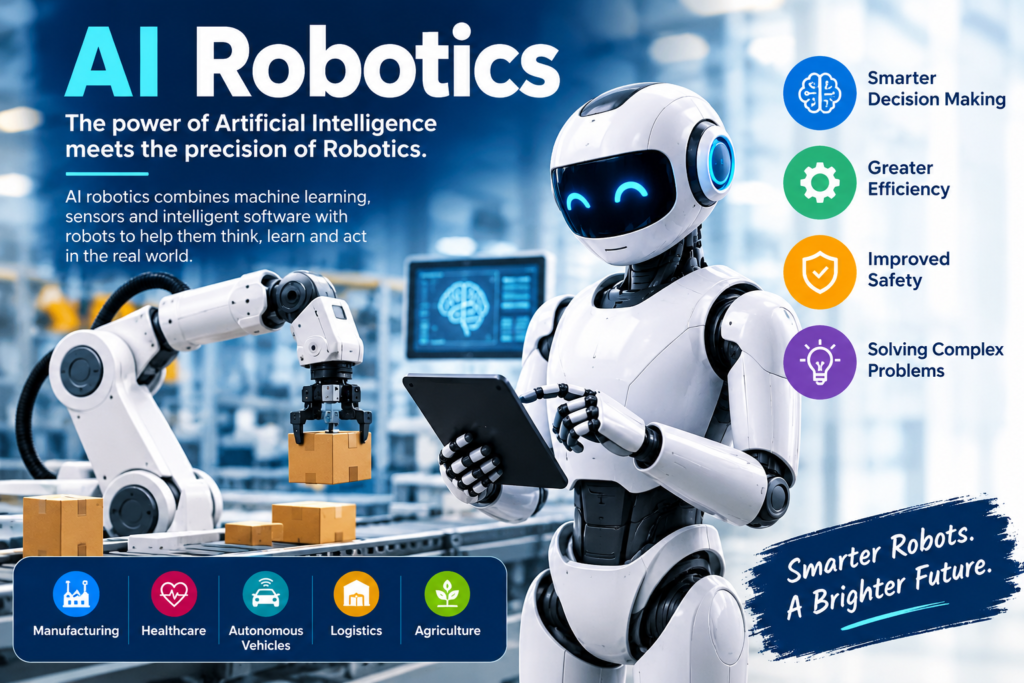
AI robotics combines artificial intelligence with robotics technology. It helps machines understand their surroundings, learn from data, make decisions, and perform tasks with less human guidance.

Traditional robots usually follow fixed instructions. They repeat the same movements until someone changes their programming. AI-powered robots can do more. They can recognize objects, respond to changes, and improve their performance through experience.

For example, a traditional robot in a factory might move a part from one conveyor belt to another. An intelligent robot can use a camera to identify different parts, choose the correct one, and adjust its movement when the part is in a new position.

This is one reason AI robotics is becoming important in modern industries.

How AI Makes Robots Different

The main difference lies in how robots process information and respond to their environment.

Feature

Traditional Robots

AI-Powered Robots

Instructions

Follow fixed programs

Can adapt using AI models

Object recognition

Often needs fixed positions or special sensors

Can identify objects using computer vision

Decision-making

Uses predefined rules

Can use learned patterns and models

Learning

Usually requires manual reprogramming

May learn from data or experience

Environment

Works best in predictable settings

Can handle some changing conditions

Human interaction

Often limited

Can support speech, gestures, or shared tasks

These differences don’t mean that every AI robot can learn independently. Many intelligent robots still rely on carefully written rules and human supervision.

Instead, AI adds flexibility to robotic systems. It helps them deal with tasks that are difficult to describe through simple instructions alone.

What Are Artificial Intelligence Robots?

Artificial intelligence robots are machines that use AI methods to understand information and select suitable actions.

They may include:

  • Industrial robots: Machines that assemble products, weld parts, or inspect materials.
  • Service robots: Robots that help with cleaning, delivery, customer service, or other everyday tasks.
  • Collaborative robots: Robots designed to work alongside people in suitable shared workspaces.
  • Autonomous robots: Machines that can perform selected tasks with limited direct control.
  • Healthcare robots: Systems that assist medical professionals with procedures, rehabilitation, or hospital logistics.

Not every robot in these categories uses AI. The term describes robots that combine physical movement with intelligent software.

The main goal is simple: make machines more capable of handling real-world tasks safely, accurately, and efficiently.

2. How Artificial Intelligence Makes Robots Smarter

The role of artificial intelligence in robotics goes beyond automation. It helps robots understand information, recognize patterns, and choose actions based on the situation.

Several technologies work together to make this possible.

2.1 Machine Learning in Robotics

Machine learning allows computers to find patterns in data and use those patterns to make predictions or decisions.

In robotics, machine learning can help a robot recognize objects, estimate movement, detect faults, or improve a task through training.

Imagine a warehouse robot that needs to identify boxes of different sizes. Engineers can train its vision system using many labeled images. Over time, the system can learn to distinguish boxes from other objects.

However, learning doesn’t happen automatically in every robot. Some systems learn before deployment, while others can adapt using new data in controlled settings.

Examples of machine learning in robotics include:

  • Identifying products on a production line.
  • Predicting when equipment may need maintenance.
  • Detecting defects in manufactured goods.
  • Estimating the position of moving objects.
  • Improving the selection of actions for a specific task.

Machine learning in robotic systems can reduce the need to write a separate rule for every possible situation. Even so, reliable training data and careful testing remain essential.

2.2 Deep Learning Robots and Computer Vision

Computer vision allows robots to interpret images and video. Deep learning, a type of machine learning, can help these systems recognize complex visual patterns. A robot equipped with robotic vision may identify a tool, locate a package, or distinguish a person from an object.

For example, a quality inspection robot can capture images of finished products. Its AI model can compare visible features against learned patterns and flag possible defects for further inspection.

Computer vision can support:

  • Object detection and classification.
  • Facial or gesture recognition in suitable applications.
  • Reading labels and barcodes.
  • Detecting obstacles.
  • Measuring the position of objects.
  • Inspecting products for visible damage.

These capabilities help AI-powered machines work in environments where objects may look different or appear in unexpected positions.

Still, lighting, camera quality, unusual objects, and poor image data can affect performance. A robot should be tested under the conditions in which it will actually operate.

2.3 Sensor Fusion and Robot Perception

Robots need information about their surroundings before they can act. They may collect this information through cameras, distance sensors, microphones, touch sensors, and other devices. Sensor fusion combines information from multiple sensors to create a more useful picture of the environment.

Consider a delivery robot moving through a busy building. Its camera may detect a person, while a distance sensor measures how close that person is. Combining these signals can help the robot decide whether to slow down or stop.

Robot perception can involve:

  1. Collecting data from sensors.
  2. Identifying useful features in the data.
  3. Estimating the position of objects.
  4. Understanding relevant changes in the environment.
  5. Sending information to the robot’s control system.

This process supports safer movement and more informed decisions.

However, sensors can fail or produce conflicting information. Good robotic systems need ways to identify uncertainty and move into a safe state when reliable perception isn’t possible.


2.4 Robotic Decision-Making

Robotic decision-making is the process of choosing an action based on available information, task goals, and operating limits.

An intelligent robot might need to decide which route to take, how to pick up an object, or whether it should ask a human for help.

For example, a warehouse robot may discover that its usual path is blocked. It can evaluate another route and select one that avoids the obstacle while still reaching its destination.

Decision-making systems may use:

  • Predefined rules.
  • Search and planning algorithms.
  • Machine learning models.
  • Reinforcement learning.
  • Optimization methods.

The right approach depends on the task. A safety-critical machine may need strict rules and predictable controls, while a research robot may benefit from learning-based planning.

The important point is that smarter robots don’t simply move faster. They select actions that better match their goals and the conditions around them.

3. Key Technologies Behind Intelligent Robots

AI robotics depends on several connected technologies. AI models provide interpretation and reasoning, while sensors, actuators, and control systems allow robots to interact with the physical world.

3.1 Natural Language Processing

Natural language processing (NLP) helps computers work with human language.

When combined with speech recognition and text-to-speech systems, it allows some robots to respond to spoken instructions or answer simple questions.

For instance, a service robot in a hospital might receive a request to deliver supplies to a particular department. A language system can interpret the request and pass the relevant task to the robot’s navigation and control software.

Possible applications include:

  • Voice-controlled robots.
  • Customer service assistants.
  • Educational robots.
  • Assistive technologies.
  • Robots that guide visitors through buildings.

Modern language models can make interactions more natural. However, a robot must still verify instructions before carrying out actions that could affect people, equipment, or sensitive information. Understanding a sentence doesn’t automatically mean a robot can safely perform the requested task.

3.2 Autonomous Navigation

Autonomous navigation helps robots move from one location to another while responding to obstacles and changes in their surroundings.

It often combines mapping, localization, motion planning, and sensor information.

For example, a mobile robot in a distribution center may use a map to plan a route, sensors to locate itself, and obstacle detection to avoid people or equipment.

Common navigation tasks include:

  • Finding a route to a destination.
  • Estimating the robot’s current position.
  • Avoiding obstacles.
  • Adjusting movement in narrow spaces.
  • Replanning when a route becomes unavailable.

Autonomous robots are useful when they must move through large or changing environments. Yet navigation performance depends on floor conditions, sensor quality, map accuracy, and the complexity of the environment.

Outdoor robots may face additional challenges, such as rain, dust, uneven ground, and changing light.

3.3 Robotic Learning

Robotic learning allows robots to improve specific behaviors through data, demonstrations, simulations, or feedback.

One approach is imitation learning. In this method, a robot learns from examples of how a human or another system performs a task.

Another approach is reinforcement learning. The robot’s learning system receives rewards or penalties during training and learns which actions tend to produce better results.

For example, researchers may train a robotic arm to grasp objects of different shapes. The training process can help the system learn movements that work across a range of object positions.

Robotic learning can support:

  • Grasping and manipulation.
  • Balancing and movement.
  • Adaptive control.
  • Task planning.
  • Better handling of unfamiliar objects.

Training often requires many attempts, realistic simulations, and carefully designed feedback. A behavior that works in simulation may fail in the real world because of friction, weight, or sensor differences. For that reason, real-world testing remains essential.

3.4 The Role of Hardware and Control Systems

AI software alone cannot make a physical robot move. Robots also need hardware that can sense the environment and carry out actions.

Key components include:

  • Sensors: Collect information about the environment.
  • Actuators: Move joints, wheels, grippers, or other parts.
  • Controllers: Manage movement and keep the robot stable.
  • Processors: Run perception, planning, and AI models.
  • Power systems: Supply the energy needed for operation.

Robotic systems work best when these components are designed together. An advanced AI model won’t compensate for a weak gripper, poor sensor placement, or an unreliable power supply.

This is why robotics innovation requires cooperation between software developers, engineers, safety specialists, and industry experts.

4. AI Robotics Applications Across Industries

AI robotics applications in industries continue to expand as businesses look for better ways to handle repetitive, complex, and physically demanding tasks.

The best applications usually have a clear purpose, measurable results, and suitable safety controls.

4.1 Manufacturing and Industrial Automation

Manufacturing is one of the most established areas for robotics technology.

Industrial robots already perform welding, painting, assembly, material handling, and other repetitive tasks. AI can extend their capabilities by helping them identify parts, inspect products, and respond to changing production conditions.

For example, a smart robot on an assembly line can use a camera to identify the correct component before picking it up. Another system can inspect finished products and flag visible defects.

Common applications include:

  • Automated assembly.
  • Visual quality inspection.
  • Predictive maintenance.
  • Sorting and packaging.
  • Material handling.
  • Adaptive robotic welding.

AI can also support robotic automation by helping production systems adjust to different products or operating conditions.

The result may be fewer repetitive manual tasks, improved consistency, and better use of production time. However, actual gains depend on the cost of deployment, the quality of integration, and the type of work being automated.

4.2 Collaborative Robots in the Workplace

Collaborative robots, often called cobots, are designed to work near people in appropriate applications.

They can help workers lift parts, position components, package products, or perform repetitive movements.

AI may improve their ability to recognize objects and adapt task sequences. For instance, a cobot may use computer vision to identify a part presented by a worker.

Still, collaboration doesn’t mean a robot is automatically safe to use without barriers. A suitable risk assessment must consider the robot, its tools, its speed, the task, and the working environment.

Businesses should select equipment and safety measures based on the intended use rather than assuming that AI alone prevents accidents.

4.3 Healthcare and Medicine

AI robotics in healthcare and manufacturing illustrates how intelligent machines can support very different needs.

In healthcare, robots may assist with surgery, rehabilitation, laboratory work, hospital logistics, and patient support.

Examples include:

  • Robotic systems that help surgeons perform precise movements.
  • Rehabilitation robots that support guided physical exercises.
  • Laboratory robots that handle samples.
  • Delivery robots that transport supplies within hospitals.
  • Assistive robots that help people complete selected daily activities.

AI may help these systems analyze sensor information, recognize patterns, or adjust selected movements.

However, medical robots require careful testing, professional oversight, and appropriate regulatory approval. AI should support qualified healthcare professionals rather than replace their responsibility for clinical decisions.

Privacy is another important concern because medical environments can involve highly sensitive information.

4.4 Agriculture and Food Production

Agriculture faces challenges such as labor shortages, changing weather, crop diseases, and pressure to use resources efficiently.

AI-powered robots can help farmers monitor crops, detect weeds, and perform selected field tasks.

For example, a robot equipped with cameras may identify weeds among crops. A connected system can then guide a targeted treatment instead of applying the same action across an entire field.

Potential applications include:

  • Crop monitoring.
  • Fruit detection and harvesting.
  • Weed identification.
  • Soil and plant observation.
  • Automated greenhouse operations.
  • Livestock monitoring.

These systems may improve precision and reduce some forms of manual work. However, outdoor robots must handle uneven terrain, weather changes, dust, and unpredictable biological conditions.

Cost is also important. A robot that works well on a large farm may not be affordable for a small farm without shared access or other support.

4.5 Warehousing, Logistics, and Retail

Warehouses and distribution centers use robots to move products, sort packages, and support order fulfillment. AI can help robots identify items, choose routes, and coordinate tasks.

A warehouse robot, for example, may receive an order, travel to the correct storage area, and transport items to a packing station. A vision system may help identify products that have been placed incorrectly. Retail businesses may also use service robots for inventory checks, floor cleaning, or selected customer support tasks.

Benefits can include faster handling, more consistent workflows, and better use of available space. Yet businesses still need people to manage exceptions, maintain equipment, and handle tasks that require judgment or personal interaction.

4.6 Education and Everyday Services

Service robots are increasingly used in education, hospitality, cleaning, and public spaces.

Educational robots can help students learn programming, mathematics, and problem-solving. Cleaning robots can map rooms and avoid common obstacles. Reception robots may answer routine questions or direct visitors.

These examples of smart robots show that AI robotics isn’t limited to large factories or advanced laboratories.

Even so, the usefulness of a service robot depends on how well it solves a real problem. A simple, reliable machine may be more valuable than an expensive robot with features that people rarely use.

5. 7 Major Benefits of AI-Powered Robots

The benefits of AI-powered robots go beyond reducing manual work. They can help businesses improve quality, manage resources, and respond to changing needs.

However, the results depend on the task, the technology, and how well the robot is integrated into the workplace.

5.1 Higher Productivity

Robots can perform many repetitive tasks for long periods. AI can help them identify the next task, select an appropriate action, and respond to some unexpected changes.

For example, an AI-enabled warehouse robot may help workers move products between storage areas and packing stations. This can reduce unnecessary walking and improve the flow of goods. Productivity gains are most likely when the automated task is clearly defined and the robot can operate reliably.

5.2 Better Accuracy and Consistency

Human workers can become tired when performing the same task repeatedly. Robots can maintain consistent movements when their equipment and operating conditions remain within suitable limits. AI-powered inspection systems can also examine many products and flag possible defects for review.

This can help manufacturers identify quality problems earlier. Still, AI models can make mistakes, so critical inspections may require additional checks.

5.3 Improved Workplace Safety

Some jobs involve heavy objects, high temperatures, hazardous materials, or repetitive physical movements.

Robots can take over selected tasks that expose workers to these risks. For example, industrial robots can handle materials in environments where human access is restricted.

However, robots introduce their own hazards. Appropriate guarding, emergency stops, training, maintenance, and risk assessments remain necessary.

5.4 Greater Flexibility

Traditional automation often requires extensive reprogramming when a product or process changes.

AI can help robots recognize different objects and adjust selected actions. This can make automation more useful in environments where products vary in size, shape, or position.

For example, a packaging robot may use computer vision to identify different packages before placing them into suitable containers.

The level of flexibility depends on the system’s design and training. AI doesn’t eliminate every setup or programming requirement.

5.5 More Efficient Resource Use

Intelligent automation can help businesses reduce unnecessary movement, improve scheduling, and detect equipment problems.

In agriculture, robots may help apply water or treatments more precisely. In manufacturing, predictive maintenance systems can identify signs of possible equipment failure.

These improvements can reduce waste and support more efficient operations, although energy use and maintenance costs must also be considered.

5.6 Support for Human Workers

Robots can take on repetitive or physically demanding tasks, giving people more time for planning, problem-solving, communication, and quality control.

Collaborative robots may assist workers with lifting, positioning, or handling materials.

The strongest results often come from combining human judgment with robotic speed and consistency. Businesses should also invest in training so workers can operate, monitor, and maintain new systems.

5.7 Data-Driven Decisions

Connected robotic systems can generate information about task times, equipment performance, defects, and workflow interruptions.

Businesses can analyze this data to identify bottlenecks and improve processes.

For example, a manufacturer may discover that a particular production stage causes repeated delays. Managers can use the information to investigate the problem and change the workflow.

The data must be accurate, relevant, and handled responsibly. More data doesn’t automatically lead to better decisions.

6. Challenges and Limitations of AI Robotics

Although robotics and AI offer major opportunities, businesses need to understand their limitations before investing.

6.1 High Initial Costs

AI robotics may require more than the purchase of a robot. Companies may also need cameras, sensors, computing equipment, software, installation, employee training, and ongoing maintenance.

Smaller businesses may find these costs difficult to manage.

A practical approach is to begin with one clearly defined task and measure its results before expanding the project.

6.2 Data Quality and Training

Machine learning systems depend on suitable data. If training data doesn’t represent real working conditions, a robot may perform poorly when it encounters unfamiliar objects or environments.

For example, a vision model trained mainly on brightly lit images may struggle in a dark warehouse.

Businesses should test systems under realistic conditions and monitor their performance after deployment.

6.3 Safety and Reliability

Physical robots can cause injury or damage if they move unexpectedly or misinterpret their surroundings.

AI models may also produce incorrect predictions or fail in unusual situations.

Safety measures should include suitable hardware controls, testing, human oversight, emergency procedures, and clear operating limits. Critical actions shouldn’t depend solely on an AI model’s prediction.

6.4 Cybersecurity and Privacy

Connected robotic systems may exchange information with cloud platforms, business networks, cameras, and other devices. Weak security can expose systems to unauthorized access or disruption.

Organizations should use access controls, secure software updates, network protection, and appropriate data policies. Cameras and microphones should only collect information that is necessary for the intended task.

6.5 Workforce Changes

Robotic automation can change the types of tasks people perform. Some repetitive roles may decline, while demand for robotics technicians, AI specialists, operators, and maintenance professionals may grow. These changes can create uncertainty for workers.

Businesses can respond by offering training and helping employees develop skills that complement automation. Planning for workforce changes is an important part of responsible technology adoption.

6.6 Ethical and Legal Concerns

AI systems can make errors or produce unfair results if they rely on unsuitable data or poorly designed decision rules.

Robots used in healthcare, public spaces, and other sensitive settings may raise questions about accountability, privacy, and human control.

Organizations should establish clear responsibilities, document system limitations, and follow applicable laws and safety standards.

The goal isn’t simply to build more intelligent machines. It’s to build systems that people can trust.

7. Latest Trends in AI Robotics

The latest trends in AI robotics focus on making machines more adaptable, easier to program, and better at working with people.

The pace of development varies by industry, and not every emerging technology is ready for widespread commercial use.

7.1 AI Models That Understand Images and Language

Some newer robotic systems combine vision, language, and action planning. These approaches aim to help robots connect spoken instructions and visual information with physical tasks.

For example, a worker may ask a robot to locate a particular object. The system can interpret the request, identify the object, and plan an appropriate action if its capabilities allow it.

These systems are promising, but they can misunderstand instructions or fail to perform actions reliably. Real-world testing remains essential.

7.2 Simulation and Digital Twins

A digital twin is a virtual representation of a physical system or process. Engineers can use simulations to test robot movements, evaluate factory layouts, and train certain AI models before deploying them in the real world.

Simulation can reduce development time and allow teams to test situations that might be expensive or dangerous to recreate physically. However, simulations don’t perfectly match reality. Differences in weight, friction, lighting, and sensor behavior can affect performance.

7.3 More Flexible Robotic Systems

Many businesses want robots that can handle several related tasks instead of performing only one fixed movement.

Advances in computer vision, robotic learning, and planning may help robots switch between supported tasks with less manual reprogramming.

For example, a robot might identify several types of packages and select an appropriate gripping method for each.

Such flexibility depends on suitable hardware, training, and reliable task planning. General-purpose performance remains a technical challenge.

7.4 Human-Robot Collaboration

Collaborative robots are becoming an important part of discussions about intelligent automation.

The aim is to let people and machines contribute their strengths to the same workflow. People provide judgment, adaptability, and problem-solving, while robots handle suitable repetitive or physically demanding tasks.

Future systems may improve how they recognize human actions and coordinate work. Safety engineering will remain essential as these capabilities develop.

7.5 Edge AI and Faster Processing

Edge AI means running AI models on or near the device that uses them instead of relying entirely on a remote server. This can reduce communication delays and help robots continue certain tasks when internet connectivity is limited.

For example, a mobile robot may process camera images locally to detect nearby obstacles. However, edge devices have limited computing power and energy. Engineers must balance model accuracy, speed, cost, and power consumption.

7.6 Robotic Process Automation and Physical Robots

Robotic process automation (RPA) usually refers to software bots that automate digital tasks, such as moving information between business applications. Physical robots, by contrast, interact with the real world.

Although the technologies are different, they can work together. An RPA workflow might receive an order, update business records, and send a task to a warehouse robot.This combination can connect office processes with physical operations and reduce repetitive work across a business.

For more information about robotics research and developments, visit the International Federation of Robotics.

8. Future of Robotics and AI: What Comes Next?

The future of robotics and AI will likely involve machines that can handle more varied tasks while working more closely with people.

Progress won’t be the same everywhere. Controlled factory environments are generally easier to automate than unpredictable homes, busy streets, or outdoor farms.

Several developments may shape the next stage of robotics technology.

More Adaptable Robots

Future intelligent robots may become better at handling unfamiliar objects, changing instructions, and different working conditions.

Improvements in robotic learning could help machines transfer skills between related tasks.

For example, a robot trained to pick up one type of package might learn to handle similar packages with less additional training.

However, transferring skills to completely new tasks remains difficult. Reliable performance will require suitable testing and safeguards.

Wider Use in Healthcare

Healthcare robots may support rehabilitation, laboratory automation, hospital deliveries, and selected assistive tasks. AI could help them interpret sensor information and adjust certain actions to the needs of a specific task. Human supervision will remain particularly important in medical settings, where mistakes can have serious consequences.

Smarter Manufacturing

Factories may increasingly connect robots with production software, sensors, and predictive maintenance systems. These connected systems could help manufacturers identify delays, adjust schedules, and detect quality problems earlier. The biggest opportunity may come from connecting different parts of a production process rather than improving one robot in isolation.

8.4 Robotics for Smaller Businesses

As hardware, software, and robotics services develop, some forms of automation may become more accessible to smaller businesses.

Leasing, shared robotics services, and task-specific systems could lower the cost of entry.

Even so, businesses will need to compare the total cost of ownership with the value created. Not every task needs a robot, and some processes may be improved more effectively through simpler automation.

New Skills and Career Opportunities

As AI robotics develops, businesses may need more people with skills in robotics engineering, machine learning, maintenance, industrial integration, and safety testing.

Workers may also need training to supervise automated systems and interpret performance data.

Students interested in this field can begin with programming, mathematics, electronics, and basic robotics projects. Practical experience can help them understand how software interacts with physical machines.

Responsible and Human-Centered Innovation

The long-term success of intelligent automation will depend on more than technical performance.

Robots must be reliable, secure, affordable, and useful to the people who work with them. Organizations also need to consider privacy, safety, job changes, and environmental effects.

A responsible approach places human needs at the center of design.

AI robotics is most valuable when it solves a real problem and delivers measurable improvements without creating unnecessary risks.

AI robotics is changing how machines interact with people, products, and their surroundings. By combining machine learning, computer vision, sensor fusion, and robotic decision-making, developers can build robots that handle a wider range of tasks.

From manufacturing and healthcare to agriculture and logistics, intelligent robots can improve productivity, support workers, and make selected processes more efficient. However, these benefits depend on reliable technology, suitable training, careful integration, and strong safety measures.

The future of robotics and AI isn’t simply about creating machines that can do more. It’s about creating machines that solve real problems, work safely alongside people, and deliver measurable value.

Know More:

KEEP EXPLORING

Other AI related links

Explore more useful guides from KnowledgeScribe.

01How to Build AI Workflows Without Coding: 7 Easy Steps02How to Write Better Prompts : A Complete Prompt Engineering Guide 202603How AI Models Are Trained: A Complete Beginner’s Guide 202604Generative AI Benefits Explained: Top 9 Key Benefits, Uses, Limits & Future05Natural Language Processing: How AI Understands Human Language 202606How AI Is Transforming Business Decision-Making: 10 Powerful Ways to Make Smarter Decisions

”FAQs”

1. What is AI robotics?

AI robotics combines artificial intelligence with physical robots. It helps machines recognize objects, understand sensor data, make decisions, and perform tasks with greater flexibility. Examples include warehouse robots, robotic inspection systems, and selected healthcare robots.

2. How is AI making robots smarter?

AI helps robots process information and respond to changing conditions. Machine learning identifies patterns, computer vision interprets images, and planning algorithms help select actions. Together, these technologies allow robots to perform tasks that may be difficult with fixed instructions alone.

3. What are the main applications of AI robotics?

Major applications include manufacturing, healthcare, agriculture, logistics, warehousing, retail, and education. Robots can assist with product inspection, material handling, rehabilitation, crop monitoring, package delivery, and other specialized tasks.

4. What are the benefits of AI-powered robots?

The main benefits include improved productivity, consistent performance, support for workplace safety, better resource use, and more flexible automation. Results depend on the task, system reliability, installation costs, and the quality of human supervision.

5. How do robots learn using AI?

Robots can learn from training data, demonstrations, simulations, or feedback. Machine learning models recognize patterns, while techniques such as imitation learning and reinforcement learning can help develop useful behaviors. Many robots still require human programming and supervised testing.

6. What is the difference between AI robots and traditional robots?

Traditional robots often follow fixed instructions and repeat predefined movements. AI robots can use learned patterns, sensor information, and planning methods to adapt to some changing conditions. However, AI robots may still rely on fixed rules for safety and control.

7. Can AI robots replace human workers?

AI robots can automate some repetitive, predictable, and physically demanding tasks. They may change job requirements and reduce demand for certain types of manual work. At the same time, people remain important for oversight, maintenance, creativity, complex decisions, and tasks that require human interaction.

8. What challenges does AI robotics face?

Major challenges include high initial costs, unreliable training data, safety risks, cybersecurity threats, privacy concerns, and difficulties operating in unpredictable environments. Businesses can reduce these risks through careful testing, maintenance, secure system design, and human oversight.

9. What is the future of robotics and AI?

Future developments may include more adaptable robots, improved vision-language-action systems, better simulation tools, and wider use of collaborative robots. Progress will depend on technical reliability, affordability, safety, and the ability to demonstrate real value in practical applications.

10. How can beginners start learning about AI robotics?