
Generative AI is changing how people learn, work, create, and solve problems. From writing emails to generating images, analyzing information, writing code, and creating study plans, this branch of artificial intelligence is becoming part of everyday digital life.
Unlike traditional software, generative AI can create new content from a user’s instructions. It can produce text, images, audio, video, code, summaries, and other forms of digital content.
The technology is also changing business. Companies are using AI to automate tasks, support customers, analyze data, improve marketing, and speed up software development. Students are using AI tools for research, brainstorming, learning, and career preparation.
At the same time, generative AI has limitations. It can produce incorrect information, repeat bias, expose sensitive data, or create content that needs human review. This is why responsible use matters.
This guide explains generative AI, how it works, its major applications, benefits, limitations, examples, career impact, and future scope.
What Is Generative AI Benefits?
Generative AI is a type of artificial intelligence that creates new content based on patterns learned from large amounts of data.
For example, a generative AI system can receive this prompt:
“Explain photosynthesis to a 10-year-old student.”
It can then create a simple explanation. The same system may also write an email, create code, summarize a document, generate an image, or help brainstorm business ideas.
This makes generative AI different from many older AI systems that were designed mainly to classify, predict, detect, or recommend.
Generative AI vs Traditional AI Explained
Traditional AI often focuses on finding an answer from known patterns. Generative AI focuses on producing new content based on learned patterns.
| Traditional AI | Generative AI |
| Classifies information | Creates new information |
| Detects patterns | Generates content |
| Predicts outcomes | Produces responses |
| Often uses fixed outputs | Can produce varied outputs |
| Common in recommendation systems | Common in chatbots and content tools |
This doesn’t mean one is better than the other. They solve different problems.
How Does Generative AI Work?
Understanding how generative AI works step by step becomes easier when we break the process into simple stages.
1. Data Collection
An AI model needs large amounts of training data. Depending on the model, this data may include text, images, audio, video, code, or other digital information. The quality and diversity of this data matter because the model learns patterns from it.
2. Model Training
During training, the model processes large amounts of data and learns relationships between different pieces of information. For a language model, this can include relationships between words, sentences, concepts, and context. This is where machine learning and deep learning play an important role.
3. Pattern Learning
The model doesn’t simply memorize every piece of training data. Instead, it learns statistical patterns that help it predict likely outputs. For example, when a language model sees:
“The sun rises in the…”
it can predict that “east” is a likely continuation. Modern systems perform this process at a much larger and more complex scale.
4. User Prompt
A user provides an instruction called a prompt.
For example:
“Write a 500-word explanation of machine learning for beginners.”
The system processes the prompt and identifies what the user is asking for.
5. Token Processing
Text is broken into smaller units called tokens. A token may represent a word, part of a word, punctuation, or another text unit. The model processes these tokens and uses context to predict what should come next.
6. Output Generation
The model generates an answer one token at a time. The final response may look like a complete paragraph, but internally it is created through many prediction steps.
7. Human Review
The final output should be checked when accuracy matters. This is especially important in healthcare, finance, education, legal work, research, and business decision-making.
The Role of Machine Learning and Deep Learning
Generative AI is closely connected to machine learning and deep learning. Machine learning allows systems to learn patterns from data without being programmed with every possible rule.
Deep learning uses neural networks with many layers to process complex patterns. Modern generative AI models often use deep learning architectures with billions or more learned parameters.
AI vs Machine Learning
The terms are related but aren’t identical. Artificial intelligence is the broader field. Machine learning is one approach used to build AI systems. Deep learning is a specialized form of machine learning. A simple way to remember the relationship is:
Artificial Intelligence → Machine Learning → Deep Learning → Many Modern Generative AI Systems
What Are Large Language Models?
Large language models, or LLMs, are AI models designed to understand and generate human-like language.
They can perform tasks such as:
- Answering questions
- Writing articles
- Summarizing text
- Translating languages
- Generating code
- Creating outlines
- Brainstorming ideas
- Explaining difficult topics
- Rewriting content
LLMs are one of the most visible forms of generative AI, but they’re not the whole field. Generative AI also includes systems designed for images, music, speech, video, 3D content, and multimodal tasks.
Major Types of Generative AI Models
Generative AI can be divided into several broad categories.
Text Generation Models
These models generate written content.
Examples include:
- Articles
- Emails
- Reports
- Stories
- Summaries
- Product descriptions
- Code explanations
Image Generation Models
These systems create images from text instructions.
A user could request:
“Create a professional illustration of a futuristic smart city.”
The system can then generate an image based on the prompt.
Audio and Speech Models
Generative AI can create or transform:
- Voice
- Music
- Sound effects
- Transcripts
- Spoken responses
Video Generation Models
Video models can create short video sequences from text, images, or other references.
Multimodal AI Models
Multimodal models can work with multiple types of information. For example, a system may accept text and images and return a text explanation. This is an important direction in current AI technology.
Applications of Generative AI
Generative AI has moved beyond experiments. Organizations are testing and deploying it across many industries.
AI in Education
Education is one of the most discussed areas for generative AI.
Students can use AI as a learning assistant rather than simply as an answer machine.
Applications of Generative AI in Education
Common uses include:
- Personalized explanations
- Study plans
- Practice questions
- Language learning
- Coding support
- Brainstorming
- Research assistance
- Summarization
- Feedback on drafts
- Learning simulations
For example, a student who doesn’t understand a physics concept can ask AI to explain it using simple language. However, students should still verify important information and complete their own thinking.
Recent research continues to examine how generative AI is changing teaching, assessment, curriculum design, and student learning.
AI in Healthcare
Generative AI can support healthcare professionals in several areas. Potential applications include:
- Medical documentation
- Patient communication
- Research assistance
- Clinical information summarization
- Administrative workflows
- Medical education
- Drug discovery research
Healthcare requires extra caution because incorrect information can cause serious harm. Generative AI should therefore support qualified professionals rather than replace clinical judgment.
AI in Business
Businesses are among the major adopters of generative AI. Companies can use AI for:
- Customer support
- Marketing
- Sales assistance
- Market research
- Data analysis
- Internal documentation
- Email drafting
- Product ideation
- Software development
- Knowledge management
The biggest opportunity isn’t always replacing an entire job.
In many cases, the greater opportunity is reducing repetitive work so employees can focus on higher-value tasks.
Generative AI for Software Development
Developers can use AI to:
- Generate code
- Explain code
- Find possible bugs
- Write tests
- Create documentation
- Convert code between languages
- Generate SQL queries
- Brainstorm technical solutions
However, generated code still needs testing and review. A developer remains responsible for checking security, performance, reliability, and maintainability.
AI Content Generation
Content creation is another major use case.
AI can help produce:
- Blog outlines
- Social media ideas
- Email drafts
- Headlines
- Product descriptions
- Video scripts
- FAQs
- Research summaries
The best results usually come from combining AI with human expertise. AI can accelerate the first draft, but people should add facts, experience, examples, originality, and editorial judgment.
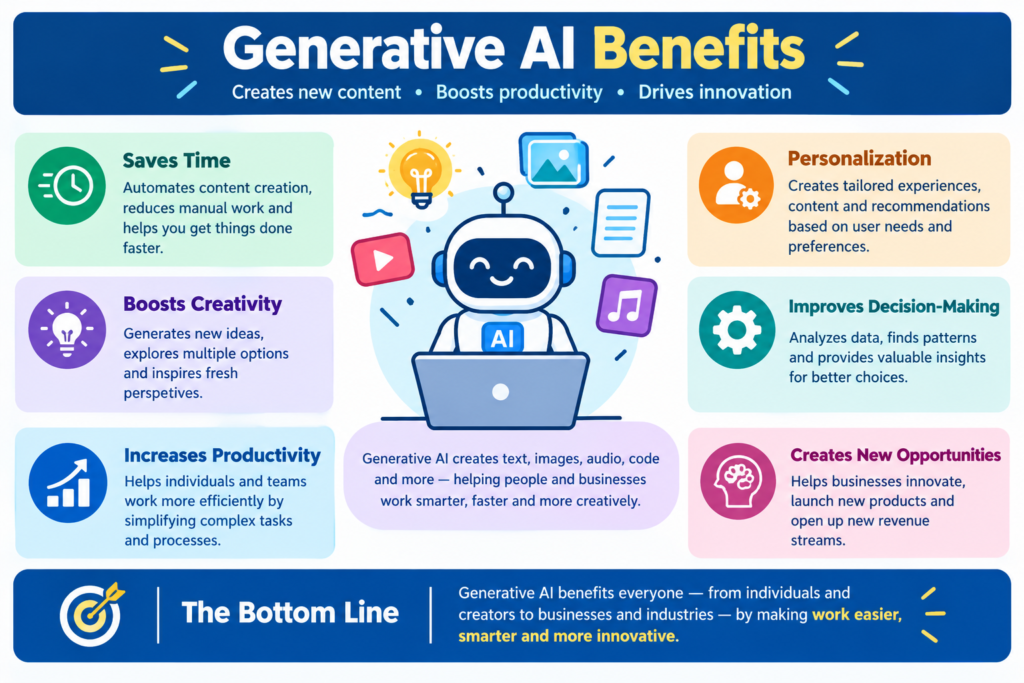
Benefits of Generative AI
There are many potential AI benefits, especially when the technology is used with clear goals and human oversight.
1. Higher Productivity
AI can complete repetitive tasks quickly. A person who spends an hour creating a basic summary may be able to produce a first draft in minutes with AI. That time can then be used for review and higher-value work.
2. Faster Content Creation
Generative AI can quickly create first drafts. This is useful for marketers, writers, teachers, developers, researchers, and business teams.
3. Personalized Learning
AI can adjust explanations based on a learner’s needs. A student can ask for:
- A simple explanation
- A detailed explanation
- Real-world examples
- A quiz
- A step-by-step solution
This can make learning more interactive.
4. Better Brainstorming
Sometimes the hardest part of a task is starting. AI can provide ideas, alternatives, questions, outlines, and examples. Humans can then select and improve the strongest ideas.
5. Accessibility
Generative AI can help people interact with information through translation, summarization, speech, and simplified explanations. This may make digital information easier to access.
6. Business Efficiency
Organizations can use AI to automate parts of workflows and reduce repetitive manual work. The result can be faster processes and potentially lower operating costs.
Limitations and Challenges of Generative AI
Generative AI is powerful, but it isn’t perfect. Understanding AI limitations is just as important as understanding its benefits.
1. Incorrect Information
AI can produce information that sounds convincing but is wrong. This is sometimes called a hallucination. For important topics, users should verify claims using trusted sources.
2. Bias
AI models learn from data. If the training data contains bias, the model may reproduce or amplify some of those patterns. This makes AI ethics and responsible model development important.
3. Privacy Concerns
Users should be careful when entering sensitive information into AI tools.Organizations also need policies for handling confidential business data.
4. Security Risks
Generative AI introduces new security concerns. These may include prompt injection, data leakage, malicious content generation, and misuse of AI systems. NIST’s Generative AI Profile identifies risks across the AI lifecycle and provides a framework for organizations that want to manage them systematically.
5. Over-Reliance
One major risk is using AI without thinking. For students, this can reduce opportunities to practice writing, research, problem-solving, and critical thinking. AI should be a learning partner, not a replacement for learning.
6. Copyright and Ownership Questions
AI-generated content creates difficult questions around ownership, training data, attribution, and originality. Businesses should establish clear policies before using generated content commercially.
7. Cost and Infrastructure
Advanced AI models require significant computing resources. Training and running large models can require powerful hardware, data centers, energy, and specialized expertise.
Generative AI for Students
Students are among the groups that can benefit from responsible use of generative AI.
Benefits of Generative AI for Students
Students can use AI to:
- Understand difficult subjects
- Create study plans
- Practice interview questions
- Improve writing
- Learn programming
- Generate quiz questions
- Brainstorm project ideas
- Summarize complex concepts
- Practice another language
- Prepare for presentations
Generative AI Examples for Beginners
Imagine a student learning Python.
Instead of asking:
“Give me the answer to this programming assignment.”
A better prompt would be:
“Explain why this Python code isn’t working. Give me hints first, then explain the solution.”
This approach supports learning rather than simply copying an answer.
Limitations of Generative AI in Learning
Students should watch for several problems:
- Incorrect explanations
- Weak original thinking
- Over-dependence on AI
- Academic integrity issues
- Poor source verification
- Reduced practice
- Privacy concerns
The goal should be AI-assisted learning, not AI-replaced learning.
Generative AI Tools for Students
Students can explore AI tools for different purposes.
| Need | Possible AI Use |
| Research | Summarize and organize ideas |
| Writing | Brainstorm and improve drafts |
| Coding | Explain errors and concepts |
| Study | Create quizzes and flashcards |
| Languages | Practice conversation |
| Presentations | Create outlines |
| Career | Practice interviews |
| Planning | Build study schedules |
Students should always follow their school’s or university’s AI policy.
Generative Engine Optimization and AI Search
Generative AI is also changing digital search. Traditional SEO focuses heavily on ranking pages in search engine results. Today, businesses also care about how their information appears in AI-generated answers. This has increased interest in generative engine optimization, answer engine optimization, and AI visibility.
What Is Generative Engine Optimization?
Generative Engine Optimization, or GEO, focuses on making information easier for AI systems to understand, retrieve, summarize, and potentially cite.
Important practices include:
- Clear answers
- Strong topical coverage
- Structured content
- Reliable sources
- Consistent facts
- Helpful examples
- Semantic relevance
- Author expertise
- Clear entity relationships
What Is Answer Engine Optimization?
Answer engine optimization focuses on creating content that can answer specific questions clearly.
For example, instead of only targeting:
“generative AI”
a page may also answer:
“How does generative AI work?”
“What are the benefits of generative AI?”
“What are the limitations of generative AI?”
This supports both traditional search and AI-powered search experiences.
Semantic Search and LLM Optimization
Search engines and AI systems increasingly rely on meaning and context rather than exact keyword matching.
That is why semantic search matters. A strong SEO strategy should cover related concepts naturally. For a generative AI article, related concepts may include:
- Machine learning
- Deep learning
- LLMs
- AI models
- Prompt engineering
- AI ethics
- AI applications
- AI research
- AI innovation
This creates stronger topical context.
AI Visibility and AI Citations
Brands now want to know whether AI systems mention them when users ask relevant questions.
This has created interest in:
- AI visibility
- AI citations
- AI snippets
- AI-powered search
- AI knowledge graphs
- LLM optimization
However, businesses shouldn’t abandon traditional SEO.
A strong AI SEO strategy should combine technical SEO, useful content, entity optimization, structured information, authority, and user-focused writing.
Prompt Engineering
Prompt engineering is the practice of creating better instructions for AI systems. A weak prompt might say:
“Write about AI.”
A stronger prompt could say: “Explain generative AI to college students using simple English, real-world examples, short paragraphs, and a comparison table.”
The second prompt provides context, audience, goal, and format.
Good prompting can improve the usefulness of AI output.
A Simple Prompt Framework
Try this structure:
Role + Task + Context + Audience + Format + Constraints
For example:
“Act as a technology educator. Explain generative AI to beginner students. Use simple English, practical examples, a table, and short paragraphs.”
This is a simple but effective approach.
AI Summarization and Knowledge Graphs
Generative AI can summarize large amounts of information quickly. For example, a researcher can use AI to create a short summary of a long report before reading the full source.
But summaries shouldn’t replace original sources when accuracy is important.
AI knowledge graphs are also becoming valuable because they help represent relationships between people, organizations, concepts, products, places, and other entities.
For SEO, clear entity relationships can help search systems understand what a website or brand is about.
Impact of Generative AI on Jobs
One of the biggest questions is the impact of generative AI on jobs. The answer isn’t simply that AI will eliminate all jobs. AI is more likely to change many tasks within jobs.
For example, a marketing professional may use AI to create initial campaign ideas. A developer may use AI to generate code suggestions. A researcher may use AI to summarize papers.
The human still needs to provide judgment. This means workers may need to develop a combination of technical and human skills.
Important skills include:
- AI literacy
- Critical thinking
- Communication
- Problem-solving
- Creativity
- Domain knowledge
- Data literacy
- Research skills
- Prompt engineering
- AI ethics
Current education and workforce trends show growing demand for practical AI skills, including AI strategy, AI agents, and applied business use.
Generative AI Career Opportunities for Students
The growth of AI creates new career paths.
Students can explore roles such as:
- AI engineer
- Machine learning engineer
- Data scientist
- AI product manager
- Prompt engineer
- AI researcher
- Automation specialist
- AI content specialist
- AI solutions consultant
- Responsible AI specialist
- AI security professional
Students don’t necessarily need to become AI researchers.
A person can combine AI knowledge with another field such as marketing, finance, healthcare, education, design, or software development.
That combination can be highly valuable.
AI Trends 2026
The AI trends 2026 landscape is moving toward more capable, integrated, and specialized systems. Several trends deserve attention.
1. Multimodal AI
AI systems are increasingly designed to work with text, images, audio, video, and other data types.
2. AI Agents
AI is moving from simply answering questions toward systems that can complete sequences of tasks. Agents may be able to plan actions, use tools, retrieve information, and complete workflows. This creates opportunities but also increases the need for security and oversight.
3. Smaller and Specialized AI Models
Not every task requires the largest model.
Smaller models can be useful for specific tasks, private deployments, lower costs, and faster responses.
4. AI in Scientific Research
Researchers are exploring AI for scientific discovery, data analysis, simulation, literature review, and hypothesis development.
5. Responsible AI
As adoption grows, organizations are paying more attention to governance, safety, transparency, privacy, and accountability. NIST continues to develop resources for trustworthy AI and risk management, including work connected to generative AI and critical infrastructure.
6. AI-Powered Search
Search is becoming more conversational. Users can increasingly ask complex questions rather than entering a few keywords. This means websites need useful, structured, authoritative information.
Future Scope of Generative AI in Research
The future scope of generative AI in research is broad.
Researchers may use AI to:
- Review large research collections
- Summarize papers
- Generate hypotheses
- Analyze datasets
- Assist with coding
- Model complex systems
- Support scientific writing
- Explore possible solutions
However, research requires strong validation. An AI-generated hypothesis is not automatically a scientific discovery. Researchers still need experiments, evidence, peer review, and reproducible methods.
AI Ethics and Responsible Innovation
The future of AI depends not only on capability but also on trust. Responsible AI should consider:
- Fairness
- Privacy
- Security
- Transparency
- Accountability
- Human oversight
- Data quality
- Safety
- Accessibility
Organizations should define where AI can be used and where human approval is mandatory. The goal isn’t to stop innovation. The goal is to make innovation safer and more useful.
How Businesses Can Prepare for the Future of AI
Businesses that want to adopt generative AI should start with practical problems.
A simple approach is:
Step 1: Identify Repetitive Work
Find tasks that consume significant employee time.
Step 2: Select Suitable AI Applications
Choose tasks where AI can provide measurable value.
Step 3: Test on a Small Scale
Start with a controlled pilot.
Step 4: Measure Results
Track time savings, quality, cost, accuracy, and user satisfaction.
Step 5: Add Human Review
Define which outputs require human approval.
Step 6: Create AI Policies
Set rules for privacy, security, data usage, and responsible AI.
Step 7: Train Employees
Employees should understand both the benefits and risks of AI.
Future of AI: What Comes Next?
The future of AI will likely involve closer collaboration between people and intelligent systems.
Generative AI may become less like a separate tool and more like a layer built into everyday software.
Students may have AI tutors.
Developers may work with AI coding assistants.
Doctors may use AI to organize information.
Researchers may use AI to explore large datasets.
Businesses may use AI agents to manage routine workflows.
The important point is that the technology will continue to evolve.
People who learn how to use AI responsibly may have an advantage over those who ignore it.
At the same time, human skills will remain important.
Creativity, judgment, empathy, leadership, communication, and critical thinking are difficult to replace with automation.
Generative AI is one of the most important developments in modern AI technology.
It combines artificial intelligence, machine learning, deep learning, large language models, and other technologies to create new content and assist with complex tasks. Its applications are already visible in education, healthcare, business, software development, research, marketing, and everyday productivity.
The benefits are significant. Generative AI can save time, support creativity, personalize learning, improve productivity, and help people work with large amounts of information.
But the technology also has real limitations.
Incorrect information, bias, privacy risks, security issues, copyright questions, and over-reliance must be taken seriously. Responsible use requires human judgment and appropriate safeguards. For students, the best approach is to learn with AI rather than depend on AI. For businesses, the focus should be on practical use cases, measurable value, employee training, and responsible governance.
The future will not simply be about humans versus AI.
It will increasingly be about humans working effectively with AI.
For additional guidance on managing generative AI risks, organizations can consult the NIST AI Risk Management Framework and Generative AI Profile.
As generative AI continues to evolve, the people and organizations that combine technology with critical thinking, expertise, ethics, and creativity will be better positioned to make the most of its opportunities.
Know More:
”FAQs”
1. What is generative AI in simple words?
Generative AI is a type of artificial intelligence that can create new content such as text, images, audio, video, and code based on instructions from users.
2. How does generative AI work step by step?
Generative AI learns patterns from large datasets during training. When a user provides a prompt, the model processes the input, predicts suitable output, and generates a response. The output should then be reviewed when accuracy is important.
3. What are some generative AI examples for beginners?
Examples include AI chatbots, writing assistants, image generators, coding assistants, AI summarizers, translation tools, and educational AI tutors.
4. What are the benefits of generative AI for students?
Students can use generative AI for personalized explanations, study plans, brainstorming, coding practice, language learning, quizzes, research support, and interview preparation.
5. What are the limitations of generative AI in learning?
The main limitations include incorrect information, over-reliance, reduced independent thinking, bias, privacy concerns, and academic integrity issues.
6. Is generative AI the same as machine learning?
No. Generative AI is a category of AI systems that can create new content. Machine learning is a broader approach that allows computers to learn patterns from data. Many generative AI systems use machine learning and deep learning.
7. Will generative AI replace human jobs?
Generative AI may automate some tasks and change how many jobs are performed. However, many roles will still require human judgment, creativity, communication, domain knowledge, and responsibility.
8. What is prompt engineering?
Prompt engineering is the process of designing clear and useful instructions for AI models. Good prompts provide context, goals, audience, format, and relevant constraints.
9. What is generative engine optimization?
Generative engine optimization, or GEO, focuses on improving the likelihood that a brand's information can be understood, retrieved, summarized, and potentially referenced by AI-powered search and answer systems.
10. What is the future of generative AI?
The future is likely to include more multimodal AI, AI agents, specialized models, AI-powered search, scientific research applications, and deeper integration into business and consumer software.