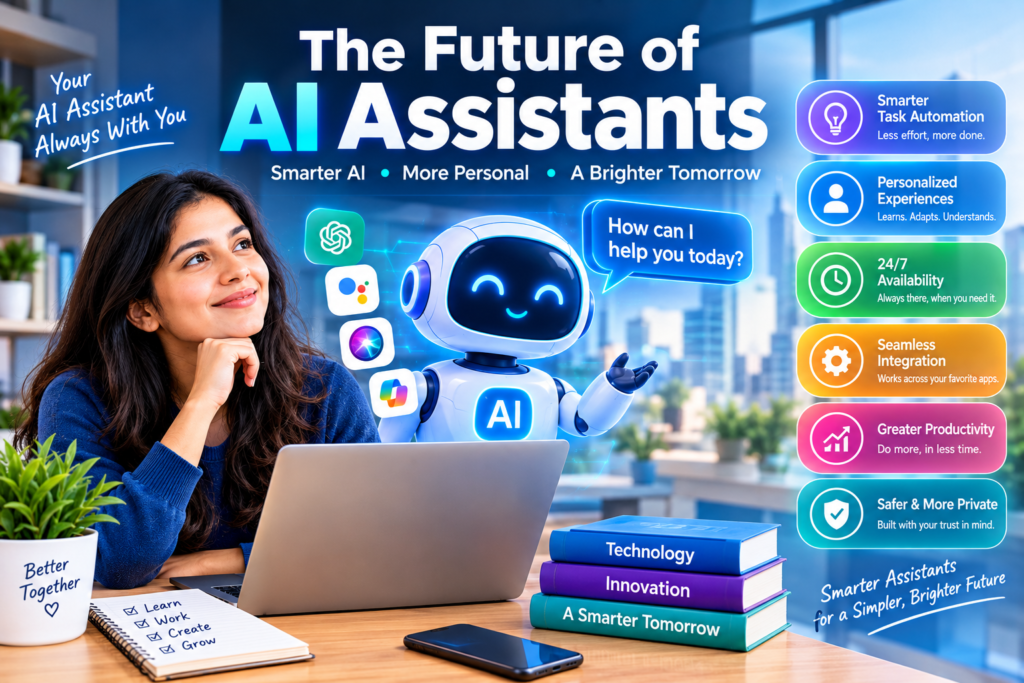
The Future of AI Assistants: From Chatbots to Autonomous Agents
A New Era of AI Assistants
AI assistants are becoming an important part of everyday life. People use them to write emails, research topics, summarize documents, learn new skills, and solve problems. Businesses use artificial intelligence assistants to support customers, analyze information, and improve daily operations.
However, the technology is moving beyond simple question-and-answer conversations.
Early chatbots mainly followed fixed rules. Modern AI assistants can understand natural language, generate original responses, and use information from different sources. Newer systems can also connect with software tools and perform tasks on behalf of users.
This development has created growing interest in autonomous AI agents.
Imagine asking an AI assistant to help organize a business event. A basic chatbot might suggest a checklist. A more advanced assistant might create a schedule and draft invitations. An autonomous agent could potentially compare venues, prepare a budget, check availability through approved tools, and organize a proposed plan for your review.
The difference is important. One system mainly provides information, while another can help carry out the work.
The future of AI assistants will depend on how well these systems combine reasoning, planning, memory, and action. They may become useful partners in education, business, software development, healthcare administration, and personal productivity.
Still, greater automation doesn’t mean every task should happen without human supervision. Reliable systems need clear instructions, secure access, and suitable limits.
In this article, we’ll explore how AI assistants are evolving, how autonomous AI agents work, where businesses can use them, and what this transformation means for the future of work.
2. What Are AI Assistants?
AI assistants are software systems that use artificial intelligence to help people complete tasks, find information, or make decisions.
They can understand questions, process information, and respond through text, voice, images, or other forms of communication.
Traditional digital assistants often perform specific actions, such as setting reminders or answering simple questions. Modern AI-powered assistants can handle more complex requests because they use machine learning, natural language processing, and large language models.
2.1 How Do AI Assistants Work?
Most modern AI assistants combine several technologies.
- Natural language processing: Helps systems understand human language and user instructions.
- Machine learning: Allows models to identify patterns in data.
- Deep learning models: Support advanced language, image, and speech processing.
- Large language models: Generate responses, explain concepts, and help with reasoning.
- External tools: Allow assistants to retrieve information or interact with connected software.
- Memory systems: Help retain relevant information when a product supports memory.
- Safety controls: Restrict actions that could cause harm or expose sensitive information.
These components work together to create useful AI experiences.
For example, a student might ask an AI assistant to explain a difficult science topic. The assistant interprets the question, generates an explanation, provides examples, and adjusts the response when the student asks follow-up questions.
A business professional might use the same technology to summarize a report, prepare a presentation, or compare several marketing ideas.
2.2 Popular Examples of AI Assistants
Several widely used tools demonstrate different approaches to intelligent assistance.
- ChatGPT: Supports writing, research, coding, analysis, and other tasks.
- Microsoft Copilot: Helps users work with information and supported Microsoft applications.
- Google Gemini: Offers AI assistance across supported Google services and other experiences.
- Claude AI: Supports writing, document analysis, coding, and complex information tasks.
- Voice assistants: Provide spoken interaction and supported device controls.
These tools differ in their features, integrations, access controls, and available models.
It’s also important to understand that an AI assistant isn’t automatically an autonomous agent. Many assistants primarily respond to requests, while agentic systems are designed to plan and execute sequences of actions.
2.3 Why AI Assistants Matter
AI assistants can reduce the time spent on repetitive work and make technical information easier to understand.
For beginners, they provide a simpler way to explore new subjects. For professionals, they can speed up research and content preparation. For businesses, they can support customer service, data analysis, and internal knowledge management.
Their value depends on the task, the quality of the information they receive, and the reliability of their output.
As these tools improve, they may become less like separate applications and more like a common interface for completing digital work.
3. From Chatbots to Autonomous AI Agents
The chatbot evolution reflects a shift from simple conversation toward systems that can take action.
Early chatbots generally used predefined rules. If a customer entered a recognized phrase, the chatbot returned a programmed answer. These systems worked well for predictable questions but struggled with unusual requests.
Machine learning introduced more flexible ways to recognize patterns. Conversational AI then improved the ability to interpret everyday language and maintain more natural interactions.
Generative AI brought another major change. Large language models can produce original text, summarize long documents, write code, and explain complicated subjects.
Now, AI agent technology is extending these abilities by connecting language models with planning methods, tools, and workflows.
3.1 Four Stages of AI Assistant Development
| Stage | Main Capability | Example |
| Rule-based chatbot | Follows predefined rules | Answers basic support questions |
| Intelligent virtual assistant | Understands more flexible requests | Helps users find information |
| Generative AI assistant | Creates and analyzes content | Drafts reports and summarizes files |
| Autonomous AI agent | Plans and executes multi-step tasks | Coordinates an approved workflow |
These stages aren’t strict categories. Modern products may combine features from several stages, and some AI agents still require substantial human guidance.
3.2 Why Autonomous AI Agents Are Different
A traditional chatbot usually responds to a prompt. An autonomous agent can work toward a defined goal by deciding what steps to take next.
For example, suppose a marketing manager asks for a campaign performance report.
A chatbot might explain which metrics to include.
An AI assistant could draft the report if the manager provides the data.
An AI agent connected to authorized analytics and reporting tools might retrieve the relevant data, calculate selected metrics, identify changes, prepare a draft, and request approval before sharing it.
This type of system can combine AI task automation with software integrations.
However, it doesn’t guarantee correct results. The agent may select the wrong data, misunderstand the goal, or make an incorrect recommendation. Testing and approval processes remain important.
3.3 What Is Agentic AI?
Agentic AI describes systems designed to pursue goals through planning, decisions, and actions rather than simply producing a single response.
Agentic workflows may involve several steps:
- Understand the user’s goal.
- Break the goal into smaller tasks.
- Choose suitable tools.
- Perform an action.
- Check the result.
- Continue, correct an error, or ask for help.
- Report the outcome.
Some systems repeat this process until they reach a stopping condition.
The future of AI assistants will likely include more products that combine conversational interfaces with these task-oriented capabilities. The most useful systems won’t necessarily be the most independent. They’ll be the ones that reliably complete appropriate tasks while keeping users informed and in control.
4. How Autonomous AI Agents Work
Understanding how autonomous AI agents work helps explain both their potential and their limitations.
An autonomous agent generally receives a goal, gathers relevant information, plans a series of steps, uses available tools, and evaluates its progress.
The exact design varies by application. Some agents follow a fixed workflow, while others can select actions dynamically.
4.1 Goal Understanding and Task Planning
The process begins with a clear objective.
For example, a user might ask an agent to prepare a competitor analysis for a new product.
The system could divide the request into smaller tasks:
- Identify competitors.
- Gather publicly available information.
- Compare product features.
- Organize pricing information.
- Summarize strengths and weaknesses.
- Prepare a report.
AI planning systems help organize these steps into a workable sequence.
A well-designed agent should also recognize when it lacks necessary information or when a request requires clarification.
4.2 Tool Use and AI Task Execution
AI agents become more useful when they can interact with external tools.
Depending on permissions, an agent may connect to search systems, databases, calendars, spreadsheets, customer relationship management platforms, or internal company software.
For example, an AI agent for sales might organize lead information, draft personalized messages, and update a CRM record after an employee approves the changes.
Tool access must be carefully controlled. Reading a document is different from sending an email or deleting a customer record.
4.3 Memory and Context Awareness
AI memory systems can help agents maintain relevant context across a task.
Short-term context may include the current goal, previous actions, and information collected during a workflow. Longer-term memory, when available, may retain selected preferences or useful facts.
Context awareness helps prevent an agent from treating every step as an unrelated request.
However, memory isn’t always complete or accurate. Systems need clear rules for storing, retrieving, updating, and deleting information.
4.4 Feedback and Error Correction
A capable agent should check whether its actions produced the expected result.
For example, if a reporting tool returns incomplete data, the agent might retry the request, use an alternative permitted method, or inform the user that the task cannot be completed.
This process is often called a feedback loop.
Without suitable checks, agents can repeat errors or make unsupported assumptions. Reliable AI agent systems therefore need validation rules, time limits, action limits, and clear failure handling.
4.5 Multi-Agent Systems
Some complex workflows use several specialized agents instead of one general-purpose agent.
A research agent might collect information, an analysis agent might compare findings, and a writing agent might prepare a report.
Multi-agent systems can divide work into manageable parts. Yet they also introduce coordination problems, extra costs, and opportunities for errors to spread between agents.
The best design depends on the task. A single well-controlled agent may be more effective than a complicated network of agents.
5. Chatbot vs. Autonomous Agent: Key Differences
The difference between chatbots and autonomous agents is mainly about how they handle tasks and interact with external systems.
Both can use language models, but their workflows may be very different.
| Feature | Traditional Chatbot | Generative AI Assistant | Autonomous AI Agent |
| Main purpose | Answer common questions | Generate or analyze content | Complete goal-oriented tasks |
| Task planning | Limited or predefined | Varies by product | Often supports multi-step planning |
| Tool use | Usually limited | May use connected tools | Often central to its design |
| Memory | Often limited | Depends on the product | May maintain task state or memory |
| Decision-making | Rules or predefined flows | Produces recommendations | Selects actions within defined limits |
| Human involvement | User asks each question | User guides the interaction | May act between user instructions |
| Example | FAQ chatbot | Writing assistant | Approved workflow automation agent |
These distinctions are useful, but they’re not absolute. Some chatbots use tools, and some agents follow strict predefined workflows.
5.1 When Should You Use a Chatbot?
A chatbot is often suitable for simple, predictable interactions.
Examples include:
- Answering frequently asked questions.
- Providing basic product information.
- Directing users to relevant support pages.
- Explaining standard policies.
- Collecting information before a support handoff.
These tasks don’t always require complex planning or independent action.
5.2 When Should You Use an Autonomous Agent?
An autonomous agent may be useful when a task involves several connected steps and the system has access to the required tools.
Examples include preparing a recurring report, organizing research, sorting incoming requests, or coordinating an internal approval process.
However, the more important the outcome, the more carefully the workflow should be designed.
Financial transfers, legal decisions, hiring decisions, and other high-impact activities require stronger safeguards and appropriate human involvement.
The right question isn’t whether autonomous agents are always better than chatbots. It’s whether their additional capabilities provide enough value to justify their cost, complexity, and risk.
6. The Role of Large Language Models in Autonomous Agents
Large language models, or LLMs, play an important role in modern AI assistants.
These models learn patterns from large amounts of training data and use those patterns to generate language, summarize information, explain concepts, and support selected reasoning tasks.
Transformer models form the foundation of many widely used language models. They help systems process relationships between words and other parts of an input.
6.1 How LLMs Support AI Agent Technology
LLMs can help an agent interpret instructions, generate a plan, select among available tools, and explain the results of its actions.
For example, an agent may receive a request to summarize recent customer feedback. The model can help identify relevant categories, formulate search queries, organize findings, and prepare a readable summary.
The surrounding software determines which tools the agent can access and which actions it can perform.
This distinction matters: a language model generating an action proposal is not the same as a system safely carrying out that action.
6.2 Retrieval-Augmented Generation
Retrieval-augmented generation, commonly called RAG, connects a language model with an external information source.
Instead of relying only on information encoded during training, a RAG-based system retrieves relevant documents or records and uses them to produce a response.
For businesses, this can help AI assistants answer questions using approved company documents, product manuals, internal policies, or support information.
A well-designed RAG system should identify relevant sources and respect document permissions. Retrieval alone doesn’t guarantee that an answer is correct.
6.3 AI Agent Frameworks
AI agent frameworks provide building blocks for creating agent-based applications.
Examples include LangChain and CrewAI. Developers can use frameworks to connect models with tools, organize workflows, and coordinate multiple agents.
Frameworks differ in their features and design choices. Selecting one depends on the application’s complexity, security requirements, deployment environment, and maintenance needs.
6.4 The Importance of Reasoning and Evaluation
AI reasoning models may improve performance on tasks requiring several connected steps. However, reasoning output can still contain mistakes.
Developers should evaluate systems using realistic tasks, verified answers, and clear performance measures.
Useful measures include:
- Task completion rate.
- Accuracy of retrieved information.
- Number of incorrect tool calls.
- Cost per completed task.
- Time saved.
- Frequency of human intervention.
- Compliance with access and approval rules.
These measures help organizations determine whether an agent delivers real value rather than simply producing impressive demonstrations.
7. Benefits of Autonomous AI Agents
Autonomous AI agents can provide several benefits when they’re applied to suitable tasks and supported by reliable systems.
7.1 Improved Productivity
Agents can reduce repetitive work by performing steps that employees would otherwise complete manually.
For example, an agent might gather information from approved sources, organize it in a spreadsheet, and prepare a report draft.
Employees can then focus on interpreting the findings and making decisions.
7.2 Faster Workflows
A workflow that requires several software applications may take considerable time when managed manually.
AI workflow automation can coordinate connected steps and reduce delays between them.
However, speed depends on the quality of integrations, data access, and the need for human approval.
7.3 Greater Scalability
An automated system may handle larger volumes of routine requests without requiring the same increase in manual effort.
A customer service organization, for example, could use AI agents to classify incoming questions and prepare suggested responses.
Complex or sensitive cases should still be directed to qualified employees.
7.4 Personalized Assistance
Intelligent virtual assistants can adapt responses to a user’s question, preferences, and relevant context.
An education assistant might explain the same concept in different ways depending on a student’s needs. A workplace assistant might organize information around an employee’s current project.
Personalization should remain transparent and respect privacy.
7.5 More Consistent Processes
Agents can follow documented procedures and checklists across repeated tasks.
This may help teams apply consistent formatting, organize records, and follow standard operating procedures.
Nevertheless, an automated system can repeat the same mistake at scale. Monitoring and quality checks are essential.
7.6 Better Access to Information
AI-powered assistants can make large collections of documents easier to search and understand.
Employees may ask questions in natural language instead of learning complex database queries or searching multiple folders.
The quality of the response depends on whether the underlying information is current, relevant, and accessible to the system.
7.7 Support for Decision-Making
AI agents can organize evidence, compare alternatives, and highlight patterns.
For instance, a business analyst might use an agent to summarize customer feedback alongside sales trends.
The agent can support a decision, but the responsible person should verify important evidence and consider factors the system may not understand.
Overall, the benefits of autonomous AI agents are strongest when organizations choose clear use cases, measure results, and retain appropriate human oversight.
8. AI Assistants for Business Automation
Businesses are exploring AI assistants to reduce manual work and improve the way teams manage information.
The most useful applications often begin with repetitive, well-defined processes rather than completely open-ended tasks.
8.1 Customer Service
AI agents can classify support tickets, search knowledge bases, summarize conversations, and draft replies.
A customer might ask about an order. An agent with authorized access could retrieve the order status and prepare an explanation.
Actions such as issuing refunds, changing account details, or making exceptions should follow explicit business rules and approval requirements.
8.2 Marketing and SEO
Marketing teams can use AI automation to support research, content planning, reporting, and campaign analysis.
Possible applications include:
- Grouping keywords by search intent.
- Summarizing competitor content.
- Organizing content briefs.
- Preparing draft metadata.
- Analyzing website performance data.
- Producing initial reporting summaries.
For SEO teams, an agent might collect data from approved analytics tools and prepare a report covering organic traffic, landing pages, and conversion trends.
Human review remains important. AI-generated content can include inaccurate claims, repetitive writing, or poor search intent alignment.
8.3 Sales and Lead Management
AI agents can organize incoming leads, summarize customer interactions, and prepare follow-up drafts.
A sales assistant might identify missing information in a CRM record and suggest the next step based on company policy.
Automated outreach should respect consent, privacy requirements, and communication rules. A human should approve consequential actions when needed.
8.4 Finance and Administration
AI assistants can help categorize documents, summarize invoices, compare records, and prepare financial reports.
These tasks can reduce administrative effort, but financial records require strong accuracy and access controls.
An agent should not independently approve payments or make high-impact financial decisions without suitable authorization and safeguards.
8.5 Human Resources
AI systems can assist with routine HR questions, policy searches, onboarding checklists, and training materials.
They can also help employees find relevant information without searching multiple internal documents.
Hiring, performance evaluation, compensation, and other sensitive decisions require particular care. Organizations should consider fairness, privacy, legal requirements, and meaningful human review.
8.6 Software Development
AI coding assistants can explain code, suggest fixes, generate tests, and help developers understand unfamiliar systems.
More advanced agents may inspect a codebase, propose changes, run tests, and prepare a change request.
However, generated code can introduce security vulnerabilities or break existing functionality. Testing, code review, and controlled deployment remain essential.
9. AI Agent Applications Across Industries
The future of AI assistants extends beyond office productivity. Different industries can use intelligent systems to support their own workflows.
| Industry | Potential Application | Important Safeguard |
| Education | Personalized explanations and study plans | Verify learning material |
| Healthcare | Administrative support and document summaries | Protect patient data |
| Finance | Document processing and fraud alerts | Validate results and decisions |
| Retail | Product discovery and customer support | Protect customer information |
| Manufacturing | Maintenance information and process monitoring | Check physical safety |
| Logistics | Shipment tracking and route planning | Validate operational constraints |
| Legal services | Document review and research assistance | Professional review |
| Software | Coding support and automated testing | Security and code review |
9.1 AI Assistants in Education and Learning
AI assistants can explain difficult concepts, create practice questions, and help learners build study schedules.
A student studying programming might ask for a simple explanation, review an example, and then request a practice problem.
More advanced learning systems may adjust the difficulty of exercises based on a learner’s progress.
These systems should support learning rather than simply provide answers. Students also need to develop independent thinking and verify important information.
9.2 Healthcare and Scientific Research
AI systems may assist with administrative documentation, literature searches, and research organization.
For example, an authorized research assistant might organize published studies by topic and summarize their methods.
Clinical decisions require appropriate professional judgment, and sensitive health information needs strict protection. AI-generated summaries should not be treated as automatically accurate.
9.3 Finance and Banking
Financial institutions can use AI to help organize documents, identify unusual patterns, and answer routine questions.
Agent-based workflows may connect several approved systems to help employees investigate a transaction or prepare a report.
High-impact decisions require clear accountability, suitable validation, and compliance with applicable regulations.
9.4 Manufacturing and Logistics
Industrial AI systems can help monitor equipment data, summarize maintenance records, and identify possible operational problems.
In logistics, AI assistants may support shipment tracking, inventory analysis, and planning.
When software interacts with physical equipment, safeguards must reflect the real-world consequences of a wrong action.
These examples show that AI agent applications can be useful across many industries. However, successful deployment depends on the specific problem, available data, system reliability, and level of risk.
10. AI Assistants for Productivity and Workflow Management
Personal and workplace productivity is likely to remain a major use case for AI assistants.
Many everyday tasks involve gathering information, organizing files, writing messages, scheduling work, and tracking progress. These activities provide opportunities for intelligent automation.
10.1 Managing Daily Tasks
A personal AI assistant may help organize a to-do list, summarize a calendar, or draft reminders.
When connected to suitable tools, it might suggest an efficient schedule based on deadlines and available time.
Users should still check for conflicts and review changes before the assistant modifies important calendar entries.
10.2 Research and Information Management
AI productivity tools can summarize long documents, compare sources, and organize notes.
An agent might collect information from a defined set of sources, extract key points, and prepare a summary with references.
This can speed up research, but it doesn’t remove the need to verify facts and check source quality.
10.3 Email and Communication
AI assistants can draft emails, summarize message threads, and suggest replies.
More advanced systems may classify incoming messages and prepare proposed actions.
Sending messages automatically requires additional care because the wrong recipient, incorrect statement, or unintended disclosure can cause problems.
10.4 Connecting Multiple Applications
AI-powered workflows can connect calendars, spreadsheets, project management tools, and document systems.
For example, an approved workflow might detect a new project request, create a draft task list, assign proposed deadlines, and notify a manager for review.
The advantage comes from coordinating several steps rather than using separate tools for every action.
10.5 How to Start Using AI Automation
Individuals and organizations can begin with a simple process:
- Choose one repetitive task.
- Document the steps and expected result.
- Identify the tools and data required.
- Test an AI assistant with sample information.
- Compare the output with a verified result.
- Add approval checks for important actions.
- Measure time saved and errors.
- Expand only when the workflow performs reliably.
Starting small makes problems easier to identify and reduces the risk of automating a flawed process.
11. Challenges and Risks of Autonomous AI Agents
Despite their potential, autonomous AI agents introduce technical, operational, and ethical challenges.
A system that can take action needs stronger controls than one that only generates text.
11.1 Incorrect Information
AI systems can produce plausible but inaccurate answers. An agent may also select the wrong tool or misunderstand an instruction.
Organizations should verify important outputs against trusted data and test the system on realistic cases.
11.2 Privacy and Data Security
AI agents may access emails, customer records, internal documents, or other sensitive information.
If permissions are too broad, an agent could expose information to the wrong person or use data for an unintended purpose.
Access should be limited to what’s necessary for the task. Sensitive information should be protected through suitable authentication, encryption, logging, and retention policies.
11.3 Excessive Autonomy
An agent might make a change that is difficult to reverse, such as deleting data or sending an incorrect message.
The solution is to establish boundaries.
For example, an agent may prepare a payment request but require a human to approve the transfer. It may draft a public announcement but wait for permission before publishing.
11.4 Prompt Injection and Untrusted Inputs
Agents often process external documents, webpages, emails, and other content. Some of that content may contain malicious instructions designed to influence the system.
Applications should treat external information as untrusted input. They should separate retrieved content from trusted instructions and restrict the actions the agent can perform.
11.5 Cost and Technical Complexity
Agentic AI systems may require model usage, software integrations, monitoring, and ongoing maintenance. Long workflows can become expensive, especially when agents repeatedly retry tasks or call several tools. Businesses should compare total operating costs with measurable benefits and consider simpler alternatives when appropriate.
11.6 Accountability and Transparency
When an AI agent makes a mistake, organizations need to know what happened and who is responsible for correcting it.
Useful safeguards include activity logs, approval records, clear ownership, and procedures for stopping or reversing actions.
The goal isn’t to eliminate all risk. It’s to ensure that AI automation operates within acceptable limits and that people can intervene when necessary.
12. Human-AI Collaboration: Why People Still Matter
The growth of autonomous AI agents doesn’t mean humans will become unnecessary.
AI systems can process information quickly and repeat structured tasks. Humans bring context, experience, judgment, empathy, and responsibility.
The strongest approach is often to combine these strengths.
12.1 AI as a Partner, Not Just a Tool
In a collaborative workflow, AI may prepare a first draft, organize evidence, or identify possible solutions. A human then reviews the work and decides what to do.
For example, an HR assistant could summarize applications against job-related criteria. A qualified recruiter would still need to evaluate candidates fairly and make appropriate decisions.
12.2 Human Oversight at the Right Level
Not every task needs the same level of supervision.
A low-risk task, such as formatting a private document, may require only occasional checks. A task involving money, confidential information, or public communication may need explicit approval.
A useful approach is to classify tasks by risk and assign appropriate permissions to each category.
12.3 Skills for the AI-Driven Workplace
Workers can prepare for changing workflows by developing several skills:
- AI literacy and prompt writing.
- Critical thinking and fact-checking.
- Data interpretation.
- Problem-solving and communication.
- Workflow design and automation.
- Privacy and security awareness.
- Domain-specific knowledge.
Technical skills will matter, but so will the ability to recognize when an AI system is wrong.
Human-AI collaboration works best when people understand both the capabilities and the limitations of the technology.
13. The Future of AI Assistants: 11 Powerful Trends
The future of AI assistants will be shaped by improvements in models, software integrations, and the ways people interact with digital systems.
The following trends represent important areas of development. Their adoption will vary across products and industries.
13.1 More Capable Autonomous Agents
AI agents are likely to handle more multi-step workflows as planning, tool use, and evaluation improve.
Rather than simply answering questions, an assistant may help coordinate an entire task from beginning to end.
13.2 Multimodal AI Systems
Multimodal AI can work with combinations of text, images, audio, and video.
This may allow assistants to interpret a chart, discuss a recorded meeting, explain an image, or combine information from different formats.
Performance will depend on the model and the quality of the input.
13.3 More Natural Voice Interactions
Voice assistants are becoming more conversational. Future systems may support smoother spoken exchanges and more useful real-time assistance.
Potential applications include accessibility support, hands-free work, language learning, and customer service.
Privacy and user consent remain important, especially when audio is recorded or stored.
13.4 Better Personalization and Memory
AI digital assistants may become better at adapting to user preferences, ongoing projects, and preferred ways of working.
Personalization can make assistance more relevant, but it needs clear controls over what information is remembered and how it is used.
13.5 AI Agents That Coordinate With Other Agents
Multi-agent systems may divide large tasks among specialized agents.
One agent could retrieve information, another could check calculations, and a third could prepare a report.
These systems will need reliable coordination, clear task boundaries, and ways to detect conflicting results.
13.6 Deeper Integration With Business Software
Enterprise AI assistants may become more closely connected with office applications, CRM platforms, analytics systems, and internal databases.
This could reduce the need to move manually between separate applications.
Organizations will need to maintain appropriate access permissions and audit trails.
13.7 More Reliable Reasoning and Verification
AI reasoning models and evaluation methods may improve how systems plan and check their work.
Future agents may use independent verification steps, trusted databases, or specialized validation tools before reporting results.
However, no model should be assumed to be error-free.
13.8 AI Assistants for Specialized Industries
Instead of relying only on general-purpose assistants, organizations may adopt systems tailored to specific fields.
Examples include assistants for legal research, engineering documentation, education, customer support, and scientific analysis.
Specialization can improve relevance, but the underlying information and model behavior still require review.
13.9 More Efficient AI Models
AI developers are working on models and systems that reduce computing requirements while maintaining useful performance.
More efficient models could make real-time AI assistance available across a wider range of devices and budgets.
The practical outcome will depend on hardware, software design, and deployment costs.
13.10 Greater Focus on Security and Governance
As agents gain access to more tools, security controls will become increasingly important.
Organizations may adopt stricter permission systems, detailed activity logs, testing standards, and approval requirements.
Trust will depend not only on what an agent can do but also on how safely it does it.
13.11 AI Assistants as Digital Work Partners
The longer-term direction may involve assistants that help manage ongoing projects rather than respond only to individual prompts.
A digital work partner could track a project’s progress, summarize changes, highlight missing information, and prepare suggested next steps.
This doesn’t mean every assistant will operate independently. The most useful systems may combine proactive suggestions with clear human control.
Taken together, these trends point toward AI assistants that are more capable, connected, and context-aware. Their success will depend on reliability and practical value, not just increasing autonomy.
14. How to Prepare for the Future of AI Assistants
Individuals and organizations don’t need to wait for fully autonomous systems to benefit from AI technology.
A practical starting point is to identify where AI already provides useful support and build from there.
14.1 For Individuals
People can start by learning how to use generative AI assistants for everyday tasks.
Useful steps include:
- Practice writing clear prompts.
- Learn to verify AI-generated information.
- Use AI to explain unfamiliar concepts.
- Experiment with document summaries and research.
- Understand privacy settings and data-sharing limits.
- Explore basic workflow automation.
The aim is to use AI thoughtfully, not to trust every output without checking it.
14.2 For Students
Students can use AI assistants to create practice questions, review difficult topics, and plan study sessions.
They should also use the tools to develop their own understanding. Simply copying an AI response may prevent them from learning the underlying material.
Students should follow their institution’s rules for AI use and disclose assistance when required.
14.3 For Businesses
Organizations should begin with a clearly defined business problem.
For example, a company might automate the classification of routine support tickets before attempting to create an agent that manages the entire customer service process.
A practical adoption plan includes:
- Identify a high-value, low-risk use case.
- Review available data and software integrations.
- Define permissions and approval requirements.
- Run a limited pilot.
- Measure accuracy, cost, and time saved.
- Gather employee feedback.
- Improve the workflow before expanding.
Businesses should also train employees to work with AI tools and establish procedures for reporting problems.
14.4 Choosing AI Assistant Tools in 2026
The best AI assistant tools depend on the task and the user’s requirements. No single tool is best for everyone.
| Requirement | What to Evaluate |
| Writing and research | Output quality and source verification |
| Workplace productivity | Integration with existing applications |
| Software development | Code quality, testing, and repository access |
| Business automation | Workflow control and permissions |
| Enterprise use | Data protection and administrative controls |
| Personal assistance | Ease of use and privacy settings |
| Agent development | Tool support, monitoring, and evaluation |
Before selecting a product, test it on realistic tasks and compare the results with your existing process. Consider cost, reliability, security, accessibility, and the level of human oversight required.
14.5 Measure Real Business Value
A successful AI project should produce measurable improvements.
Useful indicators include task completion rate, error frequency, time saved, operating cost, user satisfaction, and the number of tasks requiring human intervention.
Businesses should also measure unexpected costs, including maintenance and correcting mistakes.
These measures help distinguish practical AI innovation from experimentation that looks impressive but provides little lasting value.
From Conversations to Meaningful Action
The future of AI assistants is moving beyond simple chatbots toward systems that can help people complete increasingly complex tasks. Generative AI assistants already support writing, research, coding, and information analysis. Autonomous AI agents extend these capabilities by combining planning, tool use, and task execution.
This shift could improve productivity across business, education, marketing, customer service, and many other fields. It may also change how people interact with software, allowing them to describe a goal instead of manually completing every step.
However, greater capability brings greater responsibility. AI agents need reliable information, appropriate permissions, strong security, and clear ways for humans to review important actions.
For individuals, the best way to prepare is to learn how to use AI tools effectively and verify their results. For businesses, the best approach is to start with clear use cases, measure performance, and expand only when the system demonstrates value.
The next generation of intelligent virtual assistants won’t be defined by how naturally they talk alone. Their value will come from how reliably they help people achieve meaningful goals.
The future isn’t simply about AI that can answer questions. It’s about AI that can help turn those answers into useful action—with people remaining in control.
External Resources for Further Reading
- OpenAI — Research and developments in AI models and AI-powered tools.
- Microsoft AI — Information about AI technologies and business applications.
- Google AI — Research and resources on artificial intelligence.
- LangChain Documentation — Technical resources for developers building applications with language models.
Know More:
”FAQs”
What Are AI Assistants?
AI assistants are software systems that use artificial intelligence to help people answer questions, create content, find information, and complete tasks. Modern systems may use large language models, natural language processing, and connected tools to provide more advanced assistance.
What Is an Autonomous AI Agent?
An autonomous AI agent is a system designed to pursue a goal by planning steps, using available tools, and evaluating results with limited ongoing human input. Its level of independence depends on its design, permissions, and safeguards.
How Are AI Agents Different From Chatbots?
A chatbot mainly handles conversations and responds to user messages. An autonomous AI agent can also plan and execute multi-step tasks through connected tools. Some modern chatbots already have agent-like capabilities, so the difference depends on the product.
What Are the Benefits of Autonomous AI Agents?
Potential benefits include reduced repetitive work, faster workflows, consistent processes, better information access, and improved productivity. Results depend on the task, system reliability, and quality of implementation.
How Can AI Agents Automate Tasks?
AI agents can interpret a goal, divide it into steps, retrieve information, use authorized software tools, and check the outcome. For example, an agent might collect approved business data, prepare a report, and submit it for review.
What Industries Use AI Assistants?
AI assistants are used across education, healthcare administration, finance, retail, manufacturing, logistics, marketing, and software development. Their applications range from answering questions and summarizing documents to supporting structured business workflows.
Can AI Assistants Make Decisions Independently?
Some AI agents can select actions within predefined limits. However, their decisions can be incorrect, and their authority depends on the system's design. High-impact decisions should include suitable human oversight, validation, and accountability.
Can AI Agents Replace Human Assistants?
AI agents can automate some administrative tasks, but they can't reliably replace every human responsibility. People remain important for judgment, empathy, complex communication, accountability, and situations requiring an understanding of wider context. In many workplaces, AI is more useful as a support tool than as a complete replacement.
What Is the Role of LLMs in Autonomous Agents?
Large language models help agents interpret instructions, generate plans, summarize information, and interact with tools. Other software components manage permissions, execute actions, store task information, and verify results.
Are Autonomous AI Agents the Future?
Autonomous AI agents are likely to become an important part of the AI ecosystem as planning and tool integration improve. Their adoption will depend on reliability, security, cost, and whether they solve real problems better than simpler systems.