
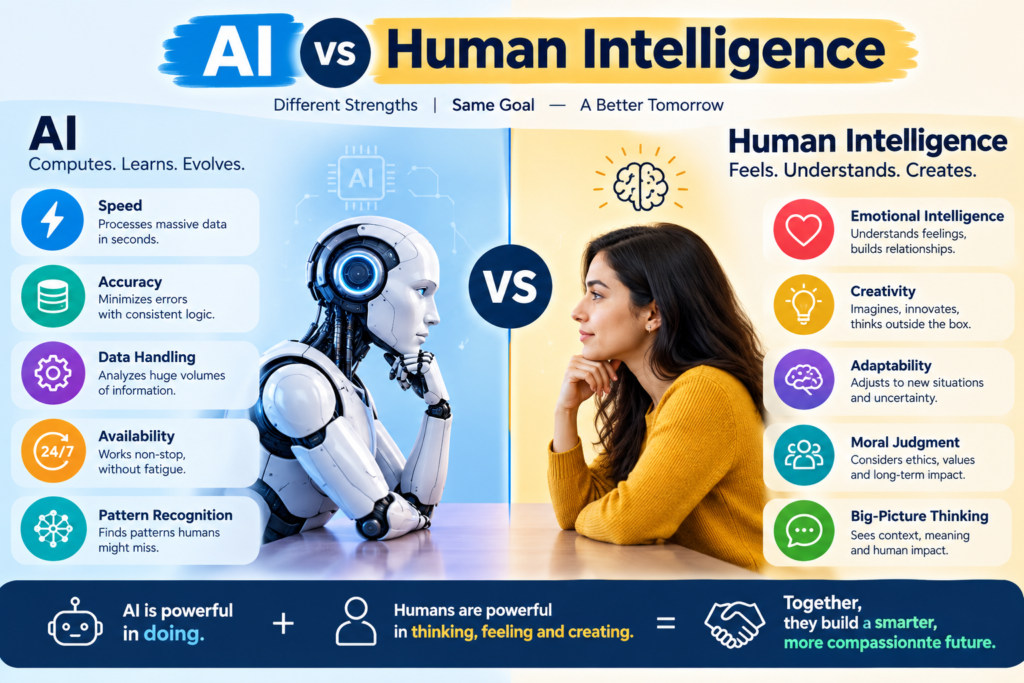
AI vs Human Intelligence: Similarities, Differences, and Limitations
Artificial intelligence is changing the way we work, learn, and solve problems. Machines can write articles, analyze data, answer questions, and create images in seconds. Meanwhile, humans can understand emotions, learn from life, build relationships, and make decisions based on values.
So, which is better: artificial intelligence or human intelligence?
The answer isn’t as simple as choosing one winner. AI and humans have different strengths. Machines are often better at processing large amounts of information quickly. Humans are better equipped to understand personal experiences, social situations, and complex moral questions.
Understanding AI vs human intelligence helps us use technology wisely. It also explains why machines can perform impressive tasks without thinking exactly as people do.
In this guide, we’ll explore the similarities, differences, benefits, and limits of both forms of intelligence. We’ll also examine whether AI can replace human intelligence and how people and machines can work together.
1. What Is Artificial Intelligence?
Artificial intelligence (AI) is a type of technology that allows computers to perform tasks that usually require human intelligence.
These tasks include recognizing images, understanding language, finding patterns, making predictions, and solving problems.
AI doesn’t work like a human brain. Instead, it uses algorithms, data, and mathematical models to produce results.
For example, an AI assistant can answer questions, while a recommendation system can suggest videos based on your viewing habits. Both systems use information to identify patterns and generate useful outputs.
How AI Systems Learn
Many modern AI systems use machine learning. This method allows computers to learn patterns from examples rather than relying only on manually written rules.
The basic process often includes:
- Collecting data: The system receives examples, such as text, images, or numbers.
- Training a model: An algorithm adjusts its internal parameters to find patterns in the data.
- Testing performance: Developers check how well the model handles examples it hasn’t seen before.
- Generating results: The trained model makes predictions or creates outputs from new inputs.
- Improving the system: Developers may update the model using better data, testing, and feedback.
Not every AI system learns continuously. Many models remain unchanged during everyday use unless their developers update or retrain them.
What Are Neural Networks?
Neural networks are computing models inspired in a broad sense by connections between neurons in the human brain. They contain layers of mathematical units that process information.
These networks support tasks such as language generation, image recognition, speech processing, and forecasting.
However, neural networks aren’t copies of biological brains. Their design and learning processes differ from human cognition in important ways.
What Is Machine Intelligence?
Machine intelligence refers to the ability of a computer system to complete tasks that require skills such as learning, prediction, pattern recognition, or planning.
Its abilities depend on the system’s design and training. One AI tool might be excellent at translating languages but poor at interpreting a complicated social situation.
This is an important point in the artificial intelligence vs humans debate: strong performance in one task doesn’t mean a machine can perform every intellectual task.
2. What Is Human Intelligence?
Human intelligence is the ability to learn, understand, reason, solve problems, and adapt to new situations.
It develops through a combination of biology, experience, education, social interaction, and practice. Unlike most AI systems, humans learn continuously from everyday life. A person can learn a new skill by observing someone, asking questions, making mistakes, and trying again.
Human intelligence also includes skills that are difficult to measure with a single test. These include emotional understanding, practical judgment, imagination, and the ability to consider personal values.
How Humans Learn and Think
The human learning process involves several connected abilities:
- Observation: Learning by watching people, events, and surroundings.
- Memory: Storing and recalling information and experiences.
- Reasoning: Connecting ideas and drawing conclusions.
- Adaptability: Changing behavior when circumstances change.
- Social learning: Gaining knowledge through communication and relationships.
- Emotional understanding: Recognizing feelings and responding to them.
For example, a new manager may learn how to lead a team by observing colleagues, handling disagreements, receiving feedback, and reflecting on mistakes. An AI system can analyze management data and suggest useful strategies. However, the manager must still understand the people involved and decide which approach fits the situation.
Human Cognition and Common Sense
Human cognition includes the mental processes used to think, remember, understand language, and make decisions. People often use common sense to interpret situations even when they have incomplete information.
Imagine that you see dark clouds, feel strong winds, and notice people rushing indoors. You may predict that a storm is approaching without checking a weather report. AI can also predict weather conditions when given suitable data. Yet, its performance depends on its model, inputs, and ability to represent the situation.
Humans can also make poor predictions. Experience and common sense are valuable, but they don’t guarantee correct decisions.
Emotional Intelligence
Emotional intelligence is the ability to recognize, understand, and manage emotions in oneself and others.
It matters in teaching, healthcare, leadership, teamwork, and relationships. An AI chatbot may identify emotional language and produce a supportive response. That doesn’t establish that it feels empathy or experiences emotions as humans do.
People can draw on lived experiences, relationships, and personal understanding when responding to someone in distress. This distinction is central to human intelligence: thinking isn’t only about producing a correct answer. Sometimes, understanding the person behind the question matters just as much.
3. Similarities Between AI and Humans
Although AI and human intelligence work differently, they share several functional similarities. Both can perform tasks involving learning, pattern recognition, language, and problem-solving. These similarities explain why AI can appear intelligent during conversations or complex tasks.
Learning From Information
Humans learn from books, teachers, observations, and personal experiences. AI models learn patterns from training data and other forms of feedback.
Both processes can lead to improved performance. However, the mechanisms are different. A child might learn the meaning of a word through a few conversations and everyday experiences. A language model typically learns statistical patterns from large amounts of training text.
The same word may therefore be understood and used through very different processes.
Recognizing Patterns
People recognize familiar faces, musical patterns, traffic signals, and changes in behavior. AI systems can identify patterns in images, speech, financial records, and scientific data.
For example, a doctor may notice signs that suggest a medical condition. An AI system trained on suitable medical images may identify patterns associated with that condition.
Both can help identify useful clues, but neither is automatically correct. Medical decisions require appropriate evidence, professional judgment, and consideration of the patient.
Solving Problems
Humans and AI can approach problems by considering available information, comparing possible solutions, and selecting an action.
A navigation system can calculate an efficient route using traffic data. A human driver can also consider unexpected factors, such as a road that feels unsafe or a sudden change in weather.
The machine may calculate faster, while the human may add context that isn’t represented in its inputs.
Understanding and Producing Language
Modern AI can summarize documents, translate text, answer questions, and generate conversations. Humans use language to share knowledge, express feelings, build relationships, and explain complex experiences.
AI can produce convincing language without necessarily having the same understanding, intentions, or lived experiences as a human speaker.
Improving Through Feedback
Both humans and AI systems can benefit from feedback. A student improves after correcting mistakes. An AI model can improve when developers use suitable training methods, evaluation results, or feedback to update it.
The key similarity is that performance can change through learning or adjustment. The key difference is how that improvement occurs. These similarities are useful, but they shouldn’t hide the major differences between biological intelligence and machine cognition.
4. AI vs Human Intelligence: 9 Key Differences
The clearest way to understand AI vs human intelligence is to compare how each handles common tasks. Neither has every advantage. The better choice depends on the goal, the available information, and the risks involved.
|
Comparison factor |
Artificial intelligence |
Human intelligence |
|
Learning |
Learns patterns from training data and feedback |
Learns through experience, observation, and practice |
|
Speed |
Processes many operations quickly |
Often slower at large-scale calculations |
|
Creativity |
Generates new combinations from learned patterns |
Draws on imagination, intention, experience, and emotion |
|
Emotions |
Can recognize emotional signals & respond them |
Experiences and interprets emotions |
|
Reasoning |
Performs well on supported tasks but can make errors |
Uses reasoning, context, & practical experience |
|
Memory |
Can retrieve and process stored information |
Uses biological memory, which can be incomplete |
|
Decision-making |
Applies models, rules, and available data |
Considers evidence, values, relationships, and responsibility |
|
Adaptability |
Depends on design, training, and available tools |
Can adapt across many unfamiliar situations |
|
Awareness |
No established evidence that current AI systems have human-like consciousness |
Humans have subjective experiences and self-awareness |
4.1 Learning and Adaptability
AI systems can learn complex patterns from large datasets. They can also perform well on new examples that resemble their training.
However, an unfamiliar situation can expose gaps in their training or design. Humans can often transfer knowledge between different situations. Someone who learns to communicate clearly at work may use the same skill to resolve a disagreement at home.
Human learning also continues through physical experience, social interaction, and reflection. Still, people don’t adapt perfectly. They may resist change or repeat old mistakes. AI can be more consistent when the task is clearly defined.
4.2 Speed and Information Processing
AI often has a major advantage in computational speed.
It can compare thousands of records, search large datasets, and perform repeated calculations much faster than a person working manually.
For example, a business can use AI to analyze customer activity and identify patterns across many transactions.
Humans, on the other hand, may be better at deciding which patterns matter and what action would benefit customers.
Fast processing doesn’t always mean better judgment. A system can produce a result quickly while using incomplete data or an unsuitable assumption.
4.3 Creativity and Original Thinking
Creativity in AI includes generating text, images, music, designs, and possible solutions.
These outputs can be useful and sometimes surprising. AI can help people explore ideas they might not have considered.
Human creativity involves more than producing something new. People can create from personal memories, cultural traditions, emotions, goals, and experiences.
For example, an AI tool can suggest ten advertising slogans. A human marketer can decide which slogan fits the brand’s identity and the audience’s feelings.
The distinction isn’t that AI can never produce original-looking work. Rather, human and machine creativity arise through different processes, and their outputs need different forms of evaluation.
4.4 Emotions and Social Understanding
Humans experience emotions such as joy, fear, sadness, and compassion. These feelings influence relationships, priorities, and decisions.
AI can identify emotional cues in text or speech and generate responses that sound caring. Yet, emotional language alone doesn’t prove that a system feels anything.
This matters in fields where trust and personal connection are essential.
For instance, a healthcare chatbot may provide general information, but a clinician must consider a patient’s symptoms, concerns, circumstances, and need for support.
AI can assist communication, but it shouldn’t automatically replace meaningful human contact.
4.5 Reasoning and Common Sense
AI can solve mathematical problems, summarize evidence, and perform multi-step reasoning tasks. Its reasoning capabilities vary by model and task.
Humans also reason from evidence, but they use background knowledge and practical experience that may not be written down.
Consider a child standing near a busy road. An adult understands the danger through a combination of learned rules, observation, and experience.
AI can identify similar risks when given suitable information. However, it may overlook important details if those details are missing or misunderstood.
Neither humans nor machines are free from errors. Good decisions require checking assumptions and considering alternatives.
4.6 Memory and Knowledge
AI systems can work with large amounts of stored information. Depending on their design, they may retrieve documents, search databases, or use information provided during a conversation.
Human memory is different. It connects facts with personal experiences, emotions, and the surrounding situation.
People can forget details or remember events incorrectly. AI can also produce false information or retrieve outdated material.
Therefore, neither form of memory should be treated as perfectly reliable.
4.7 Decision-Making and Ethics
AI decision making can support hiring, planning, fraud detection, and customer service. It may help people compare options using consistent criteria.
However, an AI recommendation can reflect biased data, incomplete objectives, or poorly chosen measures of success.
Human decision-making also suffers from bias, pressure, and personal interests. But humans can discuss ethical questions, accept responsibility, and reconsider decisions in light of social values.
For high-impact decisions, the strongest approach combines reliable evidence, suitable technical tools, human oversight, and clear accountability.
4.8 Accuracy and Reliability
AI performance comparison depends on the task, the quality of the data, and the evaluation method.
A calculator is generally more reliable than mental arithmetic for complex calculations. An experienced teacher may be better at understanding why a particular student is struggling.
AI can make confident mistakes, while people can misjudge situations. Both need checks.
Reliability improves when systems are tested, limitations are understood, and important results are independently verified.
4.9 Consciousness and Self-Awareness
Humans have subjective experiences. We can reflect on our thoughts, recognize our identities, and describe how situations feel to us.
AI can generate statements about itself, but those statements don’t demonstrate subjective experience.
There is no established evidence that today’s AI systems possess human-like consciousness.
This distinction matters because intelligent behavior and conscious experience aren’t the same thing. A system can complete a difficult task without experiencing the world as a person does.
AI Capabilities: What Machines Do Best
AI is especially useful when tasks involve large datasets, repeated operations, pattern detection, or well-defined goals.
Its main strengths include the following.
- Data analysis: Finding patterns across large collections of records.
- Automation: Handling repetitive tasks with fewer manual steps.
- Prediction: Estimating likely outcomes from historical data.
- Language processing: Summarizing, classifying, translating, and drafting text.
- Image recognition: Detecting features in suitable images and videos.
- Personalization: Suggesting content or products based on available information.
- Decision support: Helping people compare options and identify possible risks.
Real-World Examples of AI Capabilities
In business, AI can organize customer feedback, identify common complaints, and help teams prepare reports.
In education, it can explain concepts, generate practice questions, and adapt learning materials to different levels. In healthcare, carefully validated systems can assist with selected image-analysis and administrative tasks. They don’t remove the need for clinical judgment.
In research, AI can help scientists search literature, analyze data, and explore possible explanations.
When AI Is the Better Choice
AI is often a strong choice when:
- The task is clearly defined.
- Relevant data is available.
- The output can be checked.
- Speed and scale are important.
- Mistakes can be detected and managed.
For example, an AI tool may help an SEO professional group keywords, summarize website traffic, or identify pages with falling engagement. The professional must still confirm the findings, understand the audience, and decide what changes make sense.
The key is to use AI where it offers measurable value rather than assuming it will improve every task.
6. Human Intelligence: Strengths That Matter
Human intelligence remains essential because real-world problems often involve uncertainty, relationships, competing values, and incomplete information. People can combine analytical thinking with experience, imagination, and social understanding.
Context and Practical Judgment
Humans can consider why a problem matters, who is affected, and what may happen next.
For example, a manager may reject a technically efficient plan because it places an unreasonable burden on employees.
The decision involves more than optimizing a number. It requires understanding the people affected by the result.
Empathy and Communication
People can draw on their own experiences and emotional awareness to support others.
A good teacher may notice that a student is quiet because of stress rather than a lack of interest. That insight can change how the teacher responds.
AI may help identify possible signs of distress, but human support remains important when personal understanding and trust are needed.
Flexible Learning
Humans can learn from unexpected events and apply lessons across different settings.
A person who learns patience while caring for a family member may use that skill when dealing with a difficult customer.
AI can transfer learned patterns across supported tasks, but its ability to adapt depends on its design and capabilities.
Moral Responsibility
Humans can debate ethical principles, explain their choices, and take responsibility for actions.
AI can help identify ethical risks, but organizations and people must decide how systems should be used and who is accountable for their effects.
These advantages don’t mean humans always outperform machines. Instead, they show why human intelligence remains valuable even as AI capabilities grow.
7. Limitations of Artificial Intelligence Today
Despite its impressive capabilities, AI has important limitations. Understanding these weaknesses helps people avoid unrealistic expectations and use technology responsibly.
7.1 Dependence on Data
AI models learn patterns from data. If the data is incomplete, outdated, or unrepresentative, their outputs may be unreliable.
For example, a hiring model trained on biased historical decisions may unfairly favor certain candidates.
Developers must review data quality, test outcomes, and monitor performance.
7.2 Errors and False Information
Some AI systems generate incorrect answers that sound convincing. This is especially important when a user asks about unfamiliar subjects or expects exact facts.
AI-generated content should be checked against trustworthy sources, particularly for medical, legal, financial, and technical questions.
7.3 Bias and Fairness
AI can reproduce harmful patterns found in its training data or design.
A system used to assess loan applications, for instance, may produce unfair outcomes if it relies on unsuitable variables.
Fairness requires testing, oversight, and regular evaluation.
7.4 Limited Real-World Understanding
AI can describe situations without experiencing them as humans do. It may understand the language associated with danger, but that doesn’t mean it experiences fear. It may discuss parenting without having personal experience of raising a child. This difference can affect how systems handle complex social situations.
7.5 Privacy and Security Risks
AI tools may process sensitive business or personal information. Poor data practices can create privacy and security risks. Users should follow their organization’s policies, avoid sharing unnecessary confidential information, and understand how a tool handles submitted data.
7.6 Cost and Dependence on Technology
Developing and operating advanced AI systems can require computing resources, infrastructure, and technical expertise.
Organizations may also become too dependent on automated systems. If a tool fails, employees may struggle to complete tasks they no longer perform manually.
A balanced strategy keeps people trained and maintains suitable backup processes.
These are some of the most important limitations of artificial intelligence today. AI can be powerful, but its results still require appropriate checks.
8. Limitations of Human Intelligence
Humans are capable of complex thought, but human intelligence also has weaknesses.
Recognizing these limitations helps explain why AI can be a valuable partner.
8.1 Limited Attention and Memory
People can’t process unlimited information at once. Attention decreases with fatigue, and memory can become incomplete or inaccurate.
AI can help organize documents, retrieve information, and identify patterns across large datasets.
8.2 Cognitive Bias
People sometimes favor information that supports existing beliefs. They may also make decisions based on first impressions or emotional reactions.
These biases can affect hiring, investment, research, and everyday judgment.
Structured decision-making and independent review can reduce some of these risks.
8.3 Fatigue and Repetition
People need rest. Repeated tasks can become tiring, leading to mistakes.
AI can perform many repetitive operations without human-style fatigue, provided that the system remains operational and the task is within its capabilities.
8.4 Emotional Decision-Making
Emotions can help people understand what matters, but they can also influence decisions in unhelpful ways.
Fear may lead to excessive caution, while excitement may encourage unnecessary risks.
AI can offer another perspective by organizing evidence and comparing options. However, its recommendations must also be checked.
The main lesson: AI and humans have different weaknesses. Combining them thoughtfully can reduce some errors, although it cannot eliminate every risk.
9. Can AI Replace Human Intelligence?
Can AI replace human intelligence? The short answer is that AI can replace or automate some tasks, but that doesn’t mean it can replace the full range of human intelligence.
The impact depends on the occupation, the task, and how the technology is used.
Jobs and Tasks AI Can Automate
AI can support or automate parts of jobs involving:
- Repetitive data entry and document processing.
- Basic customer service responses.
- Standard report generation.
- Simple content classification.
- Routine data analysis.
- Scheduling and administrative work.
Some roles may change significantly as these capabilities improve. Others may combine automated tasks with new responsibilities.
Why Human Roles Still Matter
Many jobs involve a mixture of technical knowledge, personal relationships, judgment, and accountability. A teacher doesn’t simply deliver information. Teachers motivate students, respond to individual needs, and create a supportive learning environment.
A business leader doesn’t just analyze numbers. Leaders set priorities, manage conflict, and accept responsibility for difficult decisions. AI can support these activities, but its output doesn’t automatically replace the human role.
Will Artificial General Intelligence Change the Answer?
Artificial general intelligence (AGI) is a term commonly used for AI that could perform a broad range of intellectual tasks at a level comparable to humans.
There is no universally accepted test that establishes when AGI has been achieved. Current AI capabilities vary across tasks, and broad competence doesn’t necessarily imply consciousness or human-like understanding.
Predictions about future AI should therefore be treated carefully.
Rather than assuming that AI will replace everyone, it is more useful to identify which tasks can be automated, which need human judgment, and which could benefit from collaboration.
10. AI vs Human Intelligence in Real Life
The practical value of AI becomes clearer when we compare how people and machines work in different fields.
|
Field |
How AI helps |
Why humans remain important |
|
Education |
Creates practice questions and learning materials |
Teachers understand individual needs and guide students |
|
Healthcare |
Supports selected analysis and administrative tasks |
Clinicians assess patients and make care decisions |
|
Business |
Analyzes data and automates workflows |
People set goals and manage relationships |
|
Marketing |
Groups keywords and analyzes campaign performance |
Marketers understand brand identity and audience context |
|
Research |
Processes data and summarizes literature |
Researchers evaluate evidence and develop explanations |
|
Customer service |
Answers routine questions |
People resolve sensitive or unusual problems |
|
Creative work |
Generates drafts and design concepts |
Creators bring purpose, taste, and personal perspective |
AI in Digital Marketing
Imagine that a company wants to improve its website performance. An AI tool can analyze search queries, group related keywords, summarize traffic trends, and suggest content ideas.
A marketing professional can then check search intent, assess competitors, understand customer needs, and create a realistic strategy. This division of work allows AI to handle time-consuming analysis while the professional focuses on decisions that require context.
AI in Education
A student may use AI to explain a difficult topic or generate practice questions. The teacher can evaluate whether the explanation is accurate, identify learning gaps, and encourage independent thinking.
When used responsibly, AI can support learning rather than replace the student or teacher.
AI in Healthcare
AI may help identify patterns in selected medical images or organize patient information.
Healthcare professionals must still consider symptoms, medical history, test results, and the patient’s circumstances. These examples show that AI performance comparison should focus on specific tasks rather than treating intelligence as a single contest.
11. The Future of AI and Human Collaboration
The future of AI and human collaboration will depend on how well people combine technical capabilities with human judgment.
Instead of asking only whether machines are smarter than humans, organizations should ask how both can contribute to better outcomes.
11.1 Human-in-the-Loop AI
Human-in-the-loop systems include people in important stages of an AI workflow.
A person may review the input, check the output, approve an action, or correct a mistake.
This approach is especially valuable when decisions have serious consequences.
11.2 Building AI Skills
Workers can prepare for changes by developing skills such as:
- Data literacy and critical thinking.
- AI tool evaluation and responsible use.
- Communication and collaboration.
- Creative problem-solving.
- Domain-specific expertise.
- Privacy and security awareness.
Technical skills are valuable, but knowing when not to trust an AI output is valuable too.
11.3 Responsible AI Development
Organizations should test AI systems before deployment and monitor their effects over time.
Responsible development includes evaluating accuracy, reducing bias, protecting privacy, explaining important decisions where possible, and assigning accountability.
For further guidance, see the NIST Artificial Intelligence Risk Management Framework, which provides a framework for managing AI-related risks.
11.4 A Balanced Approach
AI can improve efficiency, but human involvement helps ensure that efficiency serves a meaningful purpose.
For example, an automated system may reduce the time needed to review applications. Human reviewers can still assess unusual cases and check whether the process is fair.
The best results often come from combining machine speed with human judgment.
Which is Smarter AI vs human intelligence
The debate over AI vs human intelligence isn’t simply about deciding which one is smarter. It is about understanding two different ways of solving problems.
AI excels at many tasks involving data processing, pattern recognition, automation, and rapid analysis. Human intelligence brings lived experience, emotional understanding, flexible judgment, and social responsibility.
Both have limitations. AI can produce incorrect or biased results, while humans can make mistakes because of fatigue, incomplete information, or personal bias. The most promising approach is to use AI where it provides clear benefits while keeping people involved in decisions that require context, ethical judgment, and accountability.
As technology develops, the ability to work effectively with AI will become increasingly useful. By combining machine capabilities with human strengths, we can build better workflows, improve decision-making, and create opportunities for innovation. Ultimately, the goal shouldn’t be to make AI compete with humans in every area. It should be to use technology to help people solve problems more effectively.
Know More:
”FAQs”
1. What is the main difference between AI and human intelligence?
The main difference lies in how they work and what they can do. AI uses algorithms and learned patterns to perform specific tasks. Humans combine biological cognition, lived experience, social understanding, emotions, and reasoning. Their strengths overlap, but they aren't identical.
2. Is AI smarter than humans?
There is no single answer because intelligence involves many abilities. AI can outperform people in tasks such as rapid calculations and processing large datasets. Humans remain highly capable of adapting to unfamiliar situations, understanding personal experiences, and making value-based judgments.
3. What are the similarities between AI and humans?
Both can recognize patterns, learn from information, solve certain problems, and work with language. However, humans learn through biological and social experiences, while AI systems use computational methods such as machine learning.
4. Can AI replace human intelligence completely?
AI can automate many tasks and may change how entire occupations operate. However, replacing every aspect of human intelligence is a much broader claim. Social understanding, responsibility, flexible learning, and the many roles people perform make complete replacement an inaccurate description of AI's current capabilities.
5. What are the biggest limitations of artificial intelligence today?
Important limitations include unreliable outputs, biased data, privacy risks, limited context, and difficulty handling some unfamiliar situations. AI can also generate incorrect information with confidence. Testing and human oversight help manage these problems.
6. Is AI creativity better than human creativity?
Neither is universally better. AI can generate many ideas quickly and explore different styles. Humans can draw on lived experiences, emotions, cultural knowledge, and personal goals. The most useful approach depends on the creative task and the quality of the final result.
7. What are the advantages of human intelligence over AI?
Human intelligence offers lived experience, emotional awareness, social relationships, flexible learning, and the ability to debate moral questions. People can also accept responsibility for decisions. These strengths are particularly important in leadership, healthcare, education, and other people-focused fields.
8. How can humans and AI work together effectively?
Humans can define goals, provide context, evaluate risks, and review decisions. AI can analyze information, generate ideas, and automate suitable tasks. Clear responsibilities, reliable data, output verification, and ongoing training help make this partnership more effective.