Understanding The Benefits and Risks of AI in Healthcare
Artificial intelligence (AI) is a type of technology that helps computers perform tasks that usually require human intelligence. These tasks include finding patterns, understanding language, analyzing images, and making predictions.
AI in Healthcare means using these abilities to support medical services. It can help doctors review test results, assist nurses with routine tasks, and help hospitals manage patient information.
For example, an AI system may examine a chest X-ray and highlight an area that needs closer attention. A doctor can then review the image and decide what to do next. The AI supports the doctor; it doesn’t replace professional medical judgment.
How AI Works in Medicine
AI healthcare technology uses computer programs called algorithms. These programs process information and identify patterns in data.
Machine learning is one important type of AI. It allows a computer system to learn patterns from examples. Deep learning is a more advanced method that uses layers of artificial neural networks to process complex information, such as medical images.
Here are the main technologies used in healthcare:
- Machine learning: Finds patterns in patient records, laboratory results, and other medical data.
- Deep learning: Helps analyze medical images and other complex information.
- Natural language processing: Helps computers understand medical notes and written reports.
- Predictive analytics: Uses available information to estimate possible future events, such as a patient’s risk of complications.
- Generative AI: Helps draft summaries, explain health information, and support administrative work.
These technologies can process large amounts of information quickly. However, the quality of their results depends on the quality of the data, the design of the system, and the setting in which it is used.
Common Healthcare AI Applications
AI healthcare applications are becoming more varied. Some are designed for doctors, while others support hospital staff, researchers, and patients.
|
Application |
How it helps |
Example |
|
Medical imaging |
Highlights areas that may need review |
Examining an X-ray or MRI |
|
Clinical decision support |
Provides information to support clinical choices |
Checking possible drug interactions |
|
Patient monitoring |
Identifies changes in recorded measurements |
Reviewing heart rate trends |
|
Healthcare chatbots |
Answers basic health questions |
Sharing clinic information |
|
Hospital management |
Helps organize daily operations |
Predicting patient demand |
|
Medical research |
Finds patterns in research data |
Identifying possible drug targets |
|
Precision medicine |
Supports care tailored to patient characteristics |
Studying treatment response |
These examples show how artificial intelligence in healthcare can support many parts of the medical system. Still, an application that works well in one hospital may not perform equally well in another. Local testing and human review remain important.
7 Major Benefits of AI in Healthcare
The benefits of AI in healthcare go beyond faster computers. When designed and used correctly, AI can support better decisions, reduce routine work, and help healthcare teams use their time more effectively.
1. Faster and More Accurate Medical Diagnosis
Doctors often review many test results, images, and patient records. AI tools can help examine these materials and flag patterns that may otherwise need more time to identify.
For example, AI medical imaging systems can help analyze X-rays, CT scans, and retinal images. They may highlight signs linked to certain diseases so a trained professional can investigate further.
AI-based diagnosis may help with:
- Detecting suspicious patterns in medical images.
- Sorting cases according to urgency.
- Identifying unusual laboratory results.
- Supporting the review of complex patient records.
However, speed doesn’t always mean accuracy. AI can miss a disease or flag a problem that isn’t present. Its output must be checked against clinical evidence and the patient’s condition.
2. Personalized Treatment Plans
Every patient is different. Age, medical history, lifestyle, genetics, and other factors can affect how a person responds to treatment.
AI-assisted healthcare can help doctors compare these factors and explore suitable treatment options. This approach supports precision medicine, which aims to match care to the needs of each patient. For example, an AI tool may help researchers identify patterns in how different groups of patients respond to a particular medicine. A doctor can consider those findings alongside clinical guidelines and the patient’s preferences.
Personalized medicine may improve treatment planning, but AI recommendations shouldn’t be treated as automatic instructions. Doctors must consider individual risks, possible side effects, and the strength of available evidence.
3. Better Patient Care and Monitoring
AI can help healthcare teams monitor patients and identify changes that need attention. Some systems review information from wearable devices, hospital monitors, or electronic health records. Depending on the system, they may alert staff when a measurement changes or when a patient appears to be at greater risk.
Potential benefits include:
- Earlier review of concerning changes.
- More organized follow-up care.
- Better support for patients with long-term conditions.
- Reminders about appointments and medicines.
- Faster access to basic health information.
AI in patient care can also help people understand complex medical instructions. Yet, a chatbot can’t safely handle every symptom or emergency. Patients need clear guidance on when to contact a healthcare professional.
4. Reduced Workload and Better Hospital Efficiency
Healthcare professionals spend considerable time writing notes, managing records, scheduling appointments, and completing administrative tasks.
Healthcare automation can help with some of this work. For instance, AI tools may draft a clinical note from a consultation or help staff sort incoming requests. A qualified professional should check important information before it becomes part of an official record.
Hospitals may also use AI to estimate demand, organize staff schedules, and manage supplies. These tools can support healthcare efficiency improvement and reduce avoidable delays.
The main goal isn’t to make healthcare less personal. It’s to give doctors and nurses more time for tasks that require their experience, communication skills, and care.
5. Earlier Warning of Possible Health Risks
Predictive analytics in healthcare uses existing information to estimate the likelihood of future events. An AI system may identify patterns associated with a higher risk of hospital readmission or worsening health. Healthcare teams can use these signals to decide whether a patient needs further assessment.
Predictive healthcare models may help hospitals plan resources and focus attention on patients who need extra support.
However, predictions are not guarantees. A high-risk score doesn’t mean a patient will definitely become ill, and a low score doesn’t mean the patient is safe. These tools need careful testing and regular review.
6. Faster Medical Research and Drug Discovery
Developing new medicines can take years and require extensive research. AI can help researchers study large datasets, examine molecular structures, and identify possible drug candidates.
It can also help researchers organize scientific literature and explore links between diseases, genes, and treatments.
These applications may make parts of the research process more efficient. Still, a promising computer prediction isn’t proof that a treatment works. Laboratory research, clinical trials, safety checks, and regulatory review remain essential.
7. Improved Access to Healthcare
AI-powered healthcare may help extend basic services to people who face barriers to medical care.
Digital health tools can provide health education, appointment reminders, translation support, and basic symptom guidance. In some settings, AI-assisted medical imaging may help clinicians review cases where specialist support is limited.
Remote monitoring can also help healthcare teams follow patients who live far from hospitals.
These benefits depend on reliable internet access, suitable devices, language support, and appropriate clinical services. AI should help reduce gaps in care, not make them wider.
7 Important Risks of AI in Healthcare
Although AI offers important opportunities, healthcare decisions can affect a person’s health, safety, and life. That makes the risks of AI in healthcare especially important.
1. Patient Data Privacy and Security
AI systems often need access to sensitive information, including medical histories, laboratory reports, scans, and treatment records. If this information is collected or stored without suitable safeguards, it may be exposed, misused, or accessed by unauthorized people.
Healthcare organizations should use strong access controls, encryption, secure storage, and clear data-handling rules. They should also explain why information is needed and how it will be used.
Patients deserve to know how their medical information is protected. Privacy shouldn’t be treated as an optional feature of smart healthcare technology.
2. Biased Results and Unfair Decisions
AI systems learn patterns from the data used to develop them. If that data doesn’t represent different patient groups, the system may perform poorly for some people.
For example, a tool developed using data from one population may be less reliable when used with patients of different ages, backgrounds, or health conditions.
This can lead to unfair risk scores, missed diagnoses, or unequal access to treatment.
Healthcare providers should test AI systems across relevant patient groups. They should also monitor performance after implementation and investigate differences in results.
3. Errors and Patient Safety
AI tools can produce incorrect, incomplete, or misleading information. Generative AI may even create statements that sound convincing but aren’t supported by medical evidence.
A diagnostic tool may miss a warning sign. A prediction model may give an inaccurate risk score. A generated summary may leave out an important detail.
These errors can harm patients if people trust the system without checking its output.
To reduce these risks, healthcare organizations need clear review procedures, staff training, performance testing, and a way to report errors. High-risk decisions should receive suitable professional oversight.
4. Reduced Human Interaction
Healthcare isn’t only about test results and prescriptions. Patients also need empathy, trust, reassurance, and clear communication.
If hospitals rely too heavily on chatbots or automated services, patients may struggle to speak to a real person. This can be especially difficult for older adults, people with disabilities, or those facing complex medical problems.
AI should support communication rather than remove it. Patients must have a clear way to reach a qualified professional when they need personal advice or emotional support.
5. High Costs and Technical Barriers
Introducing AI in hospitals can require significant investment. Costs may include software, computers, data storage, cybersecurity, staff training, and ongoing maintenance.
Some hospitals also use older systems that don’t work smoothly with modern AI tools. Poor integration can create extra work instead of saving time.
Smaller clinics may find these costs particularly challenging. Before adopting a system, healthcare leaders should assess its expected value, reliability, total cost, and impact on patient care.
6. Legal and Ethical Concerns
AI creates difficult questions about responsibility. If an AI-supported decision contributes to harm, who should be accountable: the clinician, the hospital, the software developer, or another party?
The answer depends on the circumstances and applicable laws. Organizations need clear rules for system use, professional oversight, record keeping, and incident reporting.
Ethical AI in healthcare also requires respect for patient choice, privacy, fairness, and human dignity. Patients should not be denied meaningful explanations simply because a computer system was involved in a decision.
7. Overdependence on Technology
AI tools can be useful, but excessive reliance on them can weaken human judgment. A clinician might accept a recommendation without checking the evidence. A hospital employee might overlook an error because the system appears reliable. A technical failure might also interrupt important services.
Healthcare teams should maintain their clinical skills and have backup procedures for system outages. AI recommendations should be treated as support for informed decisions, not as unquestionable orders.
AI in Medical Diagnosis and Treatment
AI in medicine is changing how healthcare professionals examine symptoms, assess risks, and plan care. Its value depends on how well it fits into real clinical practice.
AI in Medical Diagnosis
Medical diagnosis often requires doctors to combine several sources of information. These may include symptoms, physical examinations, scans, laboratory tests, and medical history. AI diagnostic platforms can help organize and analyze some of these sources. For example, an AI medical imaging tool may highlight a suspicious area in a scan. A doctor can examine that area, compare it with other findings, and decide whether more tests are needed.
AI-assisted diagnosis may be useful in:
- Radiology and medical image analysis.
- Eye disease screening.
- Examination of certain skin conditions.
- Review of laboratory results.
- Identification of patterns in electronic health records.
Important: AI results aren’t a final diagnosis. A qualified healthcare professional must interpret them in the context of the patient’s condition.
AI Clinical Decision Support
Clinical Decision Support Systems provide information that can help doctors make informed choices. Some systems use AI to identify possible drug interactions, highlight relevant guidelines, or estimate health risks.
For example, a decision support tool may flag a possible interaction between two medicines. The doctor can then check the patient’s medical history, confirm whether the warning applies, and adjust treatment if needed.
These tools can improve medical decision support, but they may also generate false alerts or overlook important details. Doctors need to understand their limitations.
AI in Treatment Planning
AI can help healthcare professionals compare treatment options and identify patterns in patient responses. It may support decisions about follow-up schedules, treatment risks, and possible care pathways.
In cancer care, for instance, AI tools may assist with reviewing scans or analyzing medical information. The final treatment plan should still reflect the patient’s diagnosis, overall health, preferences, and clinical guidelines.
AI-assisted treatment recommendations are most useful when they add reliable evidence to a clinician’s assessment rather than replace it.
AI in Hospitals and Patient Management
AI in hospitals can support both clinical work and everyday operations. Hospitals handle large amounts of information, so well-designed automation may help teams coordinate services more effectively.
Healthcare Workflow Automation
Hospitals may use AI to help with appointment scheduling, patient registration, document summaries, and routine administrative requests. These tools can reduce repetitive work and help staff find information more quickly. However, automated records need review to prevent errors from spreading into patient files.
Predictive Analytics for Hospital Management
Predictive models may help hospital managers estimate patient demand, plan staff coverage, and prepare for periods of high activity. For example, a hospital could use historical admission data to estimate how many beds may be needed. Managers can use this estimate as one input when planning resources.
Predictions should be updated when conditions change. They should also be checked for errors that could affect staffing, patient access, or resource allocation.
Healthcare Chatbots and Virtual Assistants
Healthcare chatbots can answer common questions about clinic hours, appointment preparation, and general health information. Some can help patients navigate digital services or understand routine instructions.
However, chatbots shouldn’t be the only route to medical help. They may misunderstand symptoms or fail to recognize an emergency.
Healthcare providers should explain what their chatbots can do, what they can’t do, and how patients can contact a qualified professional.
Examples of Healthcare AI Technology
Several organizations and projects have helped advance AI-related medical research and services.
|
Organization or technology |
Area of work |
Important consideration |
|
Google DeepMind |
AI research, including protein structure prediction and health-related research |
Research findings don’t automatically establish clinical benefit |
|
Microsoft AI for Health |
AI research and technology initiatives related to health |
Specific projects and programs may change over time |
|
IBM Watson Health |
Healthcare data and AI-related technology |
Its historical products and business arrangements should not be assumed to represent current offerings |
|
AI medical imaging systems |
Image analysis and clinical support |
Performance depends on the task and patient population |
|
Clinical Decision Support Systems |
Support for clinical choices |
Recommendations require appropriate professional review |
These examples illustrate the range of healthcare artificial intelligence. They don’t mean that every product from these organizations is currently available, approved for clinical use, or proven effective for every medical condition.
For additional guidance, see the World Health Organization’s work on ethics and governance of artificial intelligence for health.
Responsible AI in Healthcare: Essential Safety Rules
Healthcare organizations should introduce AI carefully. A useful system must be safe, reliable, fair, and suitable for the people who will use it.
The following practices can help reduce risks.
- Protect patient information. Collect only the data needed for a legitimate purpose and apply strong security controls.
- Test before use. Check whether the system performs reliably in the intended clinical setting.
- Check fairness. Assess performance across relevant patient groups and investigate unequal results.
- Keep humans involved. Define which decisions require review by qualified healthcare professionals.
- Train staff. Teach users how to interpret AI outputs and recognize possible errors.
- Monitor performance. Review accuracy, safety incidents, and changes in performance over time.
- Explain limitations. Make it clear when AI is being used and what its recommendations mean.
- Create backup plans. Ensure that essential services can continue when a system fails.
Responsible AI in healthcare isn’t just a technical issue. It also involves clinical leadership, patient communication, legal compliance, and ongoing quality improvement.
The Future of AI in Healthcare
The future of AI in healthcare may include more personalized care, better-supported medical research, and improved management of health services. However, these benefits will depend on evidence, careful implementation, and public trust.
1. More Personalized Medicine
AI may help researchers and clinicians understand how different patients respond to treatments. As medical data and research improve, these tools could support more individualized care. However, genetic and medical information must be handled carefully, and predictions need clinical validation.
2. Smarter Remote Patient Monitoring
Wearable devices and connected medical equipment can collect information outside traditional healthcare settings. AI may help identify patterns that deserve attention and support follow-up care.
These tools should have clear alert rules and reliable ways to contact healthcare professionals. Patients must understand that monitoring devices can’t detect every health problem.
3. Faster Medical Research
AI may help scientists examine large datasets, explore possible drug targets, and identify promising research directions. This could make some research tasks more efficient. Even so, new medicines and treatments must pass appropriate scientific, safety, and regulatory checks.
4. Better Support for Healthcare Professionals
Future AI tools may help summarize patient histories, organize medical documentation, and retrieve relevant clinical information. If these tools are reliable, they could reduce administrative pressure and give healthcare workers more time for patients. The challenge will be ensuring that efficiency doesn’t come at the cost of accuracy, privacy, or personal care.
5. Wider Access to Digital Healthcare
AI-powered healthcare may help expand basic health education and digital services, especially where specialist support is limited. But access to reliable technology, appropriate language options, and trained medical staff will remain important. The best future is not one in which AI makes every medical decision. It’s one in which technology and healthcare professionals work together to improve patient outcomes.
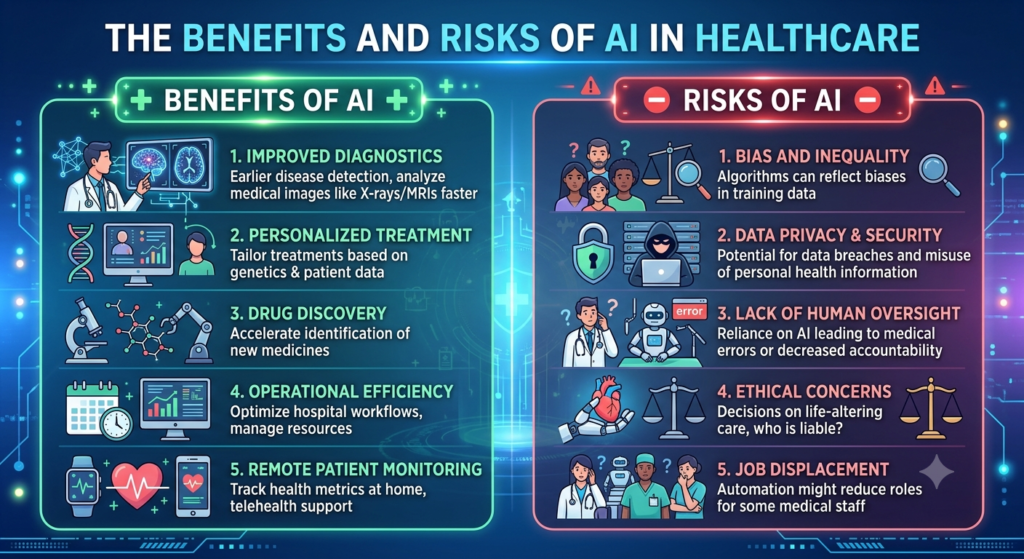
Benefits And Risks of AI in healthcare
The benefits and risks of AI in healthcare show why this technology needs both innovation and careful oversight. AI can help doctors analyze medical information, support treatment planning, improve hospital efficiency, and expand access to some health services. It may also help researchers explore new ways to prevent and treat diseases.
At the same time, AI healthcare risks include privacy breaches, biased results, inaccurate predictions, high costs, and excessive dependence on technology. These problems can affect patient safety if organizations fail to manage them properly.
The best approach is to use AI as a support system rather than a replacement for healthcare professionals. Doctors, nurses, researchers, and hospital managers should understand what their AI tools can do, where they may fail, and when human judgment is necessary.
As healthcare technology advances, responsible implementation will be just as important as technical progress. By protecting patient data, testing systems carefully, and keeping people at the center of medical decisions, healthcare organizations can work toward safer, more effective, and more accessible care.
Know More:
”FAQs”
1. What are the benefits of AI in healthcare?
The main benefits include faster analysis of medical information, support for diagnosis, personalized treatment planning, patient monitoring, and reduced administrative work. AI can also help researchers study diseases and explore new treatments. These benefits depend on the system's reliability and proper clinical oversight.
2. What are the risks of AI in healthcare?
The major risks include data privacy breaches, biased results, incorrect predictions, cybersecurity threats, and overreliance on technology. AI may also produce misleading information or perform poorly on patients who aren't well represented in its training data. Testing, human oversight, and clear safety rules can help reduce these risks.
3. How is AI used in healthcare?
AI is used in medical imaging, laboratory analysis, clinical decision support, patient monitoring, medical research, and hospital administration. Some tools analyze scans, while others help organize records or identify possible health risks. Each application requires appropriate testing and review.
4. Can AI improve patient outcomes?
Yes, AI may improve patient outcomes when it helps healthcare professionals identify important patterns, make informed decisions, or provide timely care. However, better outcomes aren't guaranteed. They depend on the quality of the system, how it is used, and whether its benefits have been demonstrated in clinical practice.
5. What are the disadvantages of AI in medicine?
The disadvantages include implementation costs, possible errors, privacy concerns, biased predictions, and reduced human interaction. Healthcare professionals may also need training to use these tools safely. AI systems can support medical decisions, but they cannot replace all forms of clinical judgment and personal care.
6. How does AI help doctors and hospitals?
AI can help doctors review medical images, organize patient information, identify potential risks, and compare treatment options. Hospitals may use it to support scheduling, estimate demand, and automate routine administrative tasks. Doctors and hospital teams remain responsible for checking relevant information and making appropriate decisions.
7. Can AI replace healthcare professionals?
No. AI can automate some tasks and assist with specific clinical activities, but healthcare professionals provide physical examinations, clinical judgment, empathy, communication, and accountability. The most useful approach is to combine AI capabilities with human expertise.
8. What ethical concerns are related to AI in healthcare?
Key ethical concerns include patient privacy, informed consent, fairness, transparency, accountability, and the risk of discrimination. Healthcare organizations should explain how AI is used, protect patient information, monitor unequal outcomes, and maintain appropriate human oversight.
9. How accurate is AI in medical diagnosis?
AI accuracy varies by medical condition, task, dataset, and clinical setting. Some systems perform well on specific, carefully defined tasks, while others may make significant errors. Accuracy in a research study doesn't guarantee the same results in everyday practice. Clinical validation and professional review are essential.
10. What is the future of AI in healthcare?
The future may bring more personalized medicine, improved medical imaging, better remote monitoring, faster research, and more efficient healthcare services. Progress will depend on reliable technology, strong privacy protections, fair testing, and effective cooperation between AI systems and healthcare professionals.