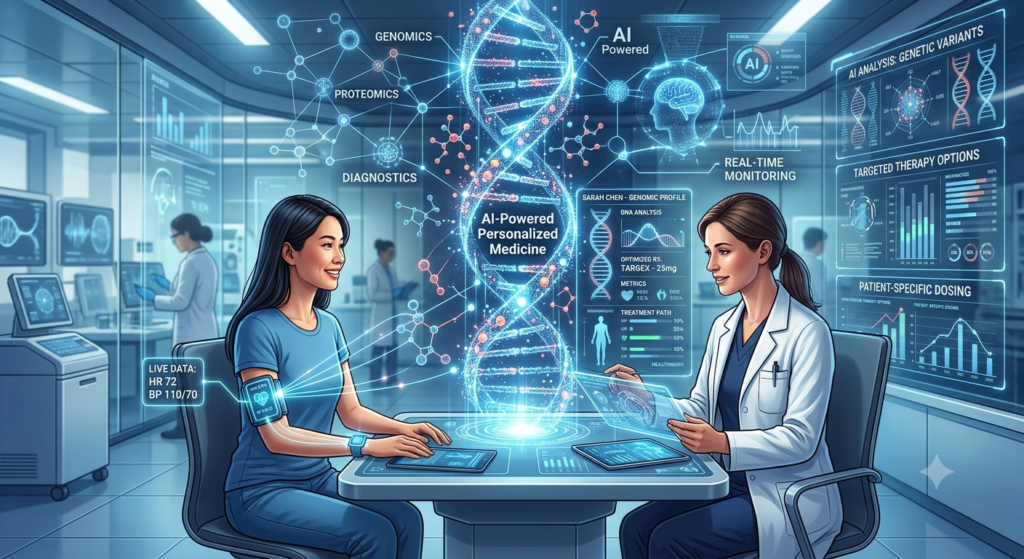
The Future of AI-Powered Personalized Medicine
Healthcare is changing fast. In the past, doctors often used similar treatments for people with the same disease. However, every person is different. Age, genes, lifestyle, medical history, and environment can all affect health. A treatment that works well for one patient may not work as well for another.
This is where AI-Powered Personalized Medicine comes in. It combines artificial intelligence (AI), medical knowledge, genetic information, and patient data to help doctors make better decisions. Instead of treating every patient in the same way, healthcare teams can use these insights to select care that better fits each person’s needs.
Artificial intelligence can study large amounts of information in less time than traditional manual methods. It can help identify patterns, estimate health risks, support diagnosis, and suggest treatment options for a doctor to review. When combined with reliable medical evidence, these tools may help make healthcare more accurate and timely.
For example, AI may help a cancer specialist understand a tumor’s genetic features. It may also help a doctor identify a patient who needs closer monitoring for heart disease. In both cases, the goal is to make care more personal and useful.
Still, AI isn’t a replacement for doctors. Its value depends on good data, careful testing, patient privacy, and human judgment.
In this guide, we’ll explore how personalized medicine works, its major benefits, practical applications, current challenges, and the future of AI-powered healthcare.
What Is AI-Powered Personalized Medicine?
AI-powered personalized medicine is an approach to healthcare that uses artificial intelligence to help tailor prevention, diagnosis, and treatment to an individual patient.
It brings together different types of health information, such as:
- Genetic test results
- Medical records
- Blood test results
- Medical images
- Age and family health history
- Lifestyle and environmental factors
- Responses to earlier treatments
AI systems can analyze these details to find patterns that may be difficult to spot through manual review alone. Doctors can then use the findings alongside medical guidelines, examination results, and patient preferences.
How AI and Personalized Medicine Work Together
Traditional healthcare often begins with a diagnosis and a standard treatment guideline. Personalized care adds another layer by asking which treatment is most suitable for this particular patient.
For example, two people may have the same type of cancer but different genetic changes in their tumors. Those differences may affect which medicines are likely to work.
AI can help researchers and clinicians compare tumor data with scientific studies and known treatment responses. A doctor can then assess whether a targeted medicine or another treatment option is appropriate.
Personalized Medicine AI can also help doctors understand why a patient may experience side effects or respond differently to a medicine. However, AI predictions don’t guarantee a particular result. They support clinical judgment rather than replace it.
Key Technologies Behind Personalized Care
Several technologies support AI in personalized healthcare.
|
Technology |
How it helps |
|
Machine learning |
Finds patterns in patient data and estimates possible outcomes |
|
Deep learning |
Analyzes complex information, including medical images |
|
Genomic analysis |
Helps identify genetic changes linked to disease or treatment response |
|
Natural language processing |
Extracts useful information from medical notes and research |
|
Predictive analytics |
Estimates health risks and identifies patients who may need attention |
|
Wearable devices |
Collect information such as heart rate and activity for monitoring |
These tools can work together to support precision medicine technology. Yet, the quality of their results depends on the quality of the data and how well the systems have been tested.
How AI Is Transforming Personalized Healthcare
Artificial intelligence is helping healthcare move toward more individualized decisions. It can connect information from different sources and reveal patterns that might otherwise remain hidden.
1. Genomics and AI
Genomics studies a person’s complete set of genes. Genetic differences can influence the risk of certain diseases and the way the body responds to medicines.
Genomics and AI can work together to analyze large genetic datasets. AI tools may help researchers identify meaningful patterns, compare genetic variations, and study links between genes and disease.
In cancer care, genomic testing may reveal changes in a tumor that are relevant to treatment selection. In other areas, genetic information can help clinicians assess inherited risks or understand how a patient may process certain medicines.
AI in genomic medicine can make complex data easier to study. However, a genetic finding doesn’t always mean that a person will develop a disease. Doctors must consider family history, other health factors, and the limits of available evidence.
2. Early Diagnosis and Risk Prediction
Early detection can make a major difference in many health conditions. AI can examine medical images, laboratory results, and health records to identify patterns that deserve further review.
For example, a validated AI tool may help a radiologist detect suspicious changes in an image. A predictive model may also help a healthcare team identify patients who could benefit from closer monitoring.
Predictive Healthcare Analytics can support earlier action by combining several risk factors. This may help clinicians prioritize follow-up tests or preventive care.
However, a high-risk score isn’t a diagnosis. AI systems can produce false alarms or miss important signs. Medical professionals must confirm findings and decide what action is needed.
3. How AI Creates Personalized Treatment Plans
AI can help doctors compare patient information with clinical guidelines, research findings, and known treatment responses.
A simplified process looks like this:
- Collect information: The care team gathers relevant medical records, test results, and patient history.
- Analyze the data: AI looks for patterns related to the patient’s condition.
- Identify possible options: The system highlights treatment approaches that may be worth considering.
- Review medical evidence: A qualified clinician checks whether the options are suitable and supported by reliable evidence.
- Make a shared decision: The doctor and patient discuss benefits, risks, costs, and personal preferences.
- Monitor the response: The care team checks whether the treatment is working and adjusts it when medically appropriate.
This approach can support AI-assisted treatment planning and patient-specific care. The aim isn’t to let a computer choose treatment on its own. It’s to give healthcare professionals better information when making complex decisions.
4. Continuous Monitoring and Personalized Patient Care
Personalized healthcare doesn’t end when a patient leaves the hospital. Wearable devices, home monitoring tools, and digital health platforms can collect useful information between appointments.
For example, a connected device may track heart rate or activity levels. When a suitable monitoring system identifies an unusual pattern, it may alert the patient or care team to review the situation.
AI-powered patient care can also help organize follow-up reminders and identify changes that need attention. Still, devices can make mistakes, and not every unusual reading signals a medical problem.
The best systems combine useful alerts with clear instructions about when to contact a healthcare professional.
Benefits of AI in Precision Medicine
AI in precision medicine offers several possible benefits when systems are accurate, properly tested, and used with appropriate medical oversight.
1. More Informed Diagnosis
AI can help clinicians review complex information and identify patterns that may need further investigation.
For example, an AI system may assist with medical image analysis or highlight a combination of findings in a patient’s records. This can support clinical decision-making, although final diagnoses require appropriate medical assessment.
2. More Suitable Treatment Options
Different patients may respond differently to the same medicine. Genetic factors, existing conditions, other medications, and lifestyle can all affect treatment decisions.
AI may help doctors compare these factors when reviewing possible therapies. This supports personalized treatment strategies instead of relying on a one-size-fits-all approach.
The final choice must still account for clinical evidence, side effects, patient needs, and treatment availability.
3. Better Disease Prevention
AI can help estimate health risks by analyzing factors such as family history, laboratory results, and lifestyle information.
For instance, a validated risk model may help a doctor identify someone who could benefit from earlier screening or lifestyle support.
This is one way predictive medicine may support preventive care. However, risk estimates must be interpreted carefully, and screening recommendations should follow established medical guidance.
4. More Efficient Healthcare Services
Healthcare teams often handle large amounts of paperwork, medical records, and test information. AI can help organize information, summarize records, and automate certain routine tasks.
This may allow staff to spend more time on patient care. It can also help researchers screen scientific literature and organize data for medical studies.
Even so, automated systems need quality checks. An incorrect summary or missed detail can affect a clinical decision if nobody reviews it.
5. Greater Patient Involvement
Personalized care works best when patients understand their options. AI-supported platforms may help explain medical information, organize health records, and prepare questions for appointments.
These tools can make healthcare information easier to access. However, AI-generated explanations should be checked against trusted medical sources, especially when a decision involves serious symptoms or major treatment choices.
Real-World Applications of AI in Precision Healthcare
AI-powered personalized medicine is already being explored and used in several areas of healthcare. Its role varies by application, and not every tool has the same level of clinical evidence.
1. Cancer Care and Genomic Testing
Cancer is not one single disease. Tumors can differ in their genetic changes, growth patterns, and response to treatment.
AI may help researchers study tumor images, genomic data, and treatment outcomes. These insights can support research into which patients may benefit from particular therapies.
For example, genomic testing may identify a tumor feature linked to an approved targeted treatment. AI tools may help clinicians interpret large datasets, but the treating specialist must confirm whether the finding is clinically relevant.
This is an important use of precision medicine AI because treatment decisions can depend on details that are not visible from the cancer type alone.
2. Heart Health and Chronic Disease
AI is also being studied in cardiovascular care, diabetes management, and other long-term conditions.
Some validated tools can help analyze heart rhythm data or medical images. Other systems can combine clinical information to estimate the risk of complications.
For patients with chronic diseases, digital monitoring may help healthcare teams follow changes over time. This can support timely reviews and more individualized care plans.
However, AI recommendations must fit established medical practice. A patient should never change medication or ignore symptoms simply because an automated system suggests that everything is normal.
3. Medicine Discovery and Rare Diseases
Developing a new medicine can take years of research and testing. AI can help researchers study biological targets, examine chemical compounds, and identify possible links between diseases and treatments.
In rare disease research, AI may help compare a patient’s symptoms and genetic findings with known disease patterns. This can sometimes help researchers identify a condition that deserves further investigation.
AI can also support the study of how different patients respond to medicines. Still, a promising prediction isn’t proof that a drug is safe or effective. Clinical studies and regulatory review remain essential.
4. Pharmacogenomics and Medication Selection
Pharmacogenomics examines how genetic differences may affect a person’s response to medicines.
Some genetic variants can influence how the body processes particular drugs. When evidence and clinical guidelines support testing, doctors may use these results to guide medicine choice or dosing.
AI can help organize genetic results, medication records, and relevant clinical guidance. This can support more informed decisions, but the system must use reliable sources and current recommendations.
5. Mental Health and Digital Support
AI tools are being explored for mental health screening, symptom tracking, and digital support. Some platforms may help people record mood changes or prepare for a conversation with a clinician.
These tools should not be treated as a substitute for a qualified mental health professional. They may also misunderstand language, miss important context, or produce misleading results.
Responsible AI healthcare solutions should protect sensitive information and provide clear routes to human support when needed.
Challenges and Ethical Concerns in AI-Powered Personalized Medicine
AI can offer valuable support, but its use in healthcare raises important questions. For personalized medicine to succeed, it must be safe, fair, transparent, and accessible.
1. Patient Privacy and Data Security
Personalized healthcare often relies on sensitive information, including genetic records, medical history, and test results.
If this information is exposed or used without proper permission, patients may face serious privacy risks. Healthcare providers must use secure systems, limit access to authorized people, and follow applicable data protection laws.
Patients should also understand how their information will be collected, stored, and used. Strong privacy practices help build trust in healthcare technology.
2. Bias and Unequal Access
AI systems learn from the data used to develop them. If that data does not represent different ages, genders, ethnic backgrounds, or patient groups, the system may work less well for some people.
For example, a model trained mainly on data from one population may produce less reliable results for another population.
Developers and healthcare organizations should test AI tools across diverse groups and monitor their performance over time. This is especially important when AI influences diagnosis, screening, or treatment decisions.
Access is another concern. Advanced genomic testing and AI-supported care may be expensive or unavailable in rural and low-resource areas. Fair implementation should help more patients benefit from innovation, not widen existing gaps.
3. Data Quality and Accuracy
AI cannot reliably solve every problem in the data it receives. Missing records, incorrect entries, poor-quality images, and outdated medical information can affect its results.
Healthcare teams should validate data, check AI recommendations, and make sure that systems are suitable for their intended use.
An AI prediction should never be treated as certain simply because it is presented with a numerical score.
4. Human Oversight and Medical Responsibility
AI can support medical decisions, but doctors remain essential. They understand the patient’s symptoms, personal concerns, medical history, and circumstances in ways that an automated system may not fully capture.
Clinical Decision Support Systems should help healthcare professionals make informed choices without removing their responsibility to assess the patient.
Patients should be able to ask questions and understand why a particular treatment is being recommended. Clear explanations and human oversight are central to responsible AI in personalized healthcare.
5. Regulation and Clinical Evidence
Not every AI product is designed or approved for clinical use. Some tools are intended for research, while others may be developed for specific medical tasks.
Healthcare organizations must check whether a system has been properly evaluated for its intended purpose. They should also monitor its performance after deployment, because data and clinical practices can change over time.
For reliable background information, readers can explore the National Human Genome Research Institute’s information on precision medicine.
10 Powerful Future Trends in AI-Powered Personalized Medicine
The future of AI-powered healthcare will depend on scientific progress, responsible design, and wider access to reliable medical services. The following trends show where the field may develop.
1. More Advanced Genomic Medicine
AI may help researchers interpret complex genetic information and discover links between genetic variations and disease.
As scientific knowledge improves, genomic healthcare solutions may help clinicians identify more treatment options for certain conditions. However, the usefulness of a genetic result will continue to depend on the available evidence.
2. Earlier and More Individualized Prevention
Predictive models may become better at combining medical history, laboratory results, and other relevant information.
This could help healthcare teams identify people who need earlier screening or closer follow-up. The goal is to prevent avoidable illness where possible, rather than wait until a condition becomes severe.
3. Digital Twins for Medical Research
A digital twin is a computer-based model that represents aspects of a real-world system. In healthcare, researchers are exploring models that simulate certain biological processes or aspects of a patient’s condition.
In the future, these models might help researchers study how different treatment options could affect specific patient groups. However, fully reliable digital replicas of individual human bodies remain a developing research goal, not a routine clinical reality.
4. Better AI-Assisted Drug Development
AI may help researchers identify promising drug candidates and study how medicines interact with biological targets.
This could make some stages of drug discovery more efficient. Yet laboratory experiments, clinical trials, safety reviews, and regulatory approval will remain necessary.
5. More Connected Healthcare Platforms
Healthcare systems often store patient information in separate locations. Better integration may allow authorized professionals to access relevant records more easily.
AI Healthcare Platforms could help organize medical histories, test results, and follow-up information. Secure data sharing and compatible systems will be essential to make this work safely.
6. Personalized Wearable Monitoring
Wearable devices may increasingly support long-term monitoring for selected health conditions.
AI could help identify meaningful changes in a person’s usual patterns and alert the care team when further assessment may be needed. Better validation and fewer unnecessary alerts will be important for patient trust.
7. Improved Clinical Decision Support
AI tools may become better at connecting patient information with current clinical guidelines and scientific research.
These systems could help doctors compare treatment options, identify possible medication risks, and summarize relevant evidence. Their recommendations must remain transparent, current, and open to professional review.
8. Personalized Care in More Medical Fields
Personalized medicine may expand beyond cancer and genetic disorders into areas such as cardiovascular health, rare diseases, and selected chronic conditions.
Progress will vary by specialty. Each application will require evidence that the technology improves decisions or patient outcomes.
9. Greater Focus on Responsible AI
Healthcare organizations are likely to place more emphasis on privacy, fairness, explainability, and independent evaluation.
These safeguards can help clinicians understand when an AI system is useful and when its results need extra scrutiny. Responsible development will be just as important as technical performance.
10. Wider Access to Precision Healthcare
Digital health services may help connect patients with specialists and provide more consistent follow-up.
If costs fall and infrastructure improves, some forms of personalized healthcare could become more accessible outside major hospitals. However, equitable access will require investment in staff training, connectivity, testing, and public health services.
How Students Can Learn About AI-Powered Personalized Medicine
AI-powered personalized medicine offers opportunities for students interested in healthcare, biology, computer science, and data analysis. Students don’t need to master every subject at once. They can start with basic concepts and gradually build their knowledge.
A Beginner’s Learning Roadmap
|
Learning stage |
What to study |
Practical activity |
|
1. Healthcare basics |
Human biology and common diseases |
Learn how diseases affect the body |
|
2. Genetics |
DNA, genes, and genetic variation |
Explore basic genomic concepts |
|
3. Data analysis |
Statistics and spreadsheets |
Analyze a simple sample dataset |
|
4. Machine learning |
Classification and prediction |
Build a beginner project using public data |
|
5. Medical AI |
Medical images and clinical decision support |
Study published AI case studies |
|
6. Ethics and privacy |
Bias, consent, and data protection |
Review an AI healthcare ethics example |
Useful Skills for the Future
Students interested in this field may benefit from learning:
- Basic biology and genetics
- Statistics and probability
- Python programming and data analysis
- Machine learning fundamentals
- Medical research methods
- Healthcare privacy and ethics
- Scientific communication
Students should practice with public, properly licensed datasets rather than real patient records without authorization. They should also learn to distinguish research findings from proven clinical applications.
An AI in precision medicine guide should cover both the technology and its limitations. Understanding the science behind a prediction is just as important as learning how to build the model.
The Next Chapter of Personalized Healthcare
The future of AI-Powered Personalized Medicine offers an important opportunity to make healthcare more individualized, informed, and proactive. By combining artificial intelligence, genomics, machine learning, and medical knowledge, healthcare professionals can gain new insights into disease risks and treatment choices.
From cancer research and genetic testing to chronic disease monitoring, AI is helping researchers explore new ways to understand individual differences. It may also help doctors analyze complex information and spend less time on certain routine tasks.
However, technology alone won’t guarantee better healthcare. Reliable data, strong privacy protections, clinical testing, fair access, and human oversight must remain central to every application.
For students, researchers, and healthcare professionals, learning about Personalized Medicine AI offers a way to understand how medicine and technology are evolving together. For patients, it highlights the value of care that considers their individual circumstances rather than relying only on general treatment approaches.
Ultimately, the goal isn’t to replace the human side of medicine with algorithms. It’s to combine scientific evidence and intelligent tools with the judgment, empathy, and experience of healthcare professionals.
Know More:
”FAQs”
1. What is AI-powered personalized medicine?
AI-powered personalized medicine uses artificial intelligence to help tailor healthcare to an individual's medical history, genetic information, lifestyle, and health risks. It supports diagnosis, prevention, and treatment decisions based on patient-specific information.
2. How does AI help personalized healthcare?
AI analyzes medical records, genetic data, laboratory results, and other health information to identify useful patterns. Doctors can use these insights to assess risks, investigate possible diagnoses, and compare suitable treatment options.
3. What are the benefits of AI in precision medicine?
The main potential benefits include more informed diagnosis, better use of genetic information, earlier risk detection, support for treatment selection, and more efficient analysis of medical data. These benefits depend on the accuracy of the tools and the quality of clinical evidence.
4. How does AI create personalized treatment plans?
AI analyzes relevant patient information and may identify treatment options supported by available data. Doctors then review the findings, consider clinical guidelines and patient preferences, and decide which treatment is appropriate. The plan can be reviewed as the patient's condition changes.
5. Can AI improve patient outcomes?
AI may improve patient outcomes when it helps clinicians make more accurate or timely decisions. However, benefits vary by application. A system must be properly tested to show that it improves care rather than simply producing accurate-looking predictions.
6. How is AI used in genomic medicine?
AI helps researchers analyze genetic data, identify patterns, and study links between genetic changes and disease. In selected cases, these findings may help clinicians understand inherited risks or choose treatments based on a tumor's genetic features.
7. What is the future of personalized medicine?
The future may include more advanced genomic analysis, improved risk prediction, connected health monitoring, and better clinical decision support. Wider adoption will depend on safety, affordability, scientific evidence, and responsible data use.
8. How does machine learning support precision healthcare?
Machine learning identifies patterns in data and uses them to make predictions or classifications. In precision healthcare, it can help analyze medical images, estimate disease risks, and study treatment responses. Its results need clinical validation and human oversight.
9. What are the challenges of AI-powered personalized medicine?
Key challenges include patient privacy, biased datasets, inaccurate predictions, high costs, limited access, and a lack of clinical evidence for some applications. Healthcare providers must address these issues before relying on AI for important medical decisions.
10. Can AI make healthcare more personalized?
Yes, AI can help healthcare professionals consider more patient-specific information when assessing care options. However, genuinely personalized care also requires medical expertise, communication, patient consent, and an understanding of each person's needs and preferences.