How AI Is Helping Discover New Best Medicines in 2026 – A New Era of Medicine Discovery
Finding a new medicine is a long and complex process. Scientists must study diseases, identify possible drug targets, test chemical compounds, and check whether a treatment is safe and effective. This work can take years, and many promising drug candidates never become approved medicines.
Today, AI in Drug Discovery is changing how researchers approach these challenges. Artificial intelligence can analyze large amounts of biological data, identify patterns, predict how molecules may behave, and help scientists select promising compounds for further testing.
The goal isn’t to replace scientists. Instead, AI gives researchers powerful tools to make better decisions, explore more possibilities, and spend less time on tasks that computers can handle.
For example, researchers can use machine learning to study the structure of a disease-related protein. They can then search for molecules that may interact with that protein. These predictions help scientists decide which candidates deserve laboratory testing.
This approach is creating new opportunities across biotechnology, pharmaceutical research, and healthcare innovation. It may also help researchers investigate rare diseases and develop treatments for patients who have limited options.
However, AI isn’t a magic solution. Computer predictions must still be checked through laboratory experiments, clinical trials, and regulatory review. A molecule that looks promising on a computer may fail when tested in living systems.
1. How AI Is Helping Discover New Best Medicines and What Is AI in Drug Discovery?
AI in drug discovery refers to the use of artificial intelligence to help researchers find, design, and evaluate potential medicines. It combines computer science, biology, chemistry, and pharmaceutical research to solve difficult scientific problems.
Traditional research often requires scientists to test many compounds before finding one worth developing. AI can help narrow the search by predicting which compounds are more likely to produce useful results.
How Does AI Drug Discovery Work?
AI systems learn from data. This data may include information about chemical structures, proteins, genes, diseases, and results from previous experiments. Researchers train models to recognize relationships within these datasets. Once trained, the models can analyze new information and make predictions.
For example, an AI model may estimate whether a chemical compound could bind to a target protein. It might also predict whether the compound could be toxic or difficult for the body to absorb. These predictions help researchers prioritize their work; they don’t prove that a compound will become a successful medicine.
Key Technologies Used in AI Medicine Discovery
- Machine learning: learns patterns from data and predicts the properties of drug candidates.
- Deep learning: uses multi-layer neural networks to analyze complex biological and chemical information.
- Natural language processing: extracts useful findings from scientific papers, patents, and medical reports.
- Generative AI: proposes new molecular structures that researchers can evaluate.
- Computer vision: analyzes laboratory images and cellular changes.
- Computational biology: uses computational methods to study genes, proteins, cells, and biological systems.
Why Is AI Important for Pharmaceutical Research?
The number of possible chemical compounds is enormous. Testing every possibility in a laboratory isn’t practical. AI helps scientists explore this large chemical space more efficiently. It can rank compounds, identify patterns, and suggest new directions for experiments.
2. How AI Is Helping Discover New Medicines
AI supports several stages of the drug discovery process. Its value comes from helping researchers analyze information, generate ideas, and make decisions more efficiently.
Identifying Disease Targets
The first step in many drug discovery projects is identifying a biological target linked to a disease. This target might be a protein, enzyme, receptor, or another part of a biological system. AI can analyze genetic data, protein information, laboratory results, and scientific publications to identify possible targets.
Researchers must still establish that the target is relevant to the disease and can be safely influenced by a medicine.
Finding Promising Drug Candidates
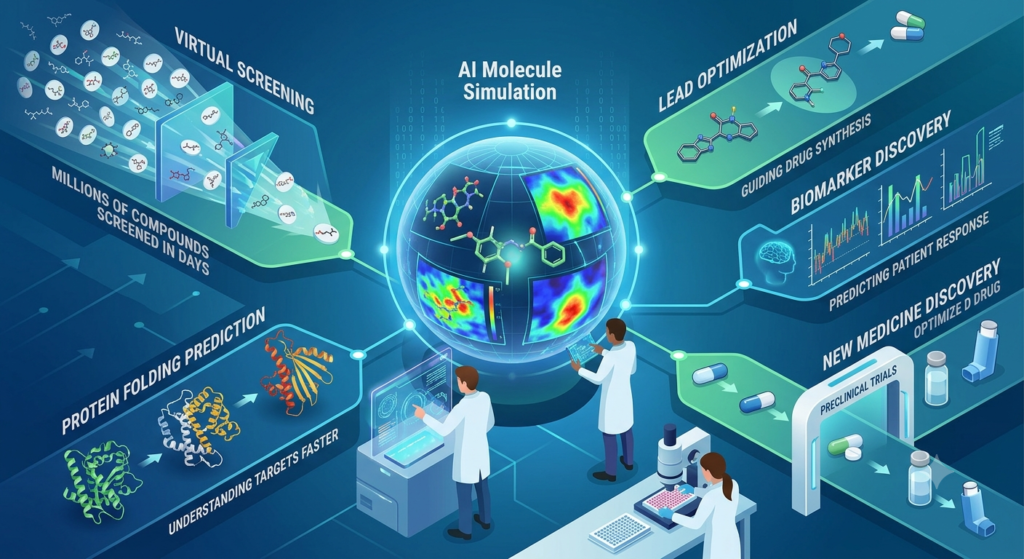
Once researchers select a target, they need to identify compounds that might affect it. AI drug screening helps compare large collections of molecules. Models can predict which compounds may bind to a target or show useful biological activity. This process can reduce the number of compounds that require physical testing.
Designing New Molecules
AI drug design goes beyond searching existing compounds. Generative models can propose new molecular structures based on desired properties. Scientists may ask a model to suggest molecules that could interact with a specific target while meeting certain chemical requirements. Researchers then evaluate these designs for stability, toxicity, solubility, and other important characteristics.
Predicting Drug Safety and Effectiveness
A potential medicine must do more than interact with a disease target. It must also reach the right part of the body, work at a useful dose, and avoid unacceptable side effects. Predictive drug discovery uses AI models to estimate properties such as toxicity, absorption, metabolism, and potential biological activity. These predictions can help researchers identify risks earlier, but they cannot replace laboratory safety studies or clinical evidence.
Supporting Drug Repurposing
Drug repurposing means finding new uses for medicines that already exist or have been studied previously. AI can compare information about drugs, diseases, genes, proteins, and clinical outcomes to identify possible new applications. A promising connection still needs to be tested, and a new use may require additional studies and regulatory approval.
3. How AI Is Helping Discover New Best Medicines and The AI-Powered Drug Discovery Process Explained
AI doesn’t follow one fixed workflow for every medicine. The process depends on the disease, available data, type of treatment, and research goals. A typical small-molecule project may include these steps:
- Collect and prepare data: gather biological, chemical, genetic, and experimental data, then check quality and consistency.
- Identify a drug target: investigate disease pathways and select biological targets for further study.
- Screen potential compounds: rank molecules by predicted interactions and other useful properties.
- Test and improve candidates: synthesize selected compounds, conduct laboratory tests, and refine designs.
- Evaluate safety and development potential: investigate toxicity, drug behavior, manufacturing needs, and other factors.
- Conduct clinical development: promising candidates may enter human trials after required preclinical studies and regulatory authorization.
From Computer Predictions to Laboratory Evidence
The most important part of this process is the feedback between AI and experiments. A model makes predictions. Scientists test those predictions. The results provide new information that can improve later predictions. This cycle allows teams to learn from unsuccessful candidates instead of relying entirely on computer-generated results.
For example, if a compound binds strongly to a target but shows poor solubility, researchers can adjust its structure and evaluate it again. This combination of computational drug discovery and laboratory science is central to reliable pharmaceutical innovation.
What Happens After Drug Discovery?
Discovering a promising molecule is only one stage of medicine development. Researchers must investigate how the compound behaves in the body, determine an appropriate dose, assess safety, and conduct clinical trials to evaluate its effects in people. Regulators review the evidence before a medicine can be marketed. Success at the discovery stage doesn’t guarantee success in clinical development.
4. Key Technologies Behind AI Drug Discovery
Machine Learning in Drug Discovery
Machine learning helps computers learn from previous experiments and scientific datasets. A model can study known molecules and learn which chemical features are linked to particular properties. It can then estimate how new molecules might behave.
- Predicting molecular activity
- Estimating toxicity risks
- Ranking potential drug candidates
- Identifying relationships between genes and diseases
- Supporting drug repurposing
The quality of predictions depends on the data used to train and test the model. Poor or incomplete data can lead to unreliable results.
Deep Learning for Drug Development
Deep learning uses neural networks with many layers to identify complex patterns in large datasets. It can analyze molecular structures, biological sequences, laboratory images, and other scientific information. These methods can help researchers study how a molecule’s structure affects its activity and analyze cellular images to identify biological responses.
Protein Structure Prediction
Proteins play essential roles in the human body. Some are involved in disease processes and can serve as targets for medicines. Understanding their three-dimensional structures can help researchers investigate how other molecules might interact with them. AI systems such as AlphaFold can predict protein structures and support research into molecular interactions. A predicted structure doesn’t automatically reveal whether a drug will work or be safe.
Generative AI and Molecular Modeling
Generative AI can create new molecular designs based on patterns learned from chemical data. Researchers can set goals such as improving predicted activity, reducing toxicity risks, or increasing solubility. Models can suggest structures, which scientists then evaluate for chemical feasibility, stability, manufacturability, and biological usefulness.
Automated Laboratories and Computational Biology
Robotic systems can prepare samples, run experiments, and record results. AI models can analyze the findings and suggest the next experiments. This combination creates a continuous learning cycle, improves research efficiency, and generates more consistent data.
5. Benefits of AI in Pharmaceutical Research
Faster Drug Candidate Identification
AI can analyze large datasets quickly. Instead of manually reviewing thousands of compounds, researchers can rank candidates according to predicted properties. This helps scientists focus on promising options. However, time saved during early discovery doesn’t necessarily reduce clinical trial timelines by the same amount.
Potential Cost Savings
Drug development requires expensive equipment, specialized staff, and extensive testing. AI may reduce wasted effort by identifying weak candidates earlier and prioritizing experiments that are more likely to produce useful information. Actual savings vary by project, and building reliable AI systems also requires investment.
Better Research Decisions
AI can combine biological, genetic, chemical, and experimental information in one workflow. This broader view may reveal relationships that would otherwise remain unnoticed. Scientists can use these findings to form hypotheses and design more targeted experiments.
New Opportunities for Rare Diseases
Rare diseases often affect small patient populations, leaving researchers with limited clinical data and fewer commercial incentives. AI can help identify disease-related genes, study biological pathways, and search for existing medicines that may have new uses. These applications create research opportunities, but treatments still require reliable evidence.
Supporting Precision Medicine
Precision medicine aims to select treatments based on relevant differences between patients, such as genetic variations or disease characteristics. AI can analyze complex patient data to identify patterns that may explain differences in treatment response. These predictions must be validated before they can reliably guide treatment.
AI Drug Discovery vs. Traditional Drug Discovery
| Factor | Traditional Approach | AI-Supported Approach |
| Data analysis | Established methods and manual review | Can analyze large, diverse datasets |
| Compound screening | May require extensive physical testing | Can prioritize candidates through virtual screening |
| Molecular design | Established chemistry methods and expert judgment | Adds AI-generated molecular suggestions |
| Experiment planning | Guided by hypotheses and prior results | Predictive models can help prioritize experiments |
| Validation | Requires experimental and clinical evidence | Requires the same scientific validation |
AI doesn’t make traditional research obsolete. The strongest approach combines computational predictions with laboratory expertise, experimental evidence, and clinical testing.
6. Real-World Examples of AI in Drug Discovery
Insilico Medicine
Insilico Medicine uses generative AI and computational methods to identify disease targets and design drug candidates. Its work on an investigational treatment for idiopathic pulmonary fibrosis has demonstrated how AI-supported discovery can progress into human clinical development. Reaching a clinical phase is evidence of progress, not proof that AI alone guarantees a successful medicine. Website: https://insilico.com/
DeepMind AlphaFold
AlphaFold has transformed access to predicted protein structures. Researchers use these predictions to study biological processes and investigate potential drug targets. AlphaFold 3 extends this work by predicting interactions involving proteins and other biological molecules. These capabilities support research, but experiments are needed to confirm drug activity. Website: https://deepmind.google/science/alphafold/
Recursion Pharmaceuticals
Recursion combines machine learning, biological data, and automated laboratory experiments to investigate disease biology and discover potential medicines. Its platform connects computational analysis with physical experiments, allowing findings to inform later predictions. Website: https://www.recursion.com/
BenevolentAI
BenevolentAI has applied AI to biomedical information and drug research. Knowledge-based approaches can help scientists connect findings from scientific literature, biological databases, and existing research to generate new hypotheses. These methods illustrate how AI-assisted research can support target identification and the search for potential drug candidates. Website: https://www.benevolent.com/
What Do These Examples Tell Us?
These organizations use different approaches, but they share a common goal: making better use of scientific data. Some focus on protein structures, while others combine cellular images, chemical modeling, and biological knowledge. Discovering a candidate, entering clinical trials, and receiving regulatory approval are separate achievements. The most meaningful measure of progress is whether research produces safe and effective treatments.
7. Applications of AI Across Healthcare and Biotechnology
AI for Rare Disease Treatment
Researchers can use AI to investigate genetic changes and identify biological pathways linked to rare conditions. Machine learning may also help compare a rare disease with better-studied conditions, revealing possible shared mechanisms and suggesting existing compounds for research. Each proposed treatment needs evidence of safety and effectiveness.
AI in Cancer Research
Different cancers, and even tumors within one patient, can have different biological features. AI can analyze tumor samples, genetic changes, protein activity, and treatment responses. These insights may support new drug targets and help researchers understand why cancer cells become resistant to existing medicines.
AI in Clinical Trials
Clinical trials are essential for evaluating potential medicines in people. AI can help identify suitable participants using appropriate data, analyze medical records for recruitment planning, predict recruitment difficulties, monitor study data for unusual patterns, and explore differences in treatment response. Privacy protections and human oversight remain essential.
AI and Drug Repurposing in Healthcare
AI can search scientific publications and biological databases for connections between drugs, diseases, and molecular pathways. Researchers can test whether a suggested connection has practical value. Repurposing may reduce some early research requirements, but it doesn’t eliminate the need to prove that the medicine works for the new condition.
Precision Medicine Development
AI can help researchers study how genetic differences and patient characteristics relate to treatment outcomes. These findings may support targeted therapies and help identify patient groups that are more likely to benefit. Reliable clinical data, careful validation, and fair access to healthcare remain important.
8. Challenges of Using AI in Drug Development
Poor or Incomplete Data
AI models depend on their training information. Errors, missing details, or limited examples of certain conditions can lead to unreliable predictions. Data from different laboratories may also use different measurement methods. Researchers can address these issues by improving standards, documenting experiments, checking model performance, and testing against independent datasets.
Predictive Errors and Scientific Uncertainty
A molecule may look promising in a simulation but fail in laboratory testing. Biological systems are complex, and drugs may interact with other molecules or behave differently in the human body than a model predicts. AI outputs should be treated as hypotheses, not established facts.
High Development and Computing Costs
AI can reduce some research expenses, but advanced systems require investment in computing infrastructure, software, data, and skilled staff. Smaller biotechnology companies may find these costs difficult. Cloud platforms, research partnerships, and open resources can reduce some barriers.
Privacy and Data Security
Pharmaceutical AI may use genetic information, medical records, and other sensitive biological data. Organizations must collect and use data appropriately, protect access, and follow applicable privacy laws. Responsible data management helps maintain public trust.
Ethical and Regulatory Concerns
Models can produce biased results if training data doesn’t represent the populations affected by a disease. Teams must document decisions, validate performance, and create procedures for identifying errors. Human oversight is essential for important scientific and medical decisions.
Can AI Guarantee a Successful Medicine?
No. AI can improve parts of drug discovery, but it can’t guarantee success. A medicine must demonstrate acceptable safety and meaningful benefits in appropriate studies and meet regulatory requirements. The strongest results come from combining AI with experimentation, experienced scientists, and robust clinical research.
9. How Pharmaceutical Companies Use AI for Research
Pharmaceutical companies use AI in different ways depending on their goals, data resources, and technical capabilities. Some develop internal platforms; others work with biotechnology companies, software providers, universities, and specialist research organizations.
| Research Activity | How AI Helps | Potential Benefit |
| Target identification | Studies biological data and disease pathways | Helps prioritize targets |
| Virtual screening | Ranks compounds by predicted properties | Reduces candidates for initial testing |
| Molecular design | Suggests new chemical structures | Expands options for researchers |
| Safety prediction | Estimates possible toxicity risks | Flags concerns earlier |
| Drug repurposing | Searches for drug-disease connections | Identifies new research opportunities |
| Clinical trial planning | Analyzes data relevant to recruitment and study design | Supports trial planning |
| Research automation | Connects AI models with laboratory systems | Reduces repetitive work |
AI Drug Discovery Tools and Platforms
Tools range from molecular modeling software to integrated research platforms. AlphaFold supports protein structure research. Insilico Medicine’s Pharma.AI supports AI-assisted target discovery and molecular design. Recursion OS combines biological data, machine learning, and laboratory experimentation. Computational chemistry platforms help scientists study molecular properties and simulate interactions.
The right platform depends on the research problem. Companies should evaluate data quality, scientific performance, integration needs, privacy, and cost before selecting a system.
Why Human Expertise Still Matters
AI tools work best when scientists understand the biological question and can judge whether a prediction makes sense. Chemists assess molecular feasibility, biologists investigate disease mechanisms, pharmacologists study how drugs behave in the body, and clinicians evaluate patient needs. AI adds analytical power but doesn’t remove the need for expertise.
10. The Future of AI in Medicine Discovery
More Accurate Molecular Design
Future systems may become better at proposing molecules with several desirable properties at once. Models may consider predicted activity, toxicity risks, solubility, stability, and manufacturing feasibility. Scientists will still need to verify predictions through experiments.
Virtual Biology and Digital Models
Researchers are exploring AI systems that model biological processes and predict how cells may respond to different interventions. These systems could help compare hypotheses before expensive experiments. Living organisms remain complex, so virtual models need extensive validation.
Better Integration of AI and Robotics
Automated laboratories can run experiments, collect data, and feed results back into AI systems. Each round can inform the next. As these systems improve, researchers may evaluate more ideas while maintaining consistent experimental procedures.
More Personalized Treatments
AI may help scientists connect molecular findings with information about patient populations. This could support precision medicine and research into specific disease subtypes. Personalized medicine also requires reliable clinical data, validation, and fair access.
Greater Collaboration Across the Industry
Drug development requires expertise from multiple organizations. AI platforms can help teams organize complex datasets and collaborate on scientific problems. Partnerships among pharmaceutical companies, technology providers, hospitals, universities, and biotechnology firms may become increasingly important.
What Will Determine Success?
- Reliable and representative data.
- Reproducible scientific results.
- Strong laboratory and clinical validation.
- Transparent evaluation of model performance.
- Appropriate privacy and safety protections.
- Cooperation between AI specialists and medical researchers.
The ultimate goal isn’t simply to create more drug candidates. It’s to develop treatments that improve people’s lives.
AI Is Shaping the Future of Medicine
AI in Drug Discovery is creating new opportunities for scientists to understand diseases, identify promising molecules, and improve the way medicines are developed. Machine learning, protein structure prediction, generative AI, and automated laboratories can help researchers explore more possibilities and make better use of scientific data.
Work by organizations such as Insilico Medicine, Recursion Pharmaceuticals, and Google DeepMind shows how AI can support different parts of pharmaceutical research. However, progress must be measured by scientific evidence and patient outcomes, not just the number of AI-generated candidates.
Challenges remain. Data quality, predictive errors, privacy, research costs, and regulatory requirements all need careful attention. AI cannot replace laboratory experiments, clinical trials, or expert medical judgment.
The combination of artificial intelligence, biotechnology, and human expertise could help researchers investigate difficult diseases and develop more targeted treatments. The real promise of AI isn’t simply finding medicines faster. It’s helping researchers discover safer, more effective treatments that meet real patient needs.
Editorial note: This article is educational and does not provide medical advice. Drug discovery claims and company programs can change; verify current details against primary scientific publications and company disclosures before publication.
Know More:
”FAQs”
What is AI in drug discovery?
AI in drug discovery is the use of artificial intelligence to help identify disease targets, screen compounds, design molecules, and predict drug properties. It helps researchers analyze data and prioritize promising candidates.
How does AI help discover new medicines?
AI analyzes biological and chemical data to identify patterns. It can help scientists find targets, screen compounds, design molecules, and identify potential safety concerns. Laboratory studies and clinical trials are still required.
Can AI create new drugs?
AI can generate molecular designs and help identify potential drug candidates. However, a promising molecule is not the same as an approved medicine. Researchers must test safety, effectiveness, and suitability for human use.
How is AI used in pharmaceutical research?
Researchers use AI for target identification, virtual screening, molecular design, toxicity prediction, drug repurposing, data analysis, and clinical trial planning.
What are the benefits of AI in drug development?
AI can help analyze large datasets, prioritize compounds, identify possible risks earlier, automate repetitive tasks, and explore new designs. Benefits vary by project.
How does machine learning improve drug discovery?
Machine learning identifies patterns in existing data and uses them to predict properties of new compounds. It can help rank molecules, estimate activity, and guide experimental testing.
Which companies use AI for drug discovery?
Examples include Insilico Medicine, Recursion Pharmaceuticals, and organizations working with AI-based protein research, including Google DeepMind. BenevolentAI has also applied AI to biomedical research.
What are the challenges of AI in pharmaceuticals?
Challenges include incomplete data, inaccurate predictions, high computing costs, privacy concerns, biased datasets, and regulatory requirements. Predictions must be validated through scientific experiments.
How does AI reduce drug development costs?
AI may reduce costs by helping prioritize promising compounds, avoid some unproductive experiments, and automate analysis. However, AI systems are costly to build, and clinical trials remain expensive.
What is the future of AI in medicine discovery?
AI may support more efficient molecular design, better disease modeling, automated laboratories, drug repurposing, and precision medicine. Its impact depends on reliable evidence and successful clinical development.