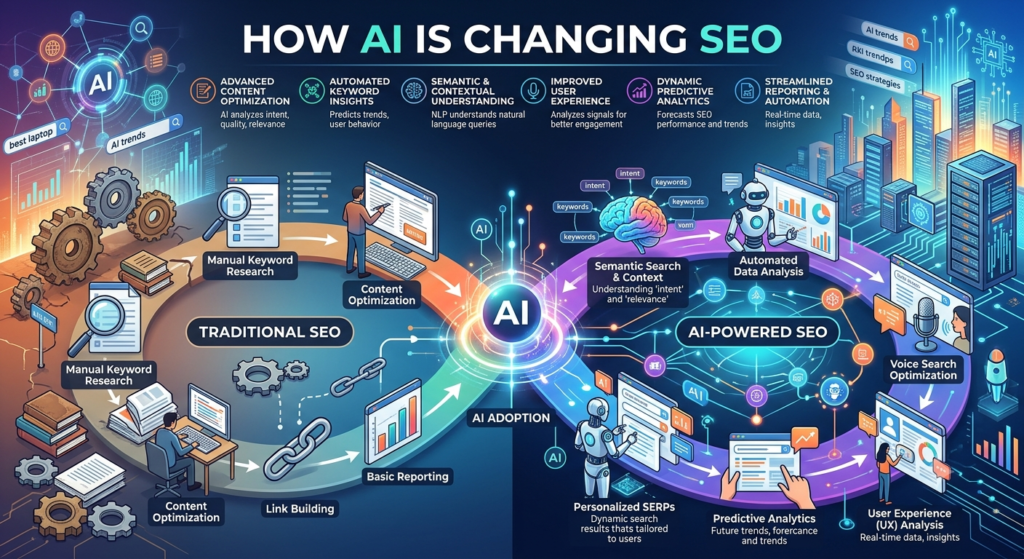
The New Era of AI SEO
Search is changing faster than ever. In the past, people entered a keyword into Google, scanned a list of websites, and clicked the page that looked most useful. Today, they can ask a question and receive an answer created by artificial intelligence.
This change is reshaping AI SEO, generative search, and search engine optimization. Search engines are becoming better at understanding questions, connecting related information, and presenting answers in natural language. For website owners, this creates both challenges and opportunities. Some searches may lead to fewer clicks because users receive answers directly on the search results page. However, useful websites can also gain visibility when AI systems reference their content or recommend their services.
The goal of SEO is no longer just to rank a webpage for a keyword. It is also to make that webpage useful, trustworthy, accessible, and relevant enough to be discovered in different search experiences. Consider a person searching for the best project management software for a small business. Traditional search might show product pages and comparison articles. A generative search tool may summarize several options, explain their differences, and cite sources.
Businesses that publish clear comparisons, real examples, product details, and helpful explanations have a better opportunity to contribute to that answer. So, how AI is changing SEO is not simply a story about new technology. It is about how people discover information and how websites demonstrate value.
In this guide, we’ll explore the impact of generative AI on SEO and explain practical ways to improve search visibility in 2026.
2. What Is Generative Search?
Generative search is a search experience that uses artificial intelligence to create answers from information gathered from one or more sources.
Instead of displaying only a list of webpages, a generative search system can summarize information, explain a complex topic, suggest next steps, and sometimes provide links to supporting sources.
For example, someone might ask, “How can a small business use AI to reduce costs?” A traditional search engine may display articles about automation, customer service, and business software. A generative search system may combine information about these subjects into one answer.
How Does Generative Search Work?
Although systems differ, the process often includes several steps:
- Understand the question: Natural language processing helps the system interpret the user’s words and intent.
- Find relevant information: The system may retrieve information from its search index, connected sources, or other available knowledge.
- Evaluate useful context: It identifies information that may answer the question.
- Generate a response: A language model organizes relevant information into a readable answer.
- Present supporting sources: Some systems provide citations or links so users can explore the original material.
Not every AI search product follows the same process. Some answers rely heavily on live web retrieval, while others may use different combinations of indexed information and model knowledge.
Examples of Generative Search Platforms
Examples of AI-assisted search experiences
Google AI Overviews : Google’s AI-generated summaries can appear in search results for eligible queries, alongside links to supporting webpages. Their presence depends on the query and search experience.
ChatGPT search : ChatGPT can search the web for relevant information and provide answers with source links when its search features are used.
Perplexity : Perplexity presents conversational answers with source references, helping users investigate a topic without opening every webpage individually.
Bing and Copilot : Microsoft’s search and AI experiences can combine web information with conversational responses, depending on the product and feature being used. These platforms create new ways for people to discover brands, products, services, and educational resources.
Why Generative Search Matters for SEO
Generative search changes how information is presented and consumed. A webpage may help a user even when the user doesn’t click through immediately. For example, an AI-generated answer might cite a company’s research article when explaining an industry trend. The user may later visit that company’s website, search for its brand, or consider its services.
This means search visibility can include more than a traditional ranking position. Businesses should continue investing in organic rankings while making their information easy to understand, verify, and reference.
3. How AI Is Changing SEO in 2026
AI is affecting several parts of search engine optimization, including keyword research, content planning, ranking systems, search experiences, and performance measurement.
However, AI hasn’t removed the need for good SEO. It has made the purpose of good SEO more important.
3.1 Search Intent Is More Important Than Exact Keywords
Traditional keyword optimization often focused on matching a specific phrase. Modern search systems can understand related terms, context, and the likely purpose behind a question.
Suppose someone searches for “affordable website development for startups.”
The user may want to understand pricing, compare agencies, explore development options, or find a provider.
A useful page should address these needs rather than repeat the phrase throughout the text.
To improve content relevance:
- Identify the main question behind each keyword.
- Explain important related concepts.
- Answer practical questions.
- Include relevant examples.
- Provide a clear next step when appropriate.
Keyword optimization still matters, but content should serve the searcher’s goal.
3.2 Search Results Are Becoming More Conversational
Users can now ask longer, more natural questions.
Instead of searching for “CRM software,” a user might ask, “Which CRM software is suitable for a small sales team with a limited budget?”
This creates opportunities for content that answers specific questions and compares different options.
Businesses can prepare by creating useful comparison pages, detailed service guides, tutorials, and FAQ sections.
3.3 Content Quality Matters More Than Content Volume
AI tools make it easier to produce large amounts of text. Unfortunately, publishing more pages doesn’t automatically improve search performance.
When many websites publish similar articles, content that provides original insights, reliable information, useful examples, and first-hand experience can offer greater value.
For example, a general article about website speed may explain common performance issues. A stronger article might also include real test results, screenshots, implementation steps, and lessons learned.
That additional value helps readers make decisions.
3.4 SEO Workflows Are Becoming More Efficient
AI can help SEO professionals with repetitive tasks, such as:
- Grouping related keywords.
- Identifying content gaps.
- Generating title and meta description ideas.
- Reviewing internal linking opportunities.
- Summarizing analytics reports.
- Finding technical issues for further investigation.
These tasks still require human review. AI-generated keyword groups may be inaccurate, and suggested technical fixes may not suit every website.
Use automation to reduce manual effort, not to remove quality control.
3.5 Brand Visibility Is Expanding Beyond Blue Links
A brand can appear in a conventional search result, a featured snippet, an AI Overview, or an AI-generated answer with source links.
These placements are not guaranteed, and the systems may select different sources for different questions.
Businesses should therefore strengthen their overall digital presence through useful website content, consistent brand information, relevant external mentions, and reliable technical foundations.
The key takeaway: AI in SEO rewards a broader approach. Strong content, technical accessibility, search intent, brand credibility, and user experience work together.
4. How AI Search Engines Work
Understanding AI search algorithms helps explain why content quality and technical accessibility matter.
AI search engines may combine traditional information retrieval with language models. The exact methods vary by platform, but several core technologies are common.
4.1 Natural Language Processing
Natural language processing, or NLP, helps computers interpret human language.
It can help a system recognize that “How do I improve my website speed?” and “Ways to make a website load faster” have closely related meanings.
For SEO professionals, this means content should use natural language and cover the subject clearly.
There is no need to include every possible variation of a keyword. Instead, explain the topic in terms that your audience understands.
4.2 Machine Learning in SEO
Machine learning allows systems to identify patterns in data and improve certain tasks.
Search engines use machine-learning technologies in various parts of search, including understanding queries, identifying relevant information, and evaluating aspects of content and user needs.
However, no single public formula explains every ranking decision. It is not possible to guarantee rankings by optimizing for one assumed AI ranking factor.
The practical approach is to improve relevance, usefulness, accessibility, and trust.
4.3 Retrieval-Augmented Generation
Retrieval-Augmented Generation, often called RAG, is an approach that combines information retrieval with text generation.
A simplified RAG process looks like this:
- A user asks a question.
- The system retrieves potentially relevant information.
- A language model uses the retrieved material as context.
- The system generates an answer based on the available context.
Not every AI search system uses an identical RAG architecture, but retrieval-based approaches help explain how external webpages can inform generated answers.
This creates a clear opportunity for publishers: provide accurate, well-structured information that can be retrieved and understood.
4.4 Entity SEO and Topic Authority
Entity SEO focuses on clearly identifying people, organizations, products, services, and concepts.
For example, a software development company should maintain consistent information about its business name, services, expertise, and official website.
Topic authority refers to the depth and consistency of a website’s coverage of a subject. It isn’t a single universal score used by all search engines.
A website that covers software development in depth may publish:
- A central guide to software development.
- Supporting pages on application development.
- Articles on software testing and maintenance.
- Service pages with specific capabilities.
- Case studies showing real project experience.
These pages can help users understand the company’s expertise and help search systems interpret its subject coverage.
4.5 Why Technical Accessibility Still Matters
Useful content must also be accessible to search systems.
If important content cannot be crawled, is blocked from indexing, or is rendered incorrectly, it may be difficult to discover through search.
Technical SEO should cover crawlability, indexability, internal links, page performance, canonical URLs, mobile usability, and appropriate structured data.
AI-powered search doesn’t make these fundamentals obsolete.
5. Traditional SEO vs. Generative Search SEO
Traditional SEO and generative search optimization share many principles, but their search experiences differ.
| Area | Traditional search | Generative search |
| Main presentation | List of webpages | Generated answers, sometimes with links |
| User behavior | Click and explore results | Read a summary and follow up |
| Content objective | Match intent and earn rankings | Match intent and provide useful, retrievable information |
| Keyword approach | Relevant keyword targeting | Keyword targeting plus contextual coverage |
| Visibility measurement | Rankings, impressions, clicks | Traditional metrics plus available AI referral and citation data |
| Trust signals | Relevant content and credible sources | Relevant content, credible evidence, and source usefulness |
| Traffic pattern | Often measured through page clicks | May include impressions or references without a website visit |
| Content format | Articles, service pages, landing pages | The same formats, written for clarity and useful extraction |
Neither approach replaces the other. A page that ranks well in traditional search may also be useful to an AI system, but a strong ranking doesn’t guarantee an AI citation. Likewise, being mentioned in a generated answer doesn’t guarantee sustained organic traffic.
Should You Stop Traditional SEO?
No. Traditional search remains important for product discovery, service research, educational queries, and many other tasks.
The better strategy is to maintain strong SEO foundations while improving content for conversational and AI-assisted search.
Continue working on:
- Search intent and keyword mapping.
- Useful landing pages.
- Technical SEO.
- Internal linking.
- Original content.
- Relevant backlinks and brand mentions.
- Conversion tracking.
Then expand your reporting to include AI-related discovery wherever reliable data is available.
6. How Generative Search Affects Website Traffic
One of the biggest concerns for businesses is the impact of generative AI on organic traffic. When an AI-generated answer provides enough information to satisfy a user, that person may not click any source. This behavior is often described as a zero-click search. However, the effect varies by topic, query type, platform, and user intent.
6.1 Informational Searches May Lose Some Clicks
Consider someone searching for “What does SEO stand for?”
A short AI-generated answer may satisfy the user immediately.
A detailed tutorial about improving website rankings serves a different purpose. Users may still need to visit a website to learn a process, compare tools, or follow practical instructions.
This is why content planning should consider the value of the visit, not just the volume of keywords.
6.2 Commercial Searches Can Create New Opportunities
Users often need more information before purchasing a service or product.
They may ask AI tools to compare providers, explain pricing, identify risks, or recommend solutions.
Businesses can address these needs through:
- Detailed service pages.
- Pricing explanations.
- Product comparisons.
- Case studies.
- Customer questions and answers.
- Practical buying guides.
These resources can help people evaluate a business, whether they discover it through traditional search or an AI-powered experience.
6.3 Brand Awareness Can Grow Without an Immediate Click
An AI-generated answer may mention a company or reference its research. Even if the user doesn’t click at that moment, the mention may support brand awareness. However, an impression or citation doesn’t automatically translate into a later visit or sale. Measure outcomes rather than assuming every mention has the same value.
6.4 How to Protect Organic Traffic
Use a balanced traffic strategy. First, maintain existing winners. Review pages that generate qualified traffic and ensure their information remains accurate.
Second, improve content depth. Add original examples, expert insights, clear explanations, and useful resources. Third, target meaningful intent. Build content that helps people solve problems, compare options, or take action.
Fourth, strengthen conversion paths. Make it easy for visitors to request a quote, register, contact your team, or explore related resources. Finally, monitor performance. Track organic clicks, impressions, conversions, branded searches, and referral traffic from AI platforms when identifiable.
The impact of generative AI on SEO is not identical for every website. Use your own data to determine which topics are losing clicks, which are gaining visibility, and where new opportunities exist.
7. What Is Generative Engine Optimization (GEO)?
Generative Engine Optimization, commonly abbreviated as GEO, refers to practices intended to improve how a brand or its content is discovered, understood, and potentially referenced by generative AI systems.
Related terms include LLM SEO, GEO SEO, AI Citation Optimization, and Answer Engine Optimization (AEO). These terms overlap, although different practitioners may define them differently. There is no universal GEO checklist that guarantees a mention in every AI answer.
7.1 How GEO Differs From Traditional Optimization
Traditional SEO aims to help relevant pages appear prominently in search results.
GEO adds another objective: making information useful and understandable in environments where AI systems generate answers from multiple sources.
For example, a cybersecurity company could create a detailed guide explaining common security risks for small businesses.
The guide could include:
- A clear definition of each risk.
- Practical steps for reducing it.
- Evidence from credible sources.
- Examples of common mistakes.
- Expert commentary.
- Links to relevant research.
This approach improves the usefulness of the page for human readers and gives search systems meaningful information to evaluate.
7.2 Five Practical GEO Strategies
Strategy 1: Answer Questions Directly
Start important sections with a concise answer, then provide context and detail.
For example:
What is technical SEO?
Technical SEO is the process of improving a website’s crawlability, indexability, structure, and technical performance so search engines can access and understand its pages. This structure is easy to scan and useful for readers seeking a quick explanation.
Strategy 2: Add Original Information
Use original research, verified statistics, real examples, expert opinions, or documented experience.
Avoid repeating generic statements that appear across many websites.
Strategy 3: Cite Reliable Sources
Support factual claims with relevant evidence. Use authoritative external sources when appropriate and link to original research rather than relying only on secondary summaries.
Strategy 4: Build Clear Topic Coverage
Create a central guide and supporting pages that answer related questions. Use descriptive headings, relevant internal links, and consistent terminology to help readers explore the subject.
Strategy 5: Keep Content Accurate
Review outdated statistics, product details, regulations, and industry recommendations. A page should not be updated simply to display a newer date. Update it when the information or its usefulness genuinely changes.
7.3 How to Measure GEO Performance
Possible measures include:
- Brand mentions in AI-generated answers.
- Citations or source links from AI search tools.
- Visits referred by AI platforms.
- Conversions from identifiable AI referrals.
- Changes in branded organic searches.
- Search impressions and clicks for relevant topics.
AI citations can vary between queries and sessions. Therefore, manual checks should use a documented method, and third-party visibility tools should be treated as estimates rather than complete records of all AI answers.
8. How to Optimize Content for Google AI Overviews
Google AI Overviews can provide AI-generated summaries for eligible searches. They may help users understand a topic and explore relevant sources.
There is no separate guaranteed method for appearing in these summaries. Google continues to rely on its broader search systems, and pages generally need to meet the usual requirements for search discovery and indexing.
8.1 Create Helpful, People-First Content
Start with the user’s needs.
If your target keyword is “how to optimize a website for mobile,” provide clear steps, practical advice, and examples. Avoid creating a long article that repeats the keyword without solving the problem.
8.2 Use Descriptive Headings
Organize content into logical sections.
For example:
- What Is Mobile SEO?
- Why Mobile Usability Matters
- How to Improve Mobile Page Speed
- How to Test a Website on Mobile
- Common Mobile SEO Mistakes
Headings should accurately describe the information that follows.
8.3 Add Supporting Evidence
Include relevant sources, practical examples, and original experience where possible. For a technical article, explain how a recommendation was tested. For a product comparison, disclose the basis of the comparison. For a business guide, provide realistic examples and clear limitations.
8.4 Improve Technical SEO
Review the following items:
- The page returns the correct HTTP status.
- Important content is available to Googlebot.
- The page is indexable when intended.
- Canonical tags identify the preferred URL.
- Internal links connect related pages.
- Mobile layouts work correctly.
- Structured data accurately reflects visible content.
Structured data can help search engines understand a page, but it doesn’t guarantee an AI Overview placement.
8.5 Follow Google’s Official Guidance
Google’s documentation is the best starting point for understanding how AI features relate to SEO. Read Google Search Central’s guidance on AI features and your website. Use this official resource to guide implementation instead of relying on claims that a particular content format guarantees AI visibility.
9. Optimizing for ChatGPT, Perplexity, and Bing Copilot
AI platforms differ in how they retrieve information, select sources, and present answers. A strategy that works for one platform may not produce the same results elsewhere. The goal should be to build a technically accessible, credible, and useful website rather than chase secret platform-specific ranking tricks.
9.1 ChatGPT SEO
ChatGPT can provide conversational answers and, when web search is used, retrieve current information from online sources.
To improve the discoverability of your website:
- Publish accurate information that answers real questions.
- Use clear page titles and headings.
- Ensure relevant pages can be crawled by the appropriate systems.
- Provide useful supporting evidence.
- Keep important business and product information current.
Review OpenAI’s official search and crawler documentation for current information about its documented crawlers and access controls. Do not assume that every ChatGPT answer uses live web retrieval or that allowing a crawler guarantees a citation.
9.2 Perplexity SEO
Perplexity provides answer-focused search experiences that often include source links. Publish well-supported content, make claims easy to verify, and link to relevant original research. Ensure that your website’s access rules permit the crawling you intend to allow. Review Perplexity’s official documentation for its current technical guidance.
9.3 Bing Copilot SEO
Microsoft’s search and AI experiences use web information in different ways depending on the product and feature. Maintain sound technical SEO, relevant content, and accurate business details. Monitor Bing’s search tools and official documentation for indexing information and search performance. A useful starting point is Bing Webmaster Tools.
9.4 A Platform-Aware SEO Checklist
| Task | Why it matters |
| Review crawl and indexing settings | Helps prevent accidental access or indexing problems |
| Publish accurate information | Supports user trust and content usefulness |
| Use clear headings and descriptions | Makes page content easier to understand |
| Link to original evidence | Helps readers verify important claims |
| Maintain consistent brand details | Reduces confusion about the business |
| Track available referral data | Shows whether identifiable AI traffic reaches the site |
Don’t block every AI crawler without considering your goals. Some businesses may want their content discovered in search experiences, while others may have licensing, privacy, or commercial reasons to restrict particular uses. Make access decisions deliberately.
10. AI Content Optimization: Quality Over Quantity
AI content optimization involves improving content with the help of artificial intelligence while maintaining accuracy, relevance, originality, and value for readers.
AI content creation tools can speed up research, outlining, editing, and idea generation. However, they can’t automatically guarantee high rankings, strong engagement, or inclusion in AI-generated answers.
10.1 Can AI-Generated Content Rank on Google?
AI-generated content can appear in search results when it meets applicable search policies and provides value to users. The important distinction is between using AI as a helpful tool and publishing large amounts of low-value content to manipulate rankings.
For example, an AI assistant can help a writer create an outline for a guide to cloud computing. A subject expert can then add practical examples, correct technical details, review the sources, and improve the explanations. That process can produce a more useful article than publishing an unchecked AI draft.
10.2 A Practical AI Content Workflow
Follow these steps to combine AI efficiency with human expertise.
Step 1: Research the topic
Identify the audience, primary keyword, related terms, search intent, and questions people need answered.
Step 2: Create a useful outline
Organize the article around the reader’s main question. Add supporting sections only when they improve coverage.
Step 3: Draft and develop
Use AI to support writing, but add original examples, practical insights, and appropriate expert input.
Step 4: Verify the information
Check statistics, sources, product features, dates, technical claims, and any potentially misleading statements.
Step 5: Publish and improve
Add relevant internal links, review the page experience, measure performance, and update the article when necessary.
10.3 Improve Readability Without Losing Depth
Simple writing helps readers understand complex ideas. Use short paragraphs, familiar words, descriptive headings, and examples. Explain technical terms the first time you introduce them. However, readability scores should not be the only quality measure. A technical guide may require specialist terminology, and removing necessary details simply to reach a particular score can reduce accuracy.
10.4 Demonstrate Experience, Expertise, Authoritativeness, and Trust
Google’s E-E-A-T framework stands for Experience, Expertise, Authoritativeness, and Trustworthiness. It is a useful way to think about content quality, not a single score that guarantees ranking positions.
Businesses can demonstrate these qualities by publishing:
- Original case studies.
- Expert-reviewed explanations.
- Real product demonstrations.
- Accurate author biographies.
- Transparent research methods.
- Reliable citations.
- Clear contact and company information.
The best AI content optimization strategy is not to make every article sound sophisticated. It’s to make each article genuinely helpful.
11. Technical SEO for AI-Powered Search
Technical SEO remains essential because search systems need to discover, access, and process website content.
A beautifully written article may struggle to gain visibility if it is blocked from crawling, accidentally marked as noindex, or disconnected from the site’s internal link structure.
11.1 Crawlability and Indexability
Check your robots.txt file, XML sitemap, canonical tags, HTTP status codes, and meta robots directives.
These elements serve different purposes. For example, robots.txt can control crawling, while a noindex directive can prevent a page from being indexed when the directive is accessible and processed. Avoid making broad technical changes without understanding their effects.
11.2 JavaScript Rendering
Many websites use JavaScript frameworks to display page content. Search engines can render JavaScript, but rendering and discovery may introduce additional complexity.
For a Next.js website, review:
- Whether important text appears in rendered HTML.
- Whether page titles and metadata update correctly.
- Whether internal links use crawlable URLs.
- Whether client-side navigation works properly.
- Whether canonical URLs are consistent.
- Whether important pages return the correct status codes.
Test representative pages using available URL inspection and rendering tools rather than assuming the entire site behaves correctly.
11.3 Core Web Vitals and User Experience
Core Web Vitals help measure important aspects of page experience.
| Metric | What it measures | Good target |
| LCP | Loading performance | 2.5 seconds or less |
| INP | Responsiveness to interactions | 200 milliseconds or less |
| CLS | Visual stability | 0.1 or less |
These thresholds are assessed at the 75th percentile of page visits, separated by mobile and desktop where applicable.
Good performance can make content easier to use. However, meeting Core Web Vitals targets doesn’t guarantee higher rankings or AI citations.
11.4 Structured Data and Schema Markup
Structured data provides explicit information about page content. Depending on the page, suitable schema types may include Article, Organization, Product, or BreadcrumbList.
Use only types that accurately describe the visible content and follow the relevant search engine guidelines. Structured data can support content understanding and eligibility for certain search features. It doesn’t force AI systems to select your website as a source.
11.5 Internal Linking and Site Architecture
A clear site structure helps visitors discover related resources and helps search engines understand the relationships between pages.
For example, a website about AI might organize content into these clusters:
- Artificial Intelligence Fundamentals
- Generative AI
- Machine Learning
- AI Tools for Business
- AI in Digital Marketing
- AI Ethics and Security
Each cluster can contain a central guide, supporting articles, and relevant service or product pages. Use descriptive anchor text and link to pages that genuinely help the reader. Avoid creating large numbers of nearly identical pages solely to expand keyword coverage.
12. Best AI Tools for SEO Beginners
AI tools can reduce the time needed for research and analysis. The right tool depends on your budget, website size, workflow, and reporting requirements.
Google Search Console : Search performance and indexing
Use it to review clicks, impressions, search queries, page performance, and available indexing reports. It is a core SEO resource rather than a generative AI writer.
Google Analytics 4 : Traffic and conversions
Analyze organic sessions, engagement, landing pages, and conversions. Use consistent tracking to understand whether search visitors take meaningful actions. Official website
Semrush : Keyword and competitor research
Explore keyword opportunities, competitor visibility, backlink data, and site issues. Validate suggestions against actual search intent. Official website
Screaming Frog SEO Spider : Technical SEO audits
Crawl a website to identify issues involving titles, metadata, response codes, internal links, and other technical elements. Official website :
ChatGPT : Research support and content planning
Generate outlines, group keywords, brainstorm FAQs, review drafts, and develop content briefs. Verify factual claims and search data independently. Official website
How to Use AI Tools Without Wasting Time
Start with a defined problem rather than purchasing multiple tools. For example, if a website has low organic traffic, first review Search Console data. Identify pages with impressions but few clicks, pages losing impressions, and queries that reveal unmet user needs.
Then use an AI assistant to organize the findings and brainstorm possible improvements. Check those suggestions against the source data before making changes. If your main problem is slow page loading, use technical auditing and performance tools instead of spending time generating more articles. A focused workflow is usually more valuable than a large collection of subscriptions.
13. How to Measure AI Search Visibility and SEO Performance
The future of SEO requires a wider view of performance, but traditional metrics remain important. Do not replace meaningful business outcomes with unverified estimates of AI visibility.
13.1 Track Traditional SEO Metrics
Monitor:
- Organic clicks and impressions.
- Click-through rate.
- Average search position.
- Organic landing page sessions.
- Conversions and qualified leads.
- Indexed pages and technical errors.
- Branded search demand.
Compare performance over suitable time periods and account for seasonality, site changes, and changes in search demand.
13.2 Monitor AI Search Mentions
Where practical, test relevant questions on AI search platforms. For example, a software company could test queries such as:
- What are the best software development companies for startups?
- How can a business build a dedicated development team?
- What should a company consider when choosing an IT outsourcing partner?
Record whether the brand appears, whether the website is cited, which competing sources appear, and whether the answer is accurate. Use a repeatable set of prompts and document the platform, date, and conditions. Answers may vary across sessions, locations, and account settings, so a few manual checks cannot establish overall market share.
13.3 Track Referral Traffic
Review analytics for visits from identifiable AI platforms. Use available source and medium reports, referral information, and suitable campaign tagging where applicable. Keep in mind that not every AI-assisted discovery visit will be attributed to an AI platform.
13.4 Measure Business Results
Visibility is useful only when interpreted in context. Measure whether organic and AI-referred visitors sign up, request information, explore products, or complete purchases. A smaller number of relevant visits may create more business value than a larger number of visitors who have no interest in your offerings.
13.5 A Simple Monthly Reporting Framework
| Metric group | What to review |
| Organic performance | Clicks, impressions, CTR, and average position |
| Content quality | Updates, accuracy, engagement, and content gaps |
| Technical health | Indexing issues, Core Web Vitals, and crawl errors |
| AI visibility | Sampled brand mentions and cited pages |
| Referral performance | Identifiable AI traffic and landing pages |
| Business outcomes | Leads, registrations, purchases, and conversion rates |
This approach connects search visibility to measurable results instead of treating every new AI feature as a separate SEO strategy.
14. Common AI SEO Mistakes to Avoid
AI makes content production easier, but it also makes several mistakes easier to repeat at scale.
Publishing Large Amounts of Unreviewed AI Content
Automatically generated pages can contain factual errors, repeated explanations, and little original value. Better approach: Review every page for accuracy, usefulness, originality, and search intent before publishing.
Assuming GEO Replaces SEO
Generative Engine Optimization builds on many established SEO principles. It doesn’t remove the need for crawlability, indexing, useful content, or sound website architecture.Better approach: Combine traditional SEO with AI-search visibility efforts.
Stuffing Content With Keywords
Repeating phrases such as “AI SEO,” “generative search,” and “AI search engines” unnaturally can make content difficult to read. Better approach: Use primary and secondary keywords where they fit naturally. Cover related concepts without forcing every variation into the text.
Treating Structured Data as a Ranking Shortcut
Schema markup helps communicate information about a page, but it does not guarantee rankings, citations, or inclusion in AI-generated answers. Better approach: Implement accurate structured data as part of a broader technical SEO strategy.
Ignoring Brand Reputation
A company website is not the only place where people discover information about a business. Industry publications, reviews, relevant professional communities, and credible third-party references may also influence brand discovery. Better approach: Build genuine relationships, maintain accurate company information, and earn relevant mentions through useful work.
Measuring Only Keyword Rankings
Rankings don’t reveal the full picture of business performance, especially when search experiences vary. Better approach: Review impressions, clicks, conversions, brand demand, and identifiable AI referrals together.
Believing Every AI Search Has the Same Rules
Google, ChatGPT, Perplexity, and Microsoft’s search experiences differ in how they retrieve and present information. Better approach: Follow official documentation, test realistic queries, and avoid unsupported claims about secret ranking formulas.
15. The Future of SEO in the Age of AI
The future of SEO will likely involve a closer relationship between search, conversation, personalized discovery, and AI-assisted decision-making. However, traditional search isn’t disappearing overnight. Many users will continue to use conventional search results, particularly when they want to visit a specific website, explore multiple products, or complete a transaction.
15.1 Conversational Search Will Expand
People can ask follow-up questions rather than starting a new search for every detail. For example, a user researching an AI writing tool might ask about features, compare pricing, explore limitations, and request alternatives. Businesses can prepare by creating connected content that answers related questions and supports different stages of the decision process.
15.2 Original Research Will Become More Valuable
When generic explanations are easy to produce, original information can help a website stand out. Examples include:
- Customer surveys.
- Industry research.
- Documented experiments.
- Expert interviews.
- Product testing.
- Real case studies.
- Original data analysis.
The value comes from the quality and relevance of the information, not simply from presenting it in a new format.
15.3 Search Visibility Will Become More Diverse
SEO teams may increasingly monitor a combination of traditional rankings, AI citations, brand mentions, referral visits, and conversions. Measurement will remain challenging because platforms do not all provide equivalent reporting. The best approach is to establish clear definitions and compare like with like.
15.4 Human Expertise Will Remain Important
AI can assist with research and writing, but human judgment is needed to assess accuracy, context, customer needs, business priorities, and ethical concerns. Subject experts can explain practical limitations that generic content may overlook. Editors can identify misleading claims. SEO professionals can decide which opportunities matter most.
15.5 A Practical Roadmap for Businesses
Use this roadmap to prepare your website for AI-powered search without abandoning proven SEO practices.
Month 1
Audit your foundations
Review technical SEO, indexing, analytics, site architecture, and existing organic landing pages.
Month 2
Improve important content
Update high-value pages, resolve factual gaps, improve internal linking, and add original evidence where possible.
Month 3
Test generative search visibility
Create a consistent set of relevant questions and record brand mentions, citations, competitors, and potential content gaps.
Ongoing
Measure, learn, and improve
Monitor traffic, leads, conversions, technical health, and changing user needs. Prioritize changes supported by evidence.
The strongest strategy is to adapt as search changes while maintaining a clear purpose: helping people find accurate information and make better decisions.
Build an SEO Strategy Ready for the AI Era
AI is changing how people search for information, compare products, and discover businesses. Generative search, Google AI Overviews, ChatGPT, Perplexity, and other AI-powered experiences are creating new ways for websites to reach their audiences.
However, the fundamentals of successful SEO remain valuable. Websites need useful content, strong technical foundations, relevant information, a good user experience, and credible expertise. Businesses should combine traditional search engine optimization with Generative Engine Optimization. This means improving existing pages, answering customer questions clearly, publishing original insights, maintaining crawlability, and measuring both traffic and business results.
AI tools can make SEO work faster, but they shouldn’t replace human judgment. Every content recommendation, technical change, and optimization decision should serve a clear purpose. The future of SEO belongs to businesses that adapt to new search experiences without losing sight of their users.
Know More:
”FAQs”
1. What is generative search?
Generative search uses AI to create answers from information available to the system. Instead of showing only a list of webpages, it may summarize information, answer follow-up questions, and provide links to supporting sources.
2. How does AI impact SEO?
AI affects how search systems understand queries, present answers, and help people discover information. It also supports SEO workflows such as keyword research, content planning, and technical analysis. Businesses should continue focusing on useful content, technical accessibility, search intent, and measurable outcomes.
3. Will AI replace traditional SEO?
No. AI changes the search experience, but websites still need to be discoverable, relevant, accessible, and trustworthy. Traditional SEO remains important, while AI search optimization adds new opportunities to improve how content is discovered and referenced.
4. How do I optimize content for Google AI Overviews?
Create accurate, helpful content that addresses the user's question. Use descriptive headings, support factual claims with reliable sources, maintain sound technical SEO, and make important pages accessible for crawling and indexing. No specific technique guarantees inclusion in AI Overviews.
5. What is Generative Engine Optimization?
Generative Engine Optimization, or GEO, is the practice of improving a brand's discoverability and potential visibility in generative AI answers. It commonly includes clear content, reliable evidence, original insights, strong technical foundations, and useful coverage of a topic.
6. How do AI search engines find website content?
Depending on the platform, AI search systems may use crawlers, search indexes, retrieval systems, and language models to locate and interpret information. They may then generate an answer and provide supporting links. The exact process differs across platforms.
7. What is LLM SEO?
LLM SEO refers to efforts to improve the discoverability of website content in experiences powered by large language models. It overlaps with GEO and AEO, but there is no single universal set of LLM SEO ranking rules.
8. Can AI-generated articles rank on search engines?
Yes, AI-assisted or AI-generated content can rank when it is useful, accurate, relevant, and consistent with search engine policies. Publishing large volumes of unhelpful content purely to manipulate rankings can create significant risks. Human review and meaningful original value remain important.
9. What are the best AI SEO tools for beginners?
Start with Google Analytics 4 for organic search performance, traffic and conversions, and an AI assistant for research and content planning. Add specialized tools such as Semrush or Screaming Frog when your workflow requires keyword research, competitor analysis, or technical auditing.
10. How can I improve visibility in AI search results?
Publish useful and accurate information, demonstrate expertise, support claims with evidence, maintain a crawlable website, strengthen relevant topic coverage, and keep business details consistent. Monitor available citations and referrals, but remember that AI-generated answers can vary and visibility cannot be guaranteed.