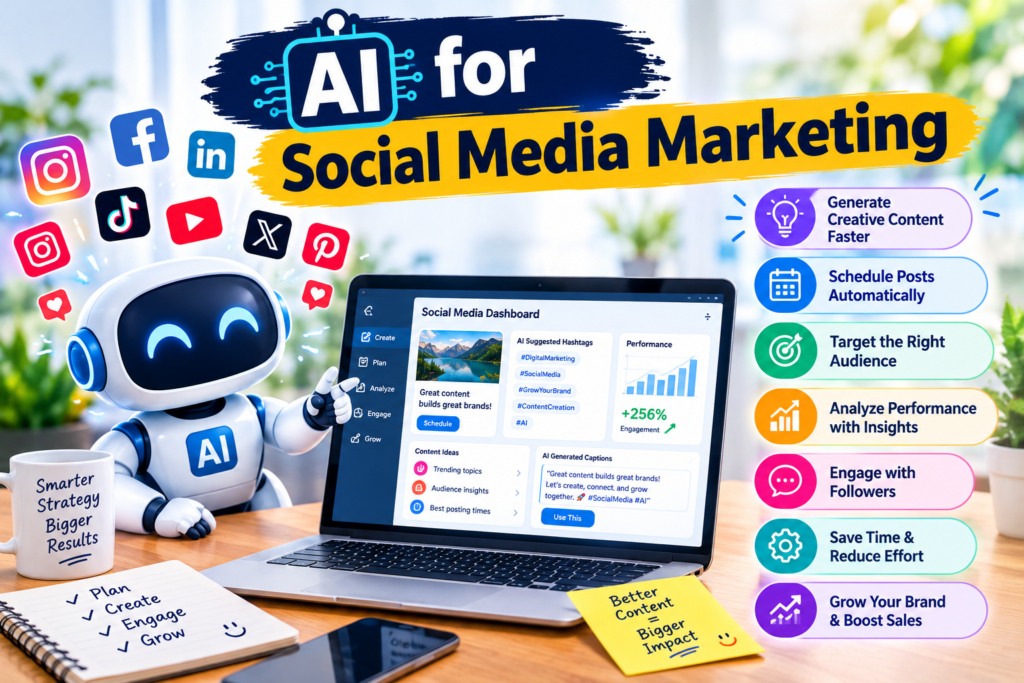
Introduction to AI for Social Media Marketing
Social media has become an important part of modern business. Companies use platforms such as Instagram, Facebook, LinkedIn, and TikTok to reach customers, share information, build trust, and promote products.
But managing these platforms can be challenging. Marketers need to create fresh content, respond to comments, understand audience interests, and track campaign performance. Doing everything manually can take a lot of time. This is where AI for social media marketing can help.
Artificial intelligence uses computer systems to perform tasks that usually require human intelligence. These tasks include understanding language, recognizing patterns, generating content, and predicting possible outcomes. In social media marketing, AI can help businesses create captions, suggest hashtags, analyze engagement, identify trends, and organize publishing schedules.
For example, a small clothing business may use an AI content assistant to create Instagram captions for a new collection. It can then use an AI analytics tool to compare post performance and learn which topics attract more attention. AI doesn’t replace the need for a marketing strategy. Instead, it helps marketers work more efficiently and make better-informed decisions.
What Is AI Social Media Marketing?
AI social media marketing is the use of artificial intelligence to plan, create, publish, manage, and improve social media content and campaigns.
It can include several activities:
- Generating captions, descriptions, and content ideas.
- Creating images and short videos.
- Scheduling posts for different platforms.
- Analyzing audience behavior and engagement.
- Monitoring brand mentions and customer sentiment.
- Supporting customer service through chatbots.
- Finding patterns in campaign performance.
- Personalizing content for different audience groups.
Consider a business that publishes five posts each week. Without AI, its marketing team may spend hours researching ideas and writing captions. With an AI-assisted workflow, the team can generate initial drafts quickly and spend more time reviewing quality, designing creative content, and talking to customers.
Why Is AI Becoming Important?
Social media platforms produce large amounts of information every day. Marketers must understand which content works, what audiences want, and where their time is best spent.
AI can process large datasets and identify patterns that may be difficult to notice manually. It can also help teams respond quickly to changing customer interests.
Still, AI-generated recommendations aren’t always correct. Marketers should review the results before making important decisions.
The goal is simple: use AI to reduce repetitive work while keeping human judgment at the center of marketing.
2. How AI Works in Social Media Marketing
AI marketing tools use different technologies to support marketing activities. Understanding these technologies makes it easier to choose the right tools and use them effectively.
2.1 Machine Learning Marketing
Machine learning allows computer systems to learn patterns from data and use those patterns to make predictions or recommendations. In social media marketing, machine learning can help analyze:
- Which posts receive the most engagement.
- What time audiences are most active.
- Which topics interest specific user groups.
- How campaign results change over time.
- Which customers may be interested in an offer.
For example, an analytics platform may find that educational carousel posts receive more saves than promotional images. A marketer can use this insight to plan more educational content. However, past performance doesn’t guarantee future results. Audience interests, platform algorithms, and market conditions can change.
2.2 Natural Language Processing
Natural language processing, or NLP, helps computers understand and work with human language. It’s useful for writing captions, analyzing comments, summarizing feedback, and identifying common customer questions.
Suppose a company receives hundreds of comments about a product. An NLP-powered tool may group them into themes such as price, product quality, delivery, and customer support. The marketing team can then understand the most common concerns and create content that addresses them.
2.3 Predictive Analytics
Predictive analytics uses historical data and statistical methods to estimate possible future outcomes.AI-powered analytics tools may help marketers forecast engagement, compare audience segments, or identify campaigns that deserve further attention.
For example, if video posts have consistently attracted more engagement than image posts for a particular account, the team may test more video content. Predictions should be treated as guidance, not certainty.
2.4 Sentiment Analysis and Social Listening
Sentiment analysis attempts to identify whether a message expresses a positive, negative, or neutral opinion. Social listening tools monitor public conversations, brand mentions, industry discussions, and relevant keywords.Together, these capabilities can help businesses understand how customers talk about their products.
For instance, a restaurant may notice an increase in complaints about delivery delays. The team can investigate the problem and communicate a solution. AI sentiment analysis can misinterpret sarcasm, slang, mixed opinions, and local expressions. Human review remains important, especially for sensitive issues.
12 Powerful Tools and Strategies for AI Social Media Marketing
The best AI marketing setup depends on your goals, budget, experience, and preferred platforms. Some tools focus on content creation, while others support scheduling, analytics, or customer conversations.
The following table provides a practical starting point.
| Tool | Main Use | Best For |
| ChatGPT | Ideas, captions, content plans, and drafts | Beginners and marketers |
| Google Gemini | Research assistance and content brainstorming | Marketing research |
| Claude | Drafting, rewriting, and organizing long content | Content teams |
| Canva | Social graphics and AI-assisted design | Creators and small businesses |
| Adobe Express | Branded graphics and short-form content | Design workflows |
| Buffer | Scheduling and publishing | Individuals and small teams |
| Hootsuite | Publishing, monitoring, and reporting | Marketing teams |
| Sprout Social | Analytics and audience engagement | Established businesses |
| Later | Visual planning and scheduling | Instagram-focused creators |
| Metricool | Reporting and performance tracking | Freelancers and businesses |
| Manychat | Automated messaging and lead capture | Customer engagement |
| HubSpot | CRM and marketing workflows | Growing businesses |
Features, AI capabilities, and pricing can change. Check each provider’s current plans before choosing a tool. Not every feature is included in a free plan.
3.1 AI Content Generation
AI content generation helps marketers produce initial drafts of captions, post descriptions, content calendars, and campaign ideas.
For example, a fitness coach can ask an AI assistant for ten social media post ideas about beginner workouts. The coach can select the strongest ideas and adapt them to the needs of the audience.
This saves time during brainstorming and helps maintain a regular publishing schedule.
3.2 AI-Powered Social Media Scheduling
An AI social media scheduler helps organize posts and publish them according to a planned schedule.
Some social media management platforms also provide recommendations about publishing times, content performance, or scheduling gaps. Marketers should still review each post to make sure the message, image, hashtags, and links are correct.
3.3 AI Analytics Tools
AI analytics tools help marketers understand social media insights, audience behavior, and content performance. They can support reporting by highlighting trends in impressions, clicks, comments, shares, and conversions. A business might compare two campaign formats and find that one generates more website visits. That information can guide the next campaign.
3.4 AI Audience Targeting
AI audience targeting involves using data and automated analysis to identify relevant audience groups. Depending on the platform and tool, marketers may use audience characteristics, past interactions, or campaign signals to improve targeting.
Use only data you’re authorized to process. Avoid collecting unnecessary personal information or making assumptions about people based on sensitive characteristics.
3.5 AI Campaign Management
AI campaign management can support ad creation, campaign monitoring, budget recommendations, and performance analysis. For example, a marketing team may use platform-provided automated bidding or creative testing features to compare advertising results.
Automated decisions should be monitored. A campaign that produces many clicks may still perform poorly if those visitors don’t become customers.
3.6 Social Listening and Sentiment Analysis
AI-assisted social listening helps identify frequently discussed topics, common questions, and changes in public conversations. This can help marketers discover content opportunities, improve customer support, and respond to potential reputation problems.
3.7 AI Chatbot Marketing
Chatbots can answer common questions, share product information, and guide visitors toward useful resources. For example, a course provider might use an automated messaging flow to explain course topics, answer basic questions, and direct interested users to the enrollment page. Clearly identify automated interactions where appropriate, and provide a way for customers to contact a person when needed.
3.8 Influencer Marketing AI
Some marketing platforms help businesses discover potential creators, review audience information, and measure campaign results.AI-assisted research can narrow the list of influencers worth investigating. However, brands should also check audience authenticity, content quality, reputation, and audience relevance.
3.9 AI Content Repurposing
Content repurposing means adapting one piece of content into several formats.
A long educational video, for instance, could become:
- Three short video clips.
- A LinkedIn post.
- An Instagram carousel.
- A list of practical tips.
- A short newsletter section.
AI can help with the first drafts, but each format should be adapted to the platform rather than copied without changes.
3.10 AI Trend Research
AI tools can help summarize industry conversations, organize research, and suggest relevant content themes.
Verify emerging trends with current platform data and reliable sources. An AI assistant may generate a plausible trend that has little real audience demand.
3.11 AI-Powered Customer Support
AI can categorize customer questions, suggest responses, and help support teams manage repetitive inquiries. Human agents should handle complaints, account problems, refunds, and other situations requiring judgment or access to confidential information.
3.12 AI Content Optimization
AI content optimization involves improving the clarity, structure, accessibility, and relevance of social media posts.
A marketer might use an AI assistant to shorten a caption, create alternative opening lines, or suggest a clearer call to action. Test the revised version with real audiences instead of assuming that AI recommendations will always increase engagement.
AI Content Creation for Social Media
Content creation is one of the most common uses of artificial intelligence in social media marketing. AI tools can help generate ideas, prepare captions, summarize research, and create visual concepts.
However, useful content still needs a clear purpose and a good understanding of the target audience.
How to Create Social Media Content Using AI
Follow this simple process.
Step 1: Define the audience. Identify who you want to reach, what they need, and what problems they want to solve.
Step 2: Choose a content goal. Decide whether your post should educate, entertain, start a conversation, generate leads, or encourage a purchase.
Step 3: Provide a clear prompt. Explain the topic, platform, tone, audience, length, and desired action.
Step 4: Review the draft. Check facts, grammar, brand voice, originality, and relevance.
Step 5: Create the visual. Use a design tool to create a graphic, carousel, or video that supports the message.
Step 6: Adapt the post. Adjust the wording and format for the platform.
Step 7: Measure the results. Review the engagement and conversion data to understand what worked.
Example of an AI Caption Generator Prompt
Here’s a practical prompt for a small business.
Act as a social media content strategist.
Create five Instagram caption ideas for a small business that sells eco-friendly water bottles.
Target audience: Students and young professionals.
Tone: Friendly, helpful, and natural.
Goals: Increase brand awareness and encourage meaningful engagement.
Requirements:
- Use simple English.
- Start with an interesting opening line.
- Highlight one practical customer benefit.
- Include a clear call to action.
- Suggest three relevant hashtags for each caption.
- Avoid unsupported claims and exaggerated promises.
- Make each caption different from the others.
This prompt provides clear instructions and gives the AI enough context to produce useful first drafts.
AI Image and Video Creation
AI design tools can help marketers create visual concepts, remove backgrounds, generate illustrations, and prepare branded content.
For example, a student promoting a digital marketing project could create a carousel explaining five social media tips. An AI-assisted design platform may help organize the layout and generate supporting visual ideas. Always review the final image for incorrect text, strange details, misleading representations, and inconsistent branding. Also, check licensing and usage terms before publishing AI-generated assets commercially.
Maintain a Human Brand Voice
AI-generated posts can sound repetitive if the same prompts and templates are used repeatedly.
To make content more authentic:
- Add real examples from your business.
- Use customer questions to inspire topics.
- Include original observations and practical experience.
- Remove generic statements that add little value.
- Match the language your audience naturally uses.
- Check that the post reflects your brand’s personality.
AI should help you communicate more clearly, not make your brand sound like every other account online.
AI Social Media Scheduling and Automation
Consistency matters in social media marketing. But publishing manually across several platforms can be difficult, especially for small teams. Social media automation tools help organize recurring tasks, while AI features can support content preparation and performance analysis.
5.1 Create an AI Content Calendar
A content calendar lists the posts you plan to publish and the dates you intend to publish them. You can use an AI assistant to generate a weekly or monthly draft calendar.
For example:
| Day | Content Type | Example Topic | Goal |
| Monday | Educational post | Three beginner marketing tips | Awareness |
| Tuesday | Short video | A common customer problem | Reach |
| Wednesday | Carousel | Step-by-step tutorial | Saves |
| Thursday | Question post | Ask followers for their opinions | Engagement |
| Friday | Case study | A real project or customer story | Trust |
| Saturday | Behind the scenes | How the product is made | Connection |
| Sunday | Weekly recap | Best tips from the week | Retention |
Use this calendar as a starting point. Adjust it to your audience, industry, and available resources.
5.2 Build a Simple Automation Workflow
A practical AI content workflow can follow these stages:
- Research audience questions and relevant topics.
- Generate initial content ideas.
- Draft captions and supporting text.
- Create or select suitable visuals.
- Review and approve each post.
- Schedule approved content.
- Monitor comments and messages.
- Analyze performance and improve the next batch.
Automation can reduce repetitive tasks, but it shouldn’t remove quality checks. Avoid automatically publishing every AI-generated draft. A single incorrect claim or inappropriate response can damage customer trust.
Choose the Right Scheduling Tool
When evaluating an AI social media scheduler, check:
- Which social networks it supports.
- Whether it supports approval workflows.
- Whether publishing is automatic or requires manual confirmation.
- What analytics and reporting are included.
- Whether team collaboration is available.
- How much the tool costs.
- What features are available on its free plan.
A free AI social media tool may be enough for a student or solo creator. A larger business may need team permissions, reporting, and more advanced workflows.
AI Audience Targeting and Personalized Marketing
Successful social media marketing begins with understanding the audience. AI can help organize audience information, analyze engagement patterns, and identify content preferences. These insights can support personalized marketing without requiring every post to be created from scratch.
Audience Segmentation
Audience segmentation means dividing a broad audience into smaller groups based on relevant characteristics or interests. For example, an online learning company may create content for:
- Students exploring career options.
- Graduates searching for entry-level jobs.
- Professionals learning new skills.
- Freelancers looking for clients.
- Businesses searching for training solutions.
Each group has different needs. A post about internship applications may be useful to students but less relevant to experienced professionals. AI can help organize topic ideas for each group and suggest different content angles.
Content Personalization
Content personalization means adapting messages to match the interests or needs of an audience. A business could create one campaign with different versions for beginners and experienced users. The core message stays consistent, while the examples and level of detail change. Personalization should be useful and respectful. Don’t reveal private information in public posts or make people uncomfortable with overly specific targeting.
Use Customer Journey Mapping
Customer journey mapping describes the steps a person may take before becoming a customer.
| Journey Stage | Audience Need | Suggested Content |
| Awareness | Understand a problem | Educational videos and introductory posts |
| Consideration | Compare possible solutions | Tutorials, guides, and comparisons |
| Decision | Evaluate a product or service | Demonstrations and case studies |
| Conversion | Take the next step | Clear offers and calls to action |
| Retention | Get continued value | Tips, support, and community content |
AI can help generate ideas for each stage and identify gaps in a content strategy. However, the journey isn’t always linear. People may discover a brand through a video, leave, return through search, and then convert through a different channel.
AI Analytics and Social Media Campaign Management
Publishing content is only one part of the job. Marketers also need to measure performance and understand whether their work supports business goals. AI analytics tools can help summarize reports, identify changes, and suggest areas for further investigation.
Track the Right Social Media Metrics
Choose metrics based on your campaign goal.
| Metric | What It Tells You |
| Reach | How many unique accounts saw content, where reported |
| Impressions | How many times content was displayed |
| Engagement rate | How engagement compares with a chosen audience or exposure measure |
| Shares | How often users shared content |
| Saves | How often users saved content |
| Link clicks | How often users clicked a link |
| Conversion rate | How often a defined action occurred relative to its denominator |
| Cost per lead | Advertising spend divided by the number of leads generated |
| Return on ad spend | Attributed revenue divided by advertising spend |
Different platforms may calculate metrics differently. Always check the definitions used in your reports.
Use AI for Content Performance Analysis
Suppose you publish twelve posts in one month. You can export the available metrics and ask an AI assistant to organize the results. A useful analysis should identify:
- Posts that performed well.
- Topics that attracted meaningful engagement.
- Content formats that generated website traffic.
- Posts that received many views but few clicks.
- Potential reasons for weak performance.
- Experiments to run next month.
Don’t ask AI to make conclusions without providing the relevant data. If the tool doesn’t have access to your analytics, it can’t reliably tell you which posts performed best.
Improve Campaign Performance
AI-driven marketing can support ongoing campaign optimization. A sensible process is to:
- Define a measurable goal.
- Establish a baseline.
- Test one or two changes.
- Compare results over a suitable period.
- Identify what likely influenced the difference.
- Apply the learning to future campaigns.
For example, test two opening lines for similar posts while keeping other factors as consistent as possible. Remember that correlation doesn’t prove causation. A post may perform well because of its topic, timing, audience, or an external event rather than the AI-generated caption alone.
AI Strategies for Instagram, Facebook, LinkedIn, and TikTok
Every social media platform has its own audience, content formats, and publishing features. A strong AI marketing strategy adapts content to each platform instead of sharing identical posts everywhere.
Best AI Tools for Instagram Marketing
Instagram is widely used for visual storytelling, Reels, carousels, Stories, and creator partnerships.
AI can help with:
- Generating Reel concepts.
- Writing caption variations.
- Planning educational carousels.
- Developing content themes.
- Reviewing available engagement data.
- Preparing creative concepts for product campaigns.
For example, a skincare business could create a carousel about a basic skincare routine. AI can help structure the information, while a qualified person checks any health-related claims.
Hashtags may help describe content, but they aren’t a guaranteed method of reaching more people. Focus on relevance, quality, and audience value.
AI Tools for Facebook Marketing
Facebook supports business pages, community discussions, video content, and advertising. AI can assist with drafting page posts, generating campaign ideas, preparing customer service responses, and organizing audience feedback.
Businesses running ads can also explore the automated optimization features provided by the platform. Review advertising claims, audience settings, and campaign results carefully. More impressions don’t automatically mean more sales.
AI Tools for LinkedIn Marketing
LinkedIn is useful for professional networking, industry insights, employer branding, and business-to-business marketing.
AI can help create:
- Industry commentary.
- Educational posts.
- Professional content calendars.
- Case study outlines.
- Thought leadership drafts.
- Hiring and employer-branding content.
For example, an IT company can use AI to develop a series of posts explaining cloud computing, software development, and cybersecurity basics. Add real experience and original insights before publishing. Generic business statements are unlikely to distinguish your brand.
AI Tools for TikTok Marketing
TikTok emphasizes short-form video and discovery through its recommendation system. AI can help marketers brainstorm video hooks, outline scripts, generate subtitles, and repurpose longer videos into short clips.
A simple video structure is:
- Hook: Introduce an interesting problem.
- Value: Share a useful tip or demonstration.
- Example: Show how the tip works.
- Call to action: Invite viewers to comment or learn more.
Keep videos natural and suited to the platform. Check current platform rules, music rights, and disclosure requirements before publishing promotional content.
ChatGPT, Gemini, Claude, and Generative AI Marketing
Generative AI can produce text, images, summaries, and other content from user instructions. Large language models, or LLMs, are especially useful for language-based marketing tasks.Popular assistants such as ChatGPT, Google Gemini, and Claude can support brainstorming, caption writing, content planning, and editing. Their outputs still require human review.
ChatGPT for Social Media Marketing
ChatGPT can help create post ideas, draft captions, develop content calendars, summarize supplied research, and generate alternative headlines.For example, you can ask it to turn a detailed blog post into five short social media posts for different audiences. Provide the source material and clear instructions. Verify claims before publication.
Gemini for Social Media Marketing
Google Gemini can assist with brainstorming, writing, summarizing information, and organizing marketing ideas. Depending on the version and available integrations, it may also support workflows involving other Google services. Use reliable sources to confirm current facts and avoid assuming that every generated reference is accurate.
Claude AI Marketing
Claude can help organize long documents, rewrite drafts, develop content outlines, and compare different messaging approaches. It may be useful when preparing a series of posts from a detailed report or campaign brief. As with other LLMs, the quality of the response depends on the instructions and source information provided.
Improve Results with AI Prompt Engineering
Prompt engineering means writing instructions that guide an AI system toward a useful output. A good marketing prompt includes:
- Role: Explain what the AI should do.
- Audience: Identify the intended readers.
- Goal: State the desired outcome.
- Context: Provide product or campaign details.
- Format: Specify the required output.
- Constraints: Include tone, length, and factual limits.
- Review criteria: Explain what a good result should contain.
For example, instead of writing “Create a LinkedIn post,” explain the audience, subject, business objective, tone, and call to action. Clear prompts usually produce more relevant first drafts, although they don’t guarantee accuracy.
Create a Repeatable AI Content Workflow
Use one consistent process for each campaign:
Research → Brief → Draft → Fact-check → Edit → Design → Approve → Publish → Measure
This AI content workflow helps teams maintain quality and avoid unnecessary repetition. It also creates a clear point where a person checks the content before it goes live.
AI Social Media Marketing for Beginners and Students
Students and beginners can learn AI social media marketing without purchasing expensive software immediately. Start with basic marketing concepts, free learning resources, and small projects. Focus on understanding why content works rather than relying entirely on automated tools.
Learn the Fundamentals First
Before using advanced AI marketing software, learn:
- Content marketing basics.
- Social media platform differences.
- Audience research.
- Copywriting and storytelling.
- Basic graphic design.
- Engagement metrics.
- Marketing goals and conversion tracking.
- Privacy and copyright principles.
These skills help you evaluate AI-generated recommendations instead of accepting them without question.
Follow This Beginner Learning Plan
| Week | Learning Activity | Practical Result |
| 1 | Learn social media marketing fundamentals | A simple marketing brief |
| 2 | Practice AI prompts and caption writing | Ten reviewed captions |
| 3 | Learn design and scheduling tools | A seven-day content calendar |
| 4 | Study analytics and engagement | A basic performance report |
You can use this plan for self-study or as the foundation for a beginner AI marketing course.
Build a Portfolio Project
Choose a local business, a fictional brand, or a personal project.
Prepare a small portfolio containing:
- A target audience description.
- A list of relevant content topics.
- Ten original social media posts.
- Three sample visual designs.
- A weekly publishing calendar.
- A set of measurable marketing goals.
- A report explaining what you would test and improve.
Clearly label simulated results as examples. Don’t present fictional campaign performance as real client work.
This project can help you demonstrate practical skills when applying for internships, freelance assignments, or entry-level marketing roles.
Are Free AI Social Media Tools Enough?
Free AI social media tools can be enough for learning, brainstorming, drafting captions, and creating simple designs.
However, free plans may limit usage, scheduling, analytics, export options, or team features. Start with tools that solve a real problem. Upgrade only when a limitation affects your workflow or business goals.
Benefits and Limitations of AI Marketing
AI offers several advantages, but it also introduces risks. Understanding both sides helps marketers build more reliable campaigns.
Key Benefits
Time savings: AI can speed up brainstorming, drafting, summarizing, and reporting.
Consistent publishing: Content calendars and scheduling tools make it easier to maintain a regular posting routine.
Better analysis: AI-assisted analytics can help identify patterns across large amounts of performance data.
Content variation: Marketers can generate multiple creative approaches and test which ones connect with their audience.
Improved workflows: Automation can reduce repetitive tasks and help teams manage more campaigns.
Support for small businesses: AI can make certain content and planning tasks easier for people who don’t have a large marketing team.
Important Limitations
AI-generated content may contain inaccurate information, repeated ideas, or unnatural language. Automated tools may also misinterpret customer sentiment, overlook cultural differences, or suggest content that doesn’t match the brand. Other concerns include privacy, copyright, security, and excessive dependence on automated decisions.
Best Practices for Responsible AI Use
Follow these practical rules:
- Verify factual claims and statistics.
- Review content before publishing.
- Protect confidential customer and company information.
- Check the licensing terms for images, videos, and other assets.
- Respect platform policies and applicable advertising laws.
- Disclose AI-generated or altered content when required.
- Provide human support for sensitive customer issues.
- Use genuine experience and original insights to build trust.
For general guidance, review the NIST Artificial Intelligence Risk Management Framework, which discusses ways to identify and manage AI-related risks. The strongest marketing approach combines automation with accountability. AI can help produce content quickly, but the business remains responsible for what it publishes.
Future of AI in Social Media Marketing
The future of AI for social media marketing will likely involve more integrated workflows, better content assistance, and more sophisticated analysis. Several developments deserve attention.
More Personalized Content
AI systems may help businesses adapt content to different audience interests and stages of the customer journey. Marketers will need to balance relevance with privacy and avoid making personalization feel intrusive.
Faster Creative Production
Generative AI is making it easier to produce draft images, video concepts, captions, and campaign variations. Human direction will remain important for brand identity, originality, and quality.
More Advanced Social Listening
Improvements in language processing may help businesses identify customer questions, emerging themes, and changes in public discussion. Accuracy will still depend on language, context, data quality, and the tool being used.
Greater Integration Between Marketing Tools
Businesses may increasingly connect content creation, scheduling, customer relationship management, and analytics. These integrations can reduce manual work and provide a more complete view of campaign performance.
Human Creativity Will Remain Valuable
As AI-generated content becomes more common, original research, real customer experiences, distinctive storytelling, and credible expertise may become even more important. The future isn’t simply about producing more posts. It’s about creating useful content that earns attention and supports meaningful business goals.
Build a Smarter Social Media Strategy with AI
AI for social media marketing gives students, creators, and businesses new ways to plan content, manage publishing, understand audiences, and evaluate results.
You don’t need to use every available tool to benefit from AI. Begin with one clear goal, choose a tool that supports it, and develop a repeatable workflow. For example, start by using an AI assistant to prepare a weekly content calendar. Review every post, publish consistently, and study the results. Once that process works well, explore scheduling, analytics, and customer engagement tools.
Keep these principles in mind:
- Use AI to save time, not to remove human judgment.
- Create content that meets real audience needs.
- Verify facts and protect customer information.
- Measure outcomes rather than relying only on views.
- Continue testing and improving your strategy.
Ultimately, successful AI-driven marketing isn’t about publishing the largest number of posts. It’s about using technology thoughtfully to create valuable content, build stronger relationships, and achieve measurable results.
AI Social Media Marketing Checklist
Use this checklist before launching any campaign.
- Define target audience and campaign goal.
- Research relevant topics and keywords.
- Select suitable AI content and scheduling tools.
- Create and review captions, images, and videos.
- Adapt content to each social media platform.
- Check facts, copyright, and privacy considerations.
- Schedule posts and monitor customer responses.
- Track engagement, traffic, leads, or sales.
- Review results and improve the next campaign.
Know More:
”FAQs”
1. What is AI for social media marketing?
AI for social media marketing uses artificial intelligence to support content creation, publishing, audience analysis, customer engagement, and campaign measurement. It helps marketers complete repetitive tasks and make data-informed decisions.
2. What are the best AI tools for social media marketing?
Popular options include ChatGPT, Gemini, Claude, Canva, Buffer, Hootsuite, Sprout Social, Later, and Metricool. The best choice depends on whether you need content creation, visual design, scheduling, analytics, or customer management.
3. Can I use AI for social media marketing for free?
Yes. Several AI assistants and design or scheduling platforms offer free plans or limited free access. Features and usage limits vary, so check current terms before choosing a tool.
4. How do I use AI to create social media content?
Start by defining your audience and goal. Give an AI assistant a clear prompt, generate a draft, verify the facts, edit the language, prepare suitable visuals, and adapt the content to the platform. Measure results after publishing.
5. Can AI automatically manage my social media accounts?
Some platforms support scheduled publishing, automated responses, reporting, and other management tasks. However, capabilities differ by tool, account type, and platform. Human monitoring is still important for accuracy, customer complaints, and sensitive conversations.
6. Will AI replace social media marketers?
AI can automate parts of a marketer's work, but it doesn't remove the need for strategy, creative judgment, relationship building, and responsible decision-making. Marketers who learn to use AI effectively may improve their productivity and expand their skills.
7. How can students learn AI social media marketing?
Students can learn the fundamentals, practice prompt writing, explore free tools, create a sample content calendar, and build a portfolio project. They should also learn analytics, copywriting, privacy, and fact-checking.
8. How does AI improve social media engagement?
AI can help identify popular topics, develop content variations, summarize audience feedback, and analyze performance. Engagement improves only when the resulting content is relevant, useful, and suited to the audience.
9. Is AI-generated social media content original?
AI can generate new combinations of words and ideas, but originality isn't guaranteed. Outputs may resemble existing content or contain unsupported claims. Review the draft, add original insight, verify sources, and check applicable copyright and licensing requirements.
10. What is the future of AI in social media marketing?
Likely developments include more advanced content assistance, automated workflows, improved analytics, and greater personalization. Human creativity, audience trust, privacy, and content quality will remain important.