

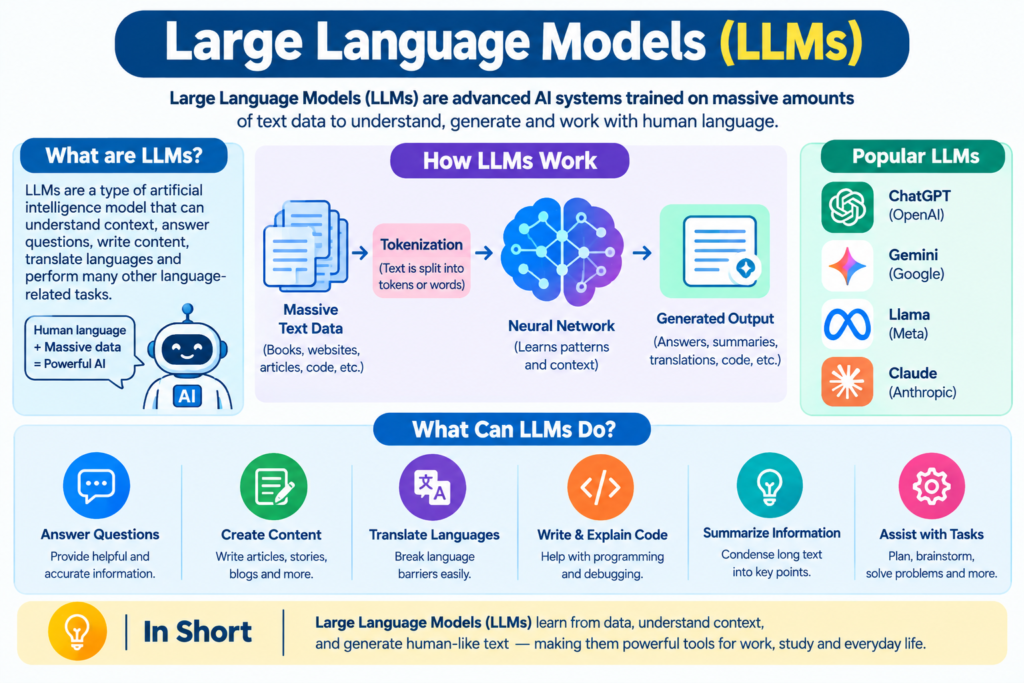
What Are Large Language Models (LLMs)? A Complete Guide
Artificial intelligence is changing how people search, learn, work, and create. One of the biggest technologies behind this change is large language models (LLMs).
But what are LLMs? How do they understand text? How are they trained? And why are tools like ChatGPT and Google Gemini able to answer questions, write content, summarize text, and help with coding?
In simple terms, a large language model is an AI system trained on large amounts of text and other data. It learns patterns in language and uses those patterns to generate useful responses.
This LLM guide explains the topic from the ground up. You don’t need an advanced background in computer science to follow it.
LLMs Explained: What Are LLMs?
What are LLMs? LLMs are artificial intelligence systems designed to understand and generate human-like language.
The term large language model has three main parts:
- Large means the model can contain a very large number of learned parameters.
- Language means it works mainly with human language and related forms of information.
- Model means it is a mathematical system trained to recognize patterns and make predictions.
For example, when you type:
“Explain climate change to a student.”
An LLM doesn’t simply search for one stored answer. It processes your input and predicts a useful sequence of words based on patterns it learned during training.
This makes LLM technology useful for many tasks, such as:
- Answering questions
- Writing and editing text
- Summarizing documents
- Translating languages
- Generating code
- Creating ideas
- Explaining difficult topics
- Extracting information
- Supporting research
So, LLM AI is a major part of modern artificial intelligence.
What Is a Large Language Model in AI?
A large language model in AI is a type of machine learning system that learns language patterns from very large datasets.
Traditional software usually follows rules written by developers. An LLM works differently. Instead of being given a rule for every possible sentence, it learns patterns from examples.
For instance, after seeing many examples of English sentences, a model may learn that:
- “The sun rises in the…” is likely followed by “east.”
- “What is the capital of France?” is likely related to “Paris.”
- “Please summarize this article” means the user wants a shorter version of the text.
The model learns these relationships during training.
This is why LLMs can handle many tasks without having a separate program for every question.
LLM AI, Machine Learning, and Deep Learning
LLMs are connected to both machine learning and deep learning.
A simple way to understand the relationship is:
Artificial Intelligence → Machine Learning → Deep Learning → Modern LLMs
| Technology | Simple Meaning |
| Artificial Intelligence | Broad field of making machines perform intelligent tasks |
| Machine Learning | AI systems that learn patterns from data |
| Deep Learning | Machine learning using large neural networks |
| LLM | A large deep learning model focused mainly on language |
Therefore, LLM machine learning and LLM deep learning are closely connected.
Most modern LLMs use deep neural networks with billions of learned parameters. These networks help the model identify complex relationships between words, sentences, concepts, and other forms of data.
How Do LLMs Work? A Step-by-Step Explanation
Understanding how LLMs work doesn’t require advanced mathematics. Think of an LLM as a highly trained pattern-learning system.
Step 1: Collecting Training Data
The first major part of LLM development is gathering training data. LLM training data can include large collections of text, code, books, websites, articles, documents, and other suitable data sources, depending on the model.
The quality of the data matters a lot. Poor-quality or unreliable data can affect the quality of the model’s output. Developers therefore use different methods to prepare, filter, clean, and organize training data.\
Step 2: Breaking Text Into Tokens
LLMs don’t usually process text exactly as humans do. Text is divided into smaller pieces called tokens. A token may represent:
- A complete word
- Part of a word
- A punctuation mark
- A short group of characters
For example, a sentence such as:
“AI is changing education.”
may be divided into several tokens. This allows the model to process text mathematically.
Step 3: Learning Patterns
The model then learns relationships between tokens. During training, the model may be asked to predict a missing or upcoming token.
For example:
“The sky is…”
The model may predict:
“blue.”
It repeats this process on a huge scale.
Over time, the model learns many patterns in language.
Step 4: Building Internal Representations
Modern LLMs create numerical representations of information. These representations help the model identify relationships between words and concepts.
For example, the words “doctor,” “hospital,” and “patient” may have meaningful relationships within the model’s learned representations. This is sometimes described as LLM knowledge representation.
However, this doesn’t mean the model stores knowledge exactly like a human brain.
Step 5: Using Transformer Models
Most modern large language models use a neural network architecture based on the Transformer approach.
Transformers became important because they can process relationships between different parts of a sequence efficiently. A key idea is attention.
Attention helps the model determine which parts of the input are important when generating an output.
For example, consider:
“Sarah gave Maya the book because she needed it.”
Understanding who “she” refers to can require looking at the surrounding context. Attention mechanisms help models handle relationships like this.
Step 6: Generating an Answer
When you send a prompt, the model processes the input and predicts what tokens should come next.
It generates the response step by step. That’s why LLM responses can feel conversational.
However, an important point is that an LLM doesn’t think exactly like a person. It generates outputs based on learned patterns and the context available to it.
Step 7: Human and System Feedback
Modern AI systems may also use additional training and evaluation methods to improve helpfulness, safety, instruction-following, and response quality.
Human feedback, automated tests, safety checks, and model evaluations can all play a role.
LLM Architecture: What Happens Inside an LLM?
The LLM architecture can be complex, but the basic idea is easier to understand.
A simplified LLM pipeline looks like this:
Input → Tokens → Embeddings → Transformer Layers → Predictions → Output
Let’s break it down.
Tokens
The user’s text is converted into tokens.
Embeddings
Tokens are converted into numerical representations called embeddings.
These representations allow the neural network to work with language mathematically.
Transformer Layers
The transformer processes the representations through multiple layers.
These layers help the model identify patterns and relationships.
Attention
Attention helps the model focus on relevant parts of the context.
Output Prediction
The model calculates probabilities for possible next tokens.
It then selects tokens according to its generation process.
Final Response
The selected tokens are converted back into readable text.
This entire process happens very quickly.
LLM vs Traditional AI: What’s the Difference?
The difference between LLM vs traditional AI is mainly about how the systems learn and how broadly they can perform tasks.
Traditional AI systems are often built for specific purposes.
For example:
- A chess program can play chess.
- A fraud detection system can identify suspicious transactions.
- A recommendation system can suggest products.
An LLM can perform many language-related tasks using one general model.
| Feature | Traditional AI | LLM |
| Main approach | Often task-specific | General language model |
| Training | Task-focused data | Very large datasets |
| Flexibility | Often limited | High for language tasks |
| Content generation | Usually limited | Strong |
| Conversation | Depends on system | Core capability |
| Coding assistance | Specialized systems needed | Common use case |
| Summarization | Usually task-specific | Built-in language capability |
This doesn’t mean LLMs are better at everything.
Traditional AI can still be more effective for highly specialized tasks where clear rules, structured data, or precise calculations are needed.
LLM vs Generative AI: Are They the Same?
The difference between LLM and generative AI is an important question. They aren’t exactly the same. Generative AI is the broader category of AI systems that create new content.
This can include:
- Text
- Images
- Audio
- Video
- Code
An LLM is a type of generative AI system focused mainly on language.
So:
Generative AI = Broad category
LLMs = One important type of generative AI
For example, a text-generation model can be an LLM, while an image-generation model isn’t necessarily an LLM.
LLM vs ChatGPT: What’s the Difference?
People often search for LLM vs ChatGPT, but these terms describe different things.
An LLM is a type of AI model.
ChatGPT is an AI application and conversational product that uses advanced AI models.
Think about it this way:
LLM = underlying model technology
ChatGPT = application that lets people interact with AI
ChatGPT can use language models to answer questions, write content, analyze information, assist with coding, and perform other tasks.
So, ChatGPT isn’t simply another name for all LLMs.
LLM vs Google Gemini vs Bard
Another common comparison is LLM vs Google Gemini.
Google Gemini is an AI model family and product ecosystem developed by Google.
Earlier, Google’s conversational AI product was known as Bard. Google later transitioned its branding to Gemini.
This means LLM vs Bard is now largely a historical comparison.
A better comparison today is between different AI models and products.
| Term | What It Means |
| LLM | General type of language model |
| GPT | A family of language models |
| ChatGPT | AI application from OpenAI |
| Gemini | Google’s AI model and product family |
| Bard | Former Google conversational AI branding |
The important point is that ChatGPT and Gemini are products and services built around AI models. “LLM” describes the broader technology category.
LLM vs GPT and LLM vs NLP Models
LLM vs GPT is another common search query.
GPT stands for Generative Pre-trained Transformer.
GPT models are a type of large language model that use the Transformer architecture.
Therefore:
GPT is a type of LLM.
Now consider LLM vs NLP models.
Natural Language Processing, or NLP, is a broader field of AI focused on helping computers work with human language.
NLP can include tasks such as:
- Sentiment analysis
- Text classification
- Translation
- Named entity recognition
- Speech and language processing
- Information extraction
LLMs are now a major part of modern NLP, but NLP existed long before today’s large language models.
LLM Applications and Use Cases
The number of LLM applications is growing quickly.
Businesses, schools, researchers, developers, and individuals can use LLMs for many tasks.
LLM in Education
LLM in education can help students understand difficult concepts.
For example, students can ask an AI system to:
- Explain a topic in simple language
- Create practice questions
- Summarize notes
- Generate study plans
- Explain coding concepts
- Translate learning material
- Provide examples
However, students should use AI as a learning assistant rather than simply copying answers.
Teachers and institutions also need clear policies for responsible AI use.
LLM in Research
LLM in research can help with:
- Literature exploration
- Summarization
- Brainstorming
- Research question development
- Document analysis
- Coding assistance
- Draft organization
Researchers should still verify important claims against original sources. An LLM can produce incorrect information with a confident tone. Human review remains essential.
LLM in Healthcare
LLM in healthcare explained simply means using language models to support tasks involving medical text and communication.
Possible uses include:
- Summarizing medical documents
- Supporting administrative work
- Organizing information
- Drafting patient-friendly explanations
- Assisting medical research
Healthcare is a high-risk area, so professional review and strong privacy controls are essential. LLMs should not replace qualified medical professionals.
LLMs in Business
Companies can use LLMs for:
- Customer support
- Content creation
- Internal knowledge search
- Document summarization
- Email drafting
- Software development
- Market research
- Workflow automation
Applications of LLMs in Daily Life
The applications of LLMs in daily life can be very simple.
You may use an LLM to:
- Plan a trip.
- Write an email.
- Learn a new topic.
- Create a shopping list.
- Summarize a long document.
- Practice a language.
- Generate recipe ideas.
- Explain a technical problem.
- Brainstorm business ideas.
- Create a study schedule.
LLM Examples: Popular Models and Systems
There are many LLM examples in the modern AI ecosystem. Some well-known model families and AI systems include:
- GPT models
- Google Gemini models
- Claude models
- Llama models
- Mistral models
- Qwen models
Different models have different strengths, sizes, capabilities, costs, context limits, and deployment options.
The AI field changes quickly, so model comparisons can become outdated.
For a deeper technical explanation of Transformer models, you can read the original research paper: Attention Is All You Need.
Benefits of Large Language Models
Large language models offer several important benefits.
1. Fast Information Support
LLMs can quickly explain or transform large amounts of text.
2. Flexible Communication
Users can ask questions in natural language instead of learning complex commands.
3. Productivity
LLMs can help with repetitive writing, summarization, brainstorming, and coding tasks.
4. Personalized Learning
Students can ask follow-up questions and request simpler explanations.
5. Multilingual Support
Many models can work with multiple languages.
6. Accessibility
Conversational AI can make complex information easier to approach.
7. Developer Support
LLMs can help developers understand code, identify possible bugs, and generate examples.
Limitations and Risks of LLM Technology
Despite their benefits, LLMs have important limitations.
Hallucinations
An LLM can generate information that sounds correct but is actually false.
This is often called a hallucination.
Users should verify important facts.
Bias
Training data can contain bias.
As a result, model outputs may sometimes reflect unwanted biases.
Outdated Information
A model may not always have access to the latest information unless it is connected to current data or search tools.
Privacy Concerns
Sensitive information should not be shared with an AI system unless the system and its data policies are appropriate for that use.
Lack of True Human Understanding
LLMs can show impressive LLM semantic understanding, but this should not be confused with human consciousness or human experience.
The model works through learned statistical and computational patterns.
Security Risks
LLMs can also create new security challenges.
Organizations need controls around:
- Data access
- Prompt injection
- Sensitive information
- Model permissions
- Generated code
- Automated actions
LLM Projects for Beginners and Students
Students interested in AI can start with small LLM projects for beginners. You don’t need to build a massive model from scratch. Try projects such as:
Project 1: AI Study Assistant
Build a simple application that answers questions from study notes.
Project 2: Document Summarizer
Create a tool that summarizes uploaded text.
Project 3: FAQ Chatbot
Build a chatbot that answers questions from a small knowledge base.
Project 4: AI Writing Assistant
Create a tool that improves grammar and sentence clarity.
Project 5: Simple Coding Assistant
Build a small application that explains basic programming errors.
For an LLM tutorial for students, start with basic Python, APIs, machine learning concepts, embeddings, prompts, and simple model integration.
You don’t need to learn everything at once.
How LLMs Are Trained
Many people ask, how are LLMs trained?
The process can involve several stages.
Pretraining
During pretraining, the model learns language patterns from large datasets.
It processes huge numbers of tokens and adjusts its internal parameters to improve predictions.
Fine-Tuning
A model may then be trained further for specific tasks or behaviors.
Fine-tuning can improve its ability to follow instructions or perform particular types of work.
Alignment and Evaluation
Developers may use additional techniques to improve helpfulness, safety, reliability, and instruction-following. The model is also tested against many evaluation tasks. The exact training process differs between models and companies.
Future of Large Language Models
The future of large language models is likely to involve more capable, useful, and specialized AI systems. Several trends are important.
Smaller and More Efficient Models
Not every task needs a huge model. Smaller models may become more useful for devices, businesses, and private applications.
Multimodal AI
Future systems can work across text, images, audio, video, and other data types.
AI Agents
LLMs may increasingly work as part of systems that can plan tasks, use tools, access information, and complete multi-step workflows.
Better Personalization
AI systems may become better at adapting responses to user goals and context.
Stronger Safety
As AI becomes more capable, safety, privacy, evaluation, and governance will become even more important.
Wider Education Use
Schools and universities may use AI tools to support personalized learning, tutoring, research, and accessibility. The goal shouldn’t be to replace human knowledge. Instead, AI can become a tool that helps people learn, create, and solve problems more effectively.
Large language models have become one of the most important technologies in modern artificial intelligence. In simple terms, an LLM is a large AI model that learns patterns from huge amounts of data and uses those patterns to process and generate language.
This LLM overview covered the basics of what are LLMs, how LLMs work, transformer models, LLM architecture, training data, applications, examples, benefits, limitations, and future trends.The most important thing to remember is that LLMs are tools. They can help people learn faster, create content, analyze information, write software, and solve many everyday problems.
At the same time, they aren’t perfect. They can make mistakes, produce biased answers, or generate information that needs verification. As LLM technology continues to develop, understanding how it works will become increasingly useful for students, professionals, businesses, researchers, and everyday users.
”FAQs”
1. What are LLMs in simple words?
LLMs are AI systems trained on large amounts of data so they can understand and generate human-like language. They can answer questions, summarize information, write text, translate content, and assist with many other language tasks.
2. How do LLMs work step by step?
LLMs generally process text as tokens, convert those tokens into numerical representations, use neural network layers and attention mechanisms to process context, and predict the next tokens needed to generate an answer.
3. Is ChatGPT an LLM?
ChatGPT is an AI application that uses advanced language models. It is better to think of ChatGPT as a product or interface built around AI models rather than using "ChatGPT" and "LLM" as exact synonyms.
4. What is the difference between an LLM and generative AI?
Generative AI is a broad category of AI that creates new content. LLMs are a type of generative AI focused mainly on language and text.
5. What are some LLM examples?
Examples include GPT models, Google Gemini models, Claude models, Llama models, Mistral models, and Qwen models. Different models have different features and capabilities.
6. How are LLMs trained?
LLMs learn from large datasets during a training process. They learn patterns by predicting tokens and adjusting their internal parameters. Additional training and evaluation may then improve their instruction-following, safety, and usefulness.
7. Can students use LLMs for learning?
Yes. Students can use LLMs to explain difficult concepts, create practice questions, summarize notes, learn programming, and brainstorm project ideas. However, students should verify important information and follow academic rules.
8. Can LLMs replace humans?
LLMs can automate or support many tasks, but they don't replace human judgment, experience, creativity, responsibility, or professional expertise in every situation. Human review remains important, especially for high-risk decisions.
9. Are LLMs the same as NLP?
No. NLP is a broader field focused on enabling computers to process and work with human language. LLMs are modern AI models that have become an important part of NLP.
10. What is the future of large language models?
The future may include more efficient models, multimodal systems, AI agents, stronger personalization, improved safety, and wider use in education, business, research, healthcare, and everyday applications.







Pingback: The Rise of AI Doppelgängers: 11 Powerful Ways Artificial Intelligence Can Create a Digital Version of You
Pingback: Beyond Job Replacement: How AI Could Change the Meaning of Work, Skills, and Human Purpose in 2026