How AI Can Help Marketers Create Better Advertising Campaigns
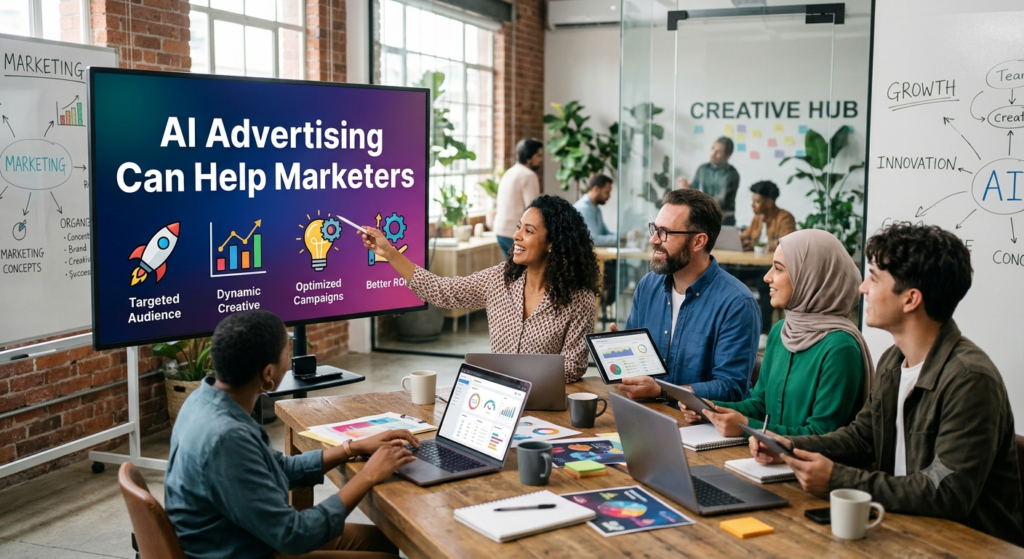
Artificial intelligence is changing how businesses advertise their products and services. Today, marketers can use AI to understand customer needs, create engaging ads, improve audience targeting, and manage campaigns more efficiently. These changes make AI advertising an important part of modern digital marketing.
Traditional advertising often requires hours of research, creative development, audience analysis, and performance tracking. AI can help reduce this workload by processing data, identifying patterns, and suggesting improvements. As a result, marketing teams can spend more time on strategy and less time on repetitive tasks.
However, AI isn’t a magic solution. It works best when marketers combine smart technology with human creativity, clear goals, and reliable data.
In this guide, we’ll explore how AI improves advertising campaigns, which tools marketers can consider, and how businesses can use AI to improve campaign performance while controlling costs.
1. AI Advertising Can Help Marketers: Understanding
AI in advertising refers to the use of artificial intelligence technologies to plan, create, deliver, and improve advertisements. These technologies can analyze large amounts of data, recognize patterns, generate content, and support decisions that would otherwise require significant manual effort.
For example, a business selling online courses may want to reach college students interested in learning new skills. AI can help analyze audience behavior, suggest relevant advertising messages, and identify which campaign variations perform best.
This process supports better decisions throughout the advertising journey.
How Does AI Work in Advertising?
AI advertising systems use several technologies to support marketing activities.
- Machine learning: Learns patterns from data to help predict likely outcomes.
- Natural language processing: Helps systems understand and generate written language.
- Generative AI: Produces advertising copy, images, video concepts, and other creative content.
- Predictive analytics: Uses historical data to estimate possible future behavior.
- Automation: Handles repetitive tasks such as reporting, bidding adjustments, and campaign workflows.
These technologies can work together. For instance, a marketer might use generative AI to create three ad headlines, machine learning to help evaluate likely audience responses, and campaign analytics to compare actual results.
The important point is that AI supports the process rather than guaranteeing success.
Why AI Matters to Modern Marketers
Customer expectations are changing. People want useful information, relevant offers, and advertising that matches their interests. At the same time, businesses must manage budgets carefully and compete across several digital channels.
AI for marketers can help address these challenges in five ways:
- Save time: Automate repetitive research and reporting tasks.
- Improve relevance: Match advertising messages to different audience groups.
- Support faster testing: Generate and compare more ad variations.
- Improve decisions: Find useful patterns in campaign performance data.
- Scale marketing: Manage more campaigns without increasing every manual task.
Consider a small company that runs campaigns on Google and Facebook. Its marketing team may struggle to review every keyword, headline, audience, and conversion. AI marketing tools can help identify areas that need attention and organize campaign insights.
Nevertheless, marketers should review AI recommendations before applying major changes. Poor data or incorrect assumptions can lead to poor decisions.
Traditional Advertising vs. AI-Powered Advertising
|
Advertising activity |
Traditional approach |
AI-powered approach |
|
Audience research |
Manual analysis and surveys |
Faster analysis of available audience data |
|
Ad copywriting |
Writers create each variation |
AI drafts variations for human review |
|
Audience targeting |
Manual rules and predefined segments |
Data-driven audience suggestions and predictive models |
|
Campaign monitoring |
Regular manual checks |
Automated alerts and performance insights |
|
Budget optimization |
Periodic adjustments |
Automated bidding or recommendations where supported |
|
Reporting |
Manually prepared reports |
Faster summaries and pattern detection |
AI doesn’t remove the need for marketing expertise. Instead, it gives marketers additional ways to understand their audience and improve advertising decisions.
2. Seven Powerful Ways AI Improves Advertising Campaigns
The real value of AI appears when marketers use it to solve specific campaign problems. The following strategies show how AI marketing campaigns can become more relevant, efficient, and measurable.
1. Improve Audience Segmentation and Targeting
Audience targeting is one of the most important parts of digital advertising. Even a creative advertisement can fail when it reaches people who have little interest in the offer.
AI can help marketers analyze permitted customer data, browsing patterns, past purchases, engagement, and conversion information to identify useful audience groups.
For example, an online education company might identify several groups:
- Students looking for internships.
- Graduates searching for their first jobs.
- Professionals seeking new skills.
- People interested in career development.
Each group has different needs. AI can help marketers develop suitable messages for each audience instead of showing everyone the same advertisement.
This approach supports customer targeting optimization and more relevant advertising.
Using AI for Audience Targeting
Marketers can follow these steps:
- Define the campaign goal, such as leads, sales, or registrations.
- Review available customer and campaign data.
- Identify meaningful audience segments.
- Create different messages for each segment.
- Test the ads and compare actual results.
AI can also support predictive advertising analytics by estimating which audiences may be more likely to complete a desired action.
However, predictions are estimates, not guarantees. Marketers must respect privacy rules, advertising platform policies, and applicable consent requirements when using personal data.
2. Create Better Ad Copy and Creative Content
Creating multiple advertising variations takes time. Marketers may need different headlines, descriptions, calls to action, images, and videos for each platform.
AI ad creation tools can help generate initial drafts quickly.
For example, a software company promoting a project management tool might ask AI to develop headlines focused on productivity, teamwork, and time savings. A marketer can then review these options and select the most suitable ideas.
AI can assist with:
- Search advertising headlines and descriptions.
- Social media ad copy.
- Product descriptions and promotional messages.
- Video scripts and storyboards.
- Image concepts and creative briefs.
- Calls to action for different audience segments.
Example of AI-Generated Ad Copy
Imagine a company offering online career courses.
|
Ad element |
Example |
|
Headline |
Build Job-Ready Skills Online |
|
Description |
Explore practical courses designed to help you develop valuable career skills. |
|
Call to action |
Explore Courses |
|
Audience |
Students and early-career professionals |
These examples are starting points, not guaranteed high-performing ads. The marketing team should verify every claim, adapt the language to the target audience, and check the platform’s character limits.
The best approach is to let AI generate ideas while humans protect accuracy, brand voice, and originality.
3. Optimize Advertising Budgets and Bids
Ad spend optimization is another area where AI can be useful. Marketers need to decide how much to spend, which campaigns deserve more investment, and where performance is weak.
AI-powered advertising platforms may use automated bidding systems to adjust bids based on campaign goals and available signals.
For example, an online retailer might run campaigns for several product categories. One campaign may generate many clicks but few purchases, while another produces fewer clicks but more valuable sales.
By reviewing conversion data and campaign costs, marketers can determine where their budget may work harder.
Useful activities include:
- Reviewing cost per click (CPC).
- Comparing cost per acquisition (CPA).
- Evaluating return on ad spend (ROAS).
- Identifying campaigns with weak conversion rates.
- Testing different budget allocations.
- Monitoring performance after budget changes.
Still, marketers shouldn’t increase spending simply because AI recommends it. They should check conversion quality, profit margins, tracking accuracy, and business goals before making significant changes.
4. Personalize Advertising Messages
Personalized advertising delivers messages that are relevant to a person’s needs, interests, or stage in the buying journey.
AI can help marketers create variations for different customer groups without writing every version from scratch.
For example, a travel company might promote family holidays to users exploring family destinations and adventure packages to users interested in outdoor activities.
Likewise, a B2B software company could use different messages for business owners, marketing managers, and technical teams.
Personalization may include:
- Different headlines for different audience segments.
- Product recommendations based on permitted behavioral data.
- Messages that reflect a customer’s stage in the buying journey.
- Creative variations for different locations or languages.
- Relevant follow-up messages where users have provided the required consent.
The goal is to make advertising more useful rather than intrusive.
Marketers should avoid sensitive personal assumptions and shouldn’t use private information in ways that customers wouldn’t reasonably expect.
5. Automate Repetitive Campaign Tasks
Campaign management involves many routine activities, including reporting, monitoring, organizing assets, and checking performance.
AI marketing automation can help simplify these tasks and reduce the time teams spend on repetitive work.
For example, a marketing team can establish a workflow that flags campaigns when spending rises sharply, reports when conversions fall, or summarizes weekly performance changes.
Campaign automation may support:
- Scheduled performance summaries.
- Alerts for unusual spending patterns.
- Draft reporting and analysis.
- Asset organization and content workflows.
- Lead classification using appropriate data.
- Routine checks for missing campaign information.
Automation works best when marketers set clear rules and review important actions.
A poorly designed workflow can repeat errors quickly. Therefore, teams should test automation on a small scale, monitor its results, and establish approval steps for major budget or campaign changes.
6. Test Ads and Improve Conversion Rates
A successful advertisement usually results from testing rather than guesswork.
Marketers can use AI to suggest different headlines, images, offers, and calls to action. They can then test these variations to learn which ones generate stronger results.
For example, an e-commerce brand might test two headlines:
- “Discover New Everyday Essentials”
- “Find Everyday Essentials for Less”
The first may attract users interested in product discovery, while the second may appeal to price-conscious shoppers. Actual performance will depend on the audience, offer, and context.
AI can support conversion rate optimization by helping marketers identify testing opportunities and interpret results.
However, tests should use reliable measurement methods. Changing multiple variables simultaneously can make it difficult to understand why performance improved or declined.
Marketers should also consider conversion quality, not just clicks. An advertisement that attracts many visitors but few valuable customers may not be the best option.
7. Use Predictive Analytics to Make Better Decisions
Predictive advertising analytics uses historical and current data to estimate likely outcomes. These estimates can help marketers plan budgets, identify risks, and choose which campaign elements to investigate.
For example, a business may analyze previous campaign results to understand which channels typically generate qualified leads. AI can help identify patterns that deserve further investigation.
Predictive analysis may support:
- Estimating likely campaign demand.
- Identifying audiences with stronger conversion potential.
- Forecasting possible advertising costs.
- Detecting unusual performance changes.
- Comparing potential campaign scenarios.
- Planning seasonal promotions.
However, predictions depend on data quality and changing market conditions. A forecast based on last year’s holiday sales may become less useful if pricing, competition, or customer behavior changes. Marketers should treat predictive insights as decision support and validate them against real results.
3. Best AI Marketing Tools for Ad Creation
Choosing the right tools is an important step in building an effective AI advertising workflow. Different platforms serve different purposes. Some help create ad copy, while others focus on bidding, campaign management, creative production, or performance analysis.
The best choice depends on your budget, advertising channels, team size, and campaign goals.
AI Tools for Google and Facebook Ads
Here are several established tools and platforms marketers can explore.
Google Ads : Google Ads provides advertising tools for search, shopping, video, and other placements. Its AI-powered campaign features can support bidding, targeting, and creative optimization, depending on the campaign type and settings.
Best for: Search advertising, lead generation, and online sales.
Meta Ads Manager : Meta’s advertising platform helps businesses manage campaigns across Facebook, Instagram, and other Meta placements. Supported automation and AI features can help with audience delivery, creative variations, and campaign optimization.
Best for: Social media advertising, lead generation, and product promotion.
ChatGPT : ChatGPT can help brainstorm advertising concepts, draft headlines, create audience-specific messages, prepare creative briefs, and summarize campaign data that you provide.
Best for: AI copywriting, campaign planning, and creative ideation.
Canva : Canva offers design tools and AI-assisted features for creating visual content. Marketers can use it to prepare social media ads, promotional graphics, and campaign assets.
Best for: Ad creatives, branded visuals, and social media content.
HubSpot : HubSpot offers marketing, CRM, automation, and reporting capabilities. Depending on the product and subscription, its tools can help teams organize leads, coordinate campaigns, and connect marketing activities with customer information.
Best for: Marketing automation and lead management.
How to Choose the Right AI Marketing Tool
Don’t select a tool simply because it has the most AI features. Start by identifying the problem you need to solve.
|
Your requirement |
Suitable tool category |
|
Generate advertising headlines |
AI writing assistants |
|
Design image-based ads |
AI-assisted design platforms |
|
Manage search campaigns |
Search advertising platforms |
|
Manage social campaigns |
Social advertising platforms |
|
Automate marketing workflows |
Marketing automation software |
|
Analyze campaign results |
Analytics and reporting tools |
|
Organize leads and customer records |
CRM and marketing platforms |
Small teams may begin with a writing assistant and the AI features available in their existing advertising platforms. Larger teams may need connected systems for creative production, customer data, campaign management, and reporting.
Before adopting a tool, review its privacy policies, data-handling practices, integrations, usage limits, and total cost. A simple workflow that produces reliable results is often more valuable than a complicated collection of disconnected tools.
4. Practical AI Advertising Strategies for Marketers
Understanding AI is only the first step. To achieve meaningful results, marketers need a repeatable process that connects business objectives, creative development, campaign execution, and performance measurement.
Step 1: Define a Clear Advertising Goal
Start by deciding what the campaign should achieve.
Common objectives include:
- Increasing brand awareness.
- Generating qualified leads.
- Driving online sales.
- Increasing product registrations.
- Promoting a new service.
- Improving customer retention.
Each goal requires different measurements. For example, an awareness campaign may focus on reach and frequency, while a lead-generation campaign should focus on qualified leads and cost per lead.
AI can help organize campaign plans, but it needs a clear objective to produce useful recommendations.
Step 2: Research Your Audience and Competitors
Study the audience’s needs, common questions, challenges, and purchasing behavior.
AI can help organize research findings, summarize customer feedback, and identify recurring themes in information you provide. It can also help brainstorm competitor comparisons and possible advertising angles. However, verify important facts against reliable sources. AI may generate inaccurate competitor claims or invent details when information is incomplete.
Build a simple audience profile that includes:
- The problem your audience wants to solve.
- The benefits they care about.
- Their common concerns or objections.
- The channels they use.
- The action you want them to take.
This information gives your AI advertising strategy a stronger foundation.
Step 3: Create Multiple Ad Variations
Use AI to draft different creative approaches for the same campaign. For example, a company promoting a digital marketing service could test messages focused on:
- Saving time through automation.
- Improving campaign visibility.
- Reaching more relevant customers.
- Making better use of advertising budgets.
Keep the main offer consistent when you want to compare different messaging approaches. Make sure all claims are accurate and supported. AI-generated copy should be edited to match your brand’s voice. Generic wording, exaggerated promises, and repetitive phrases can weaken advertising performance.
Step 4: Select the Right Channels and Formats
Different advertising channels serve different purposes.
Search ads can reach people actively looking for a product or service. Social ads can introduce offers to relevant audiences and support discovery. Video ads can explain complex products, while remarketing may help reconnect with eligible previous visitors.
AI digital advertising tools can help marketers prepare content variations for these channels.
Before launching, verify that each creative asset meets the platform’s specifications. Review image dimensions, video length, text limits, landing-page relevance, and advertising policies.
Step 5: Launch With Accurate Tracking
Good campaign decisions depend on reliable data.
Set up conversion tracking before spending a large budget. Depending on the campaign, this may include purchases, qualified leads, registrations, calls, or other meaningful actions.
Check that:
- Tracking tags are installed correctly.
- Important conversions are recorded once.
- Campaign links use consistent UTM parameters where appropriate.
- Landing pages work on mobile and desktop.
- Privacy and consent requirements are followed.
- Analytics reports match the intended business outcomes.
Without accurate tracking, AI tools may optimize toward the wrong signals. For example, a system focused on cheap clicks may attract visitors who never become customers.
Step 6: Test, Learn, and Improve
After launch, review performance regularly. Don’t judge an advertisement based on a few early clicks alone.
Compare the results with your original goal. Look for changes in conversion rates, cost per lead, sales quality, and overall return.
AI campaign optimization techniques can help identify possible improvements, but make changes carefully. When possible, use controlled experiments and allow enough time and data for meaningful comparisons.
Step 7: Turn Results Into Better Campaigns
Once a campaign finishes, document what happened.
Record which audiences responded, which messages performed well, which channels generated valuable outcomes, and where the budget was less effective.
This creates a useful learning cycle:
Research
Understand the audience and define goals
Create
Use AI to draft messages and creative ideas
Launch and Measure
Track actual results and customer actions
Optimize
Test improvements and refine the next campaign
Repeat the cycle using reliable data and human review.
This process turns AI from a content-generation shortcut into a practical marketing improvement system.
5. Measuring Advertising Results and Avoiding Common Mistakes
AI can help marketers analyze advertising performance, but the quality of the decisions still depends on the metrics they track and how they interpret them.
Important Advertising Performance Metrics
Marketing campaign analytics helps businesses understand whether their advertising is achieving its goals.
|
Metric |
What it measures |
Why it matters |
|
Click-through rate (CTR) |
Percentage of impressions that generate clicks |
Shows how well ads attract attention |
|
Cost per click (CPC) |
Average cost of each click |
Helps monitor traffic costs |
|
Conversion rate |
Percentage of visitors who complete a desired action |
Measures how effectively traffic converts |
|
Cost per acquisition (CPA) |
Cost of acquiring a customer or conversion |
Helps assess acquisition efficiency |
|
Return on ad spend (ROAS) |
Revenue attributed to ads relative to ad spend |
Helps evaluate advertising revenue |
|
Customer acquisition cost (CAC) |
Cost of acquiring a customer across relevant activities |
Supports broader business planning |
|
Qualified lead rate |
Share of leads meeting defined quality criteria |
Shows whether campaigns attract suitable prospects |
For example, a campaign with a high CTR may appear successful, but it could still generate poor business results if visitors don’t convert. Similarly, a campaign with a higher CPC may deliver more valuable customers.
Therefore, AI ad optimization should consider the complete customer journey rather than focusing on a single metric.
Common AI Advertising Mistakes to Avoid
Even advanced tools can produce disappointing results when marketers use them without proper oversight.
- Publishing AI-generated content without reviewing it : AI may produce incorrect facts, unsuitable claims, or generic messages. Review all advertisements before publication.
- Relying on poor-quality data : Incomplete conversion tracking and inaccurate customer records can lead to misleading recommendations. Check your data before making decisions.
- Automating everything : Not every task should be fully automated. Human approval is especially important for budgets, sensitive claims, customer communications, and major strategic changes.
- Ignoring brand identity : AI-generated ads may sound similar to competitors. Maintain a consistent tone, use genuine customer insights, and highlight what makes your business different.
- Focusing only on short-term results : A campaign may generate clicks without building trust or attracting profitable customers. Evaluate performance against broader business objectives.
- Ignoring privacy and advertising policies : Use customer information responsibly, follow applicable privacy laws, and comply with each advertising platform’s rules.
How to Maintain Human Control
The strongest AI-powered advertising workflows combine automation with human judgment. Let AI assist with research, drafting, pattern detection, and routine analysis. Let marketers make the final decisions about positioning, customer needs, brand voice, creative quality, and business priorities. This balance helps businesses gain efficiency without sacrificing trust or accountability.
Build Better Campaigns With AI
AI is creating new opportunities for marketers to develop more relevant, efficient, and measurable advertising campaigns. From AI ad creation and audience segmentation to budget optimization and predictive analytics, these technologies can help businesses make better use of their marketing resources.
The key is to use AI with a clear purpose. Start with a specific business goal, choose tools that solve real problems, establish accurate tracking, and test improvements before scaling your spending.
Know More:
”FAQs”
1. What is AI advertising?
AI advertising uses artificial intelligence to support the planning, creation, delivery, and optimization of advertisements. It can help marketers analyze data, generate ad copy, identify audience patterns, and improve campaign decisions.
2. How does AI improve advertising campaigns?
AI can help marketers understand audiences, generate creative variations, automate routine tasks, analyze performance, and identify potential optimization opportunities. Results depend on the quality of the data, campaign strategy, and human oversight.
3. What are the best AI tools for ad creation?
Useful options include ChatGPT for copywriting and brainstorming, Canva for creative design, Google Ads for search advertising, and Meta Ads Manager for social advertising. The best choice depends on your campaign goals and existing workflow.
4. Can AI increase ad conversions?
AI can help improve conversion rates by supporting audience targeting, creative testing, personalization, and landing-page analysis. However, it cannot guarantee higher conversions. Offer quality, pricing, competition, website experience, and customer intent also influence results.
5. How can small businesses use AI in digital advertising?
Small businesses can begin by using AI to draft headlines, create social media content, research audience needs, and summarize campaign performance. They can then use available advertising platform features to test messages and manage budgets more effectively.
6. Will AI replace digital advertising professionals?
AI is more likely to change many marketing tasks than eliminate the need for skilled professionals. Marketers still need to develop strategies, understand customers, protect brand reputation, evaluate data, and make responsible decisions.
7. Is AI-generated advertising content good for SEO and brand reputation?
AI-generated content can support advertising and marketing when it is useful, accurate, original in its presentation, and reviewed by people. Repetitive, misleading, or low-value content can harm trust. Businesses should prioritize quality and user value instead of relying on automation alone.
8. How can marketers measure the success of AI-powered advertising?
Track metrics that match the campaign objective, such as qualified leads, conversion rate, CPA, revenue, and ROAS. Compare results against a baseline and evaluate whether improvements are meaningful. Also monitor conversion quality and overall business value.


