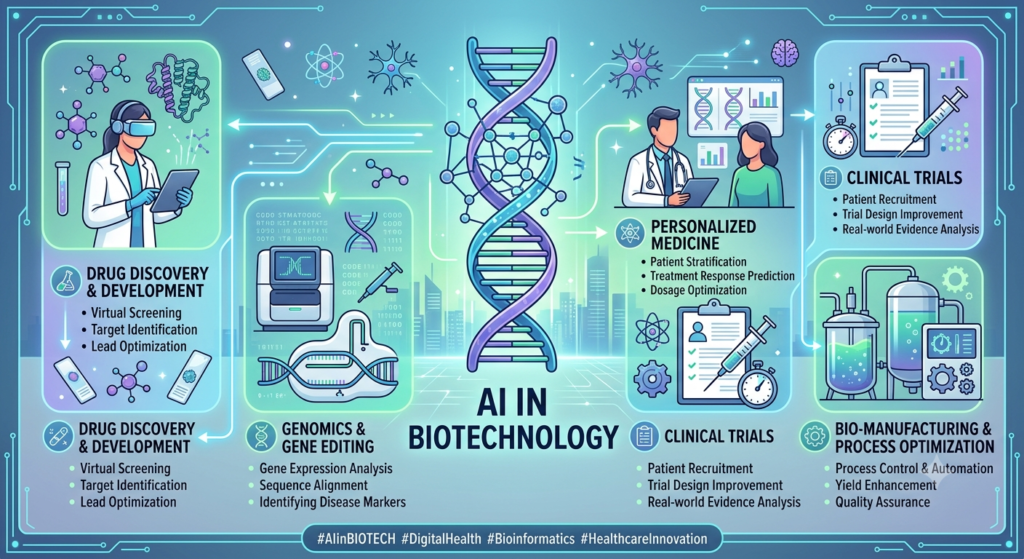
AI in Biotechnology: 10 Powerful Applications and Future Trends
Artificial intelligence is changing how scientists study living organisms, develop medicines, and solve complex biological problems. From understanding human DNA to designing new proteins, modern technology is opening doors that once seemed impossible.
AI in Biotechnology combines artificial intelligence with biological science to help researchers understand complex data, predict biological outcomes, and improve laboratory work. It brings together machine learning, deep learning, genomics, bioinformatics, and computational biology.
Traditional biotechnology often depends on laboratory experiments, manual analysis, and repeated testing. These methods remain essential, but they can take a great deal of time. AI helps researchers analyze large amounts of information, identify useful patterns, and choose which experiments to perform next.
For example, scientists can use AI to study genetic variations linked to diseases. Pharmaceutical researchers can predict which molecules may become useful medicines. Agricultural scientists can explore ways to improve crop resistance and productivity.
These developments are creating new opportunities across healthcare, agriculture, food production, environmental science, and pharmaceutical research.
However, AI isn’t a replacement for scientific knowledge or laboratory testing. Its predictions must be checked through reliable experiments, expert review, and clinical studies when human health is involved.
This article explains AI in biotechnology, its major applications, practical examples, benefits, challenges, and future possibilities. It also provides a simple introduction for students and beginners who want to understand this growing field.
1. What Is AI in Biotechnology?
AI in biotechnology refers to the use of intelligent computer systems to analyze biological information, recognize patterns, make predictions, and support scientific decisions.
Biotechnology uses living organisms, cells, enzymes, and biological processes to create useful products or solve problems. Artificial intelligence adds powerful data analysis and prediction tools to this work.
Together, these fields can improve research in medicine, agriculture, genetics, and industrial biology.
How Does Artificial Intelligence in Biotechnology Work?
AI systems learn from data. Depending on the task, this data may include DNA sequences, protein structures, medical images, laboratory measurements, or chemical properties.
Researchers prepare the data and use suitable algorithms to identify relationships within it. The resulting model can then make predictions about new information.
A simplified workflow looks like this:
- Collect data: Gather genetic information, laboratory results, or biological images.
- Prepare data: Remove errors, organize records, and check data quality.
- Train an AI model: Use machine learning or deep learning to identify patterns.
- Generate predictions: Estimate possible biological outcomes or promising research targets.
- Test results: Conduct experiments to check whether predictions are correct.
- Improve the model: Use new findings to improve future predictions.
This process supports AI-powered biological research and helps scientists focus on promising ideas.
Key Technologies Behind AI in Biotechnology
| Technology | Main purpose | Example |
| Machine learning | Finds patterns in data | Predicting disease risk |
| Deep learning | Learns complex data relationships | Analyzing protein structures |
| Natural language processing | Extracts information from scientific text | Reviewing research papers |
| Computer vision | Interprets images | Examining cell images |
| Robotics and automation | Performs repeatable laboratory tasks | Automated sample handling |
| Predictive analytics | Estimates possible outcomes | Identifying promising drug candidates |
Why Are AI and Biotechnology a Strong Match?
Biology is highly complex. Even a small change in a gene or protein can affect how a living system works. Researchers also generate enormous amounts of data through modern experiments.
AI can help analyze this information more efficiently than manual review alone.
For example, a genomics project may produce millions of data points. An AI model can help identify patterns that researchers might otherwise struggle to find.
Still, biological systems are complicated. A pattern found in one dataset may not apply to every patient, organism, or environment. Scientists must consider this limitation when using AI predictions.
2. Major Applications of AI in Biotechnology
Applications of AI in biotechnology cover almost every stage of modern biological research. These tools support early discovery, laboratory testing, product development, and healthcare.
2.1 AI in Drug Discovery
Drug discovery is one of the most important uses of AI in biotech. Developing a new medicine requires researchers to identify a disease target, find suitable molecules, test their effects, and evaluate their safety.
AI can help scientists screen large collections of chemical compounds and predict which ones may interact with a biological target.
It can also support the identification of drug targets and the prediction of molecular properties.
Key applications include:
- Screening potential drug candidates.
- Predicting how molecules may interact with proteins.
- Identifying new uses for existing medicines.
- Estimating certain safety risks.
- Supporting the design of new molecules.
AI-assisted drug development can help researchers prioritize promising candidates. However, a promising computer prediction doesn’t prove that a drug is safe or effective in humans. Laboratory studies and clinical trials remain necessary.
2.2 AI in Genomics
Genomics focuses on the study of an organism’s complete genetic information. AI in genomics helps scientists analyze DNA sequences, identify genetic variations, and explore possible links between genes and diseases.
Machine learning in biotechnology can help classify genetic patterns and identify changes that deserve further investigation.
For example, researchers may use AI to compare genetic information from different groups and identify variations associated with a particular condition.
These findings can support genetic research, disease studies, and the development of precision medicine.
2.3 AI in Protein Structure Prediction
Proteins perform essential functions in living organisms. Their shapes affect how they work and interact with other molecules.
Predicting protein structure from biological information is a major scientific challenge.
DeepMind’s AlphaFold has made an important contribution by predicting many protein structures with high accuracy. Researchers can use these predictions to explore protein function and generate new research questions.
Protein structure prediction can support drug discovery, enzyme research, and the study of biological processes.
Nevertheless, proteins can change shape, interact with other molecules, and behave differently under different conditions. Structural predictions don’t answer every question about protein function.
2.4 AI in Genetic Engineering
Genetic engineering involves changing an organism’s genetic material for research or practical purposes.
AI can help researchers study genes, compare possible genetic changes, and predict the effects of certain modifications.
When combined with CRISPR Technology, AI may support the selection of gene-editing targets and the evaluation of possible unintended effects.
Researchers can also use computational models to explore how genetic changes may affect cells.
These tools can improve planning, but genetic engineering requires careful experimental validation, safety checks, and ethical oversight.
2.5 AI in Bioinformatics
Bioinformatics combines biology, computing, statistics, and data science. AI in bioinformatics helps researchers process large biological datasets and identify meaningful relationships.
Common applications include:
- DNA and RNA sequence analysis.
- Protein classification.
- Gene expression analysis.
- Biological network analysis.
- Identification of disease-related patterns.
- Analysis of microbial communities.
Bioinformatics tools help turn raw biological data into useful scientific information. AI extends these capabilities by learning complex relationships that may be difficult to detect through basic statistical methods.
2.6 AI in Pharmaceutical Research
Pharmaceutical research involves discovering, testing, and developing medicines. AI can support several stages of this process.
Researchers may use AI to estimate molecular properties, organize scientific evidence, identify potential drug combinations, and analyze experimental results.
AI systems can also help manage research information across large projects.
These capabilities may improve decision-making and reduce unnecessary experiments. However, they don’t remove the need for safety testing, regulatory review, or clinical evidence.
2.7 AI in Biomedical Research
AI in biomedical research supports the study of diseases, cells, tissues, and biological mechanisms.
For instance, computer vision models can analyze microscopy images to identify cell types or measure changes in cell appearance.
Machine learning can also help researchers examine medical images, laboratory results, and other biomedical information.
These methods are useful when datasets are too large for efficient manual analysis.
2.8 AI in Agriculture and Industrial Biotechnology
AI isn’t limited to healthcare. Agricultural biotechnology can use AI to study crop traits, plant diseases, and genetic characteristics associated with environmental stress.
Industrial biotechnology can use AI to optimize enzymes, fermentation processes, and the production of biological materials.
For example, a manufacturer may use sensor data to monitor fermentation conditions and identify changes that affect product quality.
These applications can support biotechnology automation and more efficient production systems.
2.9 AI in Synthetic Biology
Synthetic biology involves designing or modifying biological systems for useful purposes.
AI can help researchers explore genetic designs, predict biological behavior, and identify promising enzyme variants.
Applications may include biofuel research, sustainable chemical production, and the development of new biological materials.
However, biological systems often behave in unexpected ways. Computer-generated designs must be tested under suitable laboratory conditions.
2.10 AI in Clinical and Diagnostic Research
AI can help researchers study patterns in laboratory tests, medical images, and molecular data.
In clinical research, these methods may support patient classification, biomarker discovery, and the identification of groups that respond differently to treatments.
AI healthcare biotechnology also supports research into diagnostic tools and personalized treatment strategies.
Clinical use requires strong evidence, appropriate oversight, and careful evaluation of bias and reliability.
3. How AI Is Transforming Genomics and Genetic Engineering
Genetic research has become increasingly data-intensive. Modern sequencing technologies allow scientists to study large amounts of genetic information, but understanding its biological meaning remains difficult.
AI-driven genetic research helps researchers analyze this information and develop testable hypotheses.
AI Applications in Genetic Research
One important application is genetic variant analysis. A genetic variant is a difference in DNA sequence. Some variants have no known harmful effect, while others may influence biological traits or disease risk.
AI models can help prioritize variants for further study by combining genetic information with other evidence.
Another application is gene expression analysis. Researchers measure how active different genes are under specific conditions. AI can help identify groups of genes that change together or patterns associated with particular cell states.
AI may also support the study of regulatory DNA regions, which influence when and where genes become active.
The Role of AI in CRISPR Technology
CRISPR-based gene editing allows scientists to make targeted changes to DNA. AI can help evaluate potential editing targets and predict certain outcomes.
This may help researchers compare candidate targets before conducting laboratory experiments.
However, predicted editing outcomes can differ from real biological results. Scientists must examine off-target changes, cell responses, and other safety concerns.
Responsible use is especially important when genetic engineering could affect humans, ecosystems, or future generations.
Benefits of AI in Genomics and Biotechnology
AI can help researchers:
- Process large genetic datasets.
- Prioritize genetic variations for study.
- Compare gene expression patterns.
- Explore gene-disease relationships.
- Design more focused experiments.
- Develop new questions for biological research.
These capabilities support biotechnology innovation with AI. They also highlight the importance of accurate datasets, independent validation, and expert interpretation.
4. AI in Drug Discovery: From Molecules to Medicines
Drug discovery is expensive, complex, and uncertain. Many early candidates fail because they don’t work as expected, have safety problems, or cannot be developed into effective treatments.
AI offers new ways to study these problems earlier in the research process.
Finding New Drug Targets
A drug target is a biological molecule or process that a medicine is designed to affect.
AI can help researchers analyze scientific literature, genetic studies, protein data, and disease-related measurements to identify possible targets.
These predictions may help researchers understand disease mechanisms and select targets for further investigation.
Designing and Screening Molecules
AI models can estimate how chemical structures may behave and help researchers identify compounds worth testing.
Some systems can generate new molecular structures with desired properties. Researchers can then evaluate these candidates for activity, stability, toxicity, and other characteristics.
This approach can reduce the number of compounds that need to be examined in the earliest stages of discovery.
Repurposing Existing Medicines
Drug repurposing means investigating whether an existing medicine could be useful for another disease or condition.
AI can help researchers compare drug properties, disease pathways, and scientific findings to identify possible new uses.
These predictions can guide further studies, but they don’t establish that a medicine is effective for a new condition.
Can AI Improve Drug Discovery?
Yes, AI can improve parts of drug discovery by helping researchers analyze data, prioritize compounds, and plan experiments.
However, it doesn’t guarantee faster approval or lower overall costs in every project. Model performance depends on data quality, biological complexity, and the way predictions are validated.
The strongest results come when computational analysis works alongside laboratory science and clinical research.
5. AI in Bioinformatics and Computational Biology
Bioinformatics and computational biology are central to modern life sciences. Both fields use computational methods to understand biological information, although computational biology often places greater emphasis on mathematical models of biological systems.
AI adds new ways to analyze complex data and develop predictive models.
Understanding Large Biological Datasets
Biological research can generate data from DNA sequencing, RNA sequencing, protein analysis, microscopy, and laboratory experiments.
AI can help identify patterns across these sources.
For example, researchers may combine gene expression data with protein information to study how cells respond to a treatment.
This type of analysis can reveal relationships that deserve additional experimental testing.
Biological Data Analytics
Biological data analytics involves organizing and interpreting information from living systems.
AI can support:
- Pattern recognition in biological datasets.
- Classification of cell types.
- Prediction of molecular properties.
- Analysis of biological networks.
- Identification of unusual experimental results.
These tasks can support computational biology solutions and improve research planning.
AI and Scientific Literature
Scientific research produces a growing volume of published information. Natural language processing tools can help researchers search papers, extract key findings, and compare evidence across studies.
These tools may help scientists find relevant information more quickly.
However, AI-generated summaries can contain errors or miss important context. Researchers should verify important claims against original scientific sources.
For students, a combination of programming, statistics, biology, and critical reading provides a strong foundation in bioinformatics and AI.
6. AI in Precision Medicine and Personalized Healthcare
Precision medicine aims to select healthcare approaches based on individual characteristics, including genetics, clinical history, environment, and lifestyle where relevant.
AI can help researchers analyze these factors and explore why patients may respond differently to the same treatment.
How AI Supports Personalized Treatment
AI models can combine information from several sources to identify patterns associated with treatment response.
For example, researchers may study whether certain genetic variations are linked to differences in how patients process a medicine.
Other studies may examine biomarkers that help distinguish disease subtypes.
These findings can support the development of more personalized treatment strategies.
AI in Disease Detection and Diagnosis Research
AI can help analyze medical images, laboratory measurements, and molecular data to identify patterns linked to disease.
In biotechnology research, these methods can support biomarker discovery and the development of diagnostic tests.
However, an algorithm’s performance in a research dataset doesn’t guarantee that it will work equally well in every hospital or population.
Before clinical use, systems need appropriate validation and monitoring.
Challenges in Precision Medicine AI
Personalized healthcare depends on reliable and representative data. If a model is trained mostly on one population, it may perform less accurately for people who are underrepresented in the dataset.
Patient privacy is also essential. Genetic information can be highly sensitive and requires careful protection.
For these reasons, precision medicine technology must combine scientific progress with privacy safeguards, fairness, and clinical oversight.
7. Real-World Examples of AI in Biotechnology
Several organizations demonstrate how AI is being used to address biological research challenges. Their work illustrates different approaches rather than proving that every AI method will succeed.
DeepMind and AlphaFold
AlphaFold — Protein Structure Prediction
AlphaFold, developed by DeepMind and its collaborators, has advanced the prediction of protein structures from amino acid sequences. Its work helps researchers investigate protein function, disease biology, and potential drug targets.
Its predictions are valuable research resources, but they don’t replace experiments designed to test protein behavior.
Insilico Medicine
Insilico Medicine — AI-Assisted Drug Development
Insilico Medicine uses AI-based methods in drug discovery and development. Its work includes identifying potential targets and designing drug candidates.
The company’s approach illustrates how computational models can support early pharmaceutical research and candidate selection.
BenevolentAI
BenevolentAI — Biomedical Knowledge Analysis
BenevolentAI has worked on applying AI and data analysis to biomedical research. Such approaches can help researchers connect scientific literature, biological evidence, and potential therapeutic targets.
Recursion Pharmaceuticals
Recursion Pharmaceuticals — Biological Data and Automation
Recursion Pharmaceuticals combines biological experimentation, imaging, data science, and AI to investigate disease biology and potential treatments.
This approach shows how automated experiments and computational analysis can work together in drug discovery.
What Can We Learn From These Examples?
These organizations illustrate several important trends:
- AI can support different stages of biological research.
- Protein prediction and drug discovery are distinct but related applications.
- Automated experiments can generate data for AI analysis.
- Scientific validation remains essential.
- Research success depends on more than the performance of a computer model.
For additional scientific information, readers can explore the AlphaFold Protein Structure Database at alphafold.ebi.ac.uk.
8. Benefits of AI in Biotechnology
The benefits of AI in biotechnology depend on the research goal, available data, and quality of implementation. When used correctly, these systems can improve several aspects of scientific work.
Faster Data Analysis
AI can process large datasets and identify patterns more quickly than many manual approaches.
This can help researchers spend less time on repetitive analysis and more time interpreting findings.
Better Research Prioritization
Scientists often have many possible experiments but limited time and resources.
AI can help rank candidates, identify promising targets, and select experiments that may provide useful information.
This doesn’t eliminate uncertainty, but it can support better planning.
Improved Automation
Biotechnology automation combines software, laboratory instruments, and data systems to perform repeatable tasks.
AI may help monitor experiments, identify unusual results, and adjust certain processes within validated limits.
Automation can also improve consistency when procedures are carefully designed.
Support for New Discoveries
AI can identify relationships that aren’t immediately obvious to researchers.
These findings may lead to new hypotheses about genes, proteins, diseases, or biological processes.
The value comes from combining computational predictions with scientific reasoning and experimental evidence.
Potential Cost and Resource Savings
AI may reduce unnecessary experiments and help researchers allocate resources more effectively.
However, building reliable models, managing data, purchasing computing resources, and validating predictions can also be expensive.
Savings depend on the specific project and should be measured rather than assumed.
Summary of Key Benefits
| Benefit | Potential impact | Important limitation |
| Faster analysis | Shorter data-processing time | Data quality still matters |
| Better prioritization | More focused experiments | Predictions may be wrong |
| Automation | Greater consistency | Equipment requires validation |
| Discovery support | New research hypotheses | Findings need confirmation |
| Resource efficiency | Better use of time and materials | Initial costs can be high |
| Personalized research | Better understanding of patient differences | Bias and privacy risks remain |
9. Challenges and Limitations of AI in Biotechnology
Despite its promise, AI in biotechnology faces important scientific, technical, ethical, and financial challenges.
Data Quality and Availability
AI models depend on suitable training data. Biological datasets may contain missing values, inconsistent measurements, errors, or limited representation of certain organisms and populations.
Poor-quality data can produce unreliable predictions.
Researchers need clear data standards, suitable quality checks, and independent testing.
Limited Biological Understanding
A model may identify a statistical pattern without explaining the underlying biological mechanism.
For example, two variables may appear related because of another factor that wasn’t measured.
Scientists must distinguish correlation from causation and avoid treating every AI prediction as a biological fact.
Privacy and Security
Genetic and medical information can reveal sensitive details about individuals and their families.
Organizations must protect this data through appropriate access controls, secure storage, and responsible data-sharing practices.
Bias and Fairness
If training data does not represent the intended population, AI models may produce uneven results.
This is particularly important in precision medicine and diagnostic research.
Researchers should test model performance across relevant groups and clearly document limitations.
High Implementation Costs
Developing and maintaining AI systems can require skilled staff, computing resources, laboratory integration, and ongoing monitoring.
Smaller research teams may find these requirements difficult to manage.
Open-source tools, shared research infrastructure, and well-defined pilot projects may help reduce barriers.
Ethical and Regulatory Questions
AI-supported biological research raises questions about accountability, consent, safety, and the responsible use of genetic information.
Some applications, including gene editing and synthetic biology, may require additional oversight because their effects can extend beyond an individual experiment.
Clear governance and expert supervision are essential for responsible innovation.
10. Future Possibilities of AI in Biotechnology
The future possibilities of AI in biotechnology extend beyond faster analysis. Researchers are working toward systems that connect computational predictions, laboratory experiments, and biological understanding more closely.
These developments may help make research more efficient, targeted, and adaptable.
AI-Driven Laboratory Research
Future laboratories may use AI to help select experiments, coordinate instruments, and analyze results as experiments progress.
In carefully controlled settings, this approach could allow researchers to test hypotheses in repeated cycles.
Such systems will still require validated procedures, safety controls, and human oversight.
Advances in Protein and Molecular Design
AI models may improve the design of proteins, enzymes, and other biological molecules.
Researchers could use these systems to investigate new enzymes for industrial production, develop improved research tools, or explore possible therapeutic candidates.
However, a designed molecule must still be tested for stability, function, safety, and performance in real conditions.
Growth of Precision Medicine
As genomic and clinical datasets improve, AI may help researchers better understand differences between patients.
This could support improved disease classification, biomarker discovery, and treatment research.
Progress will depend on reliable data, fair representation, clinical evidence, and privacy protection.
Synthetic Biology Innovation
AI may help scientists design biological systems for sustainable manufacturing, agriculture, and environmental applications.
Possible areas include enzyme development, alternative materials, and improved biological production processes.
The long-term value of these applications will depend on whether they are safe, practical, and economically sustainable.
Integration With Robotics and Digital Biotechnology
Smart biotechnology systems may combine AI, laboratory robotics, sensors, and data platforms.
These systems could help monitor experiments, track samples, and identify process changes.
The result may be a more connected research environment in which experimental data can inform later decisions.
Future Trends to Watch
| Emerging trend | Possible application |
| AI-designed proteins | Enzyme and therapeutic research |
| Automated laboratories | Faster experimental cycles |
| Multimodal AI | Combining genetic, imaging, and clinical data |
| Improved genomic models | Genetic research and disease studies |
| AI-assisted biomanufacturing | More consistent biological production |
| Digital twins of biological processes | Simulating selected biological or industrial systems |
| Responsible AI frameworks | Better oversight, transparency, and data protection |
AI and the future of biotechnology will depend on cooperation between biologists, data scientists, engineers, clinicians, and regulators. The greatest advances are likely to come when AI tools solve clearly defined scientific problems and their results can be tested in the real world.
11. AI in Biotechnology for Students and Beginners
Students interested in AI in biotechnology can begin by learning the basic concepts of biology, statistics, and computer science.
You don’t need to master every subject at once. A step-by-step approach can help you build useful skills.
Essential Skills to Learn
- Biology fundamentals: Understand cells, DNA, RNA, proteins, genes, and basic genetics.
- Statistics: Learn probability, averages, distributions, correlation, and experimental design.
- Programming: Start with Python, especially data structures, functions, and basic data analysis.
- Machine learning: Study classification, regression, model evaluation, and overfitting.
- Bioinformatics: Learn how to work with biological sequences and public scientific datasets.
- Scientific communication: Practice reading research papers and explaining results clearly.
Beginner-Friendly Project Ideas
| Project | Skills developed |
| Analyze a public DNA sequence | Sequence handling and basic biology |
| Explore gene expression data | Data analysis and statistics |
| Classify biological samples | Introductory machine learning |
| Visualize protein structures | Molecular biology and visualization |
| Review scientific papers using AI | Literature analysis and verification |
Students should use publicly available datasets with suitable permissions and avoid uploading identifiable genetic or medical information to unapproved services. A good beginner project doesn’t need to produce a major scientific discovery. Its goal is to demonstrate a clear question, sound methods, and honest interpretation.
Future of biotechnology with artificial intelligence
AI in Biotechnology is creating new opportunities to understand biological systems, improve scientific research, and develop innovative products. Its applications span drug discovery, genomics, genetic engineering, bioinformatics, precision medicine, synthetic biology, and industrial biotechnology.
Machine learning and deep learning can help researchers analyze complex data, identify patterns, and prioritize promising experiments. Tools such as AlphaFold also demonstrate how AI can address challenging scientific problems.
However, biotechnology involves living systems that are often difficult to predict. AI models can make mistakes, reflect biased data, or produce results that don’t hold up under experimental testing. Privacy, safety, ethics, and scientific validation must remain central to their use.
The future of biotechnology with artificial intelligence will depend on combining powerful computational tools with human expertise and sound experimental methods. For students, researchers, and biotechnology companies, learning how to use AI responsibly can create valuable opportunities in the growing life sciences industry.
Know More:
”FAQs”
1. What is AI in biotechnology?
AI in biotechnology is the use of artificial intelligence to analyze biological data, make predictions, and support scientific research. It is used in genomics, drug discovery, bioinformatics, genetic engineering, and other areas of life sciences.
2. How is AI used in biotechnology?
AI helps scientists analyze DNA sequences, predict protein structures, screen drug candidates, examine biological images, and automate selected laboratory tasks. It supports research decisions but doesn't replace laboratory testing.
3. What are the applications of AI in biotechnology?
Major applications include drug discovery, genomics, protein structure prediction, genetic engineering, bioinformatics, precision medicine, synthetic biology, agricultural biotechnology, and biological manufacturing.
4. How does AI help in genomics research?
AI can analyze genetic sequences, prioritize genetic variants, identify patterns in gene expression, and help researchers explore relationships between genes and diseases. Predictions require scientific validation before they can support clinical decisions.
5. Can AI improve drug discovery?
Yes. AI can help researchers identify potential drug targets, screen molecules, predict selected molecular properties, and explore new uses for existing medicines. However, it cannot guarantee that a drug will be safe or effective.
6. What are the benefits of AI in biotechnology?
Benefits may include faster data analysis, improved research prioritization, more efficient automation, better experimental planning, and support for new scientific discoveries. The actual impact depends on data quality and the research setting.
7. What is the future of AI in biotechnology?
Future developments may include more advanced protein design, AI-assisted laboratories, improved precision medicine research, synthetic biology, and smarter biological manufacturing. Responsible testing and human oversight will remain important.
8. How does machine learning support biotechnology?
Machine learning identifies patterns in biological data and uses them to make predictions. It can support genetic analysis, disease research, protein classification, drug screening, and the study of biological processes.
9. What are examples of AI in biotechnology?
Examples include AlphaFold for protein structure prediction, AI-based drug discovery research at Insilico Medicine, biomedical data analysis at BenevolentAI, and automated biological research at Recursion Pharmaceuticals.
10. How is AI transforming life sciences?
AI is helping life sciences researchers process larger datasets, prioritize experiments, develop research hypotheses, and connect computational analysis with laboratory work. It is creating new opportunities while also increasing the need for reliable data, validation, and responsible governance.