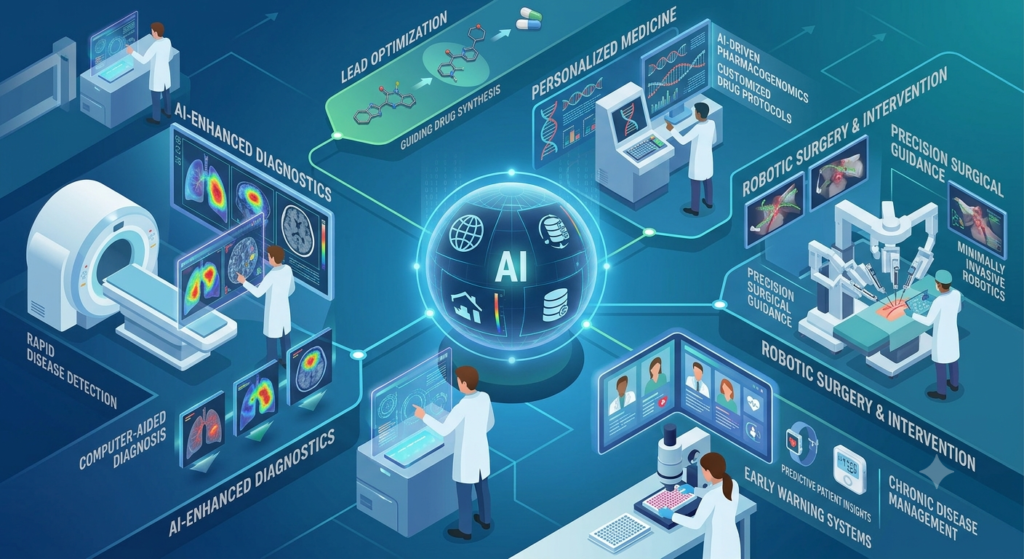
1.How Artificial Intelligence Is Transforming Healthcare and How AI Is Changing Modern Healthcare
Healthcare is changing fast. Doctors now have access to digital tools that can help them detect diseases, study medical records, and plan treatments. One of the most important changes is the growth of artificial intelligence in healthcare.
Artificial intelligence, or AI, allows computers to perform tasks that usually require human thinking. These tasks include finding patterns, understanding language, making predictions, and analyzing images. In medicine, these abilities can help healthcare teams work more efficiently.
The use of AI in healthcare is growing across hospitals, clinics, laboratories, and research centers. It supports medical diagnosis, patient monitoring, drug discovery, and hospital management. It can also help doctors understand large amounts of health data.
However, AI isn’t a replacement for human care. Doctors bring medical knowledge, experience, empathy, and judgment to every patient. AI works best when it supports these skills.
Why Is Healthcare Adopting AI?
Healthcare organizations face several challenges. These include rising costs, growing patient numbers, staff shortages, and the need for faster diagnosis. AI healthcare solutions can help address some of these problems.
- Faster analysis: AI can process large amounts of data quickly.
- Better support for doctors: AI tools can highlight patterns that need further review.
- More personalized care: AI can help match treatment plans to individual needs.
- Improved efficiency: Automation can reduce repetitive administrative work.
- Stronger research: AI can help scientists study diseases and identify possible new treatments.
The impact of artificial intelligence on the healthcare industry depends on how well these tools are designed and used. Good results require reliable data, clinical testing, staff training, and human oversight.
2. How Artificial Intelligence Is Transforming Healthcare and What Is Artificial Intelligence in Healthcare?
Artificial intelligence in healthcare refers to the use of computer systems to support medical, clinical, and administrative tasks. These systems can learn from data, recognize patterns, generate text, or provide predictions.
In simple terms, AI helps computers find useful information in health data. A doctor can then use that information to make a more informed decision.
Main Types of Healthcare AI Technology
1. Machine learning
Machine learning in healthcare uses data to identify patterns and make predictions. For example, a model may analyze past patient records to estimate the risk of a medical condition.
2. Deep learning
Deep learning uses complex networks of connected computing units. It’s useful for tasks such as analyzing medical images and identifying patterns in scans.
3. Natural language processing
Natural language processing helps computers understand human language. Healthcare teams can use it to extract information from clinical notes and medical documents.
4. Generative AI
Generative AI can create new content, including text, summaries, and draft reports. It can help with clinical documentation, patient education, and research support.
5. Predictive analytics
Predictive analytics in healthcare uses existing data to estimate possible future events. Hospitals may use it to identify patients who could need extra care.
How Does AI Work in Healthcare?
- Collect data: A system receives relevant information, such as medical images or patient records.
- Analyze data: An AI model searches for patterns in that information.
- Generate an output: The system provides a prediction, classification, summary, or suggestion.
- Review the result: A qualified professional checks the result when clinical judgment is needed.
- Take action: The healthcare team decides whether and how to use the information.
AI systems don’t all work in the same way. Some use fixed rules, while others learn patterns from training data. Their accuracy also varies by task and setting.
AI Versus Traditional Healthcare Technology
Traditional software generally follows programmed rules, while AI-powered software can identify learned patterns. AI may analyze complex relationships, support predictions, flag suspicious medical-image patterns, and provide decision support. Both types of technology remain important. AI adds new capabilities, but reliable databases, secure networks, and traditional software still form the foundation of modern healthcare.
3. How AI Is Transforming Healthcare: 10 Powerful Applications
AI is changing how medical teams detect diseases, manage patients, conduct research, and deliver services. The following applications show how AI is transforming healthcare in practice.
3.1 AI in Medical Diagnosis
Medical diagnosis is one of the most promising areas for AI. Doctors often review X-rays, CT scans, MRI scans, laboratory results, and patient histories. AI systems can analyze selected types of information and highlight patterns that may require attention.
For example, AI in radiology can help identify suspicious areas in medical images. A radiologist can then review these findings alongside the patient’s symptoms and other test results. Medical diagnosis using AI may support the detection of certain cancers, eye diseases, and other conditions. Performance depends on the specific tool, disease, patient group, and clinical setting.
- Supporting early detection.
- Helping clinicians review large numbers of images.
- Highlighting findings that might need a closer look.
- Supporting more consistent review processes.
AI-assisted diagnosis should be treated as clinical support, not as a final medical decision.
3.2 AI in Personalized Medicine
Every patient is different. Age, medical history, genetics, lifestyle, and other factors can affect treatment outcomes. Personalized medicine with AI aims to help doctors understand these differences. AI systems can analyze relevant patient information to identify patterns that may help guide care.
For example, a clinical team may use a validated model to estimate how a patient could respond to a particular treatment. Doctors can then consider that information alongside medical guidelines and the patient’s preferences. Personalized recommendations require high-quality data and clinical validation. A prediction doesn’t guarantee that a treatment will work.
3.3 AI in Drug Discovery and Medical Research
Developing a new medicine takes time, money, and extensive testing. AI in drug discovery can help researchers explore large chemical databases, identify promising compounds, and predict certain molecular properties. It can also support the analysis of scientific publications and research data.
These tools may help scientists narrow down which ideas deserve further investigation. AI medical research also supports work on disease biology, clinical trial planning, and the search for potential drug targets. An AI-generated prediction doesn’t prove that a medicine is safe or effective. Laboratory studies, clinical trials, regulatory review, and other research steps remain necessary.
3.4 AI-Powered Patient Monitoring
Patient care doesn’t end when someone leaves a hospital or clinic. Remote patient monitoring AI can help analyze information from connected devices, such as blood pressure monitors, heart rate sensors, and glucose monitors.
A monitoring system may flag readings that fall outside a patient’s agreed care limits. A healthcare professional can review the information and decide whether follow-up is needed. These tools may support people with long-term conditions, but not every unusual reading signals an emergency. Systems need suitable thresholds, clear alerts, and reliable follow-up procedures.
3.5 AI-Assisted Surgery
AI-assisted surgery combines digital tools, medical imaging, and computer analysis to support surgical teams. Some systems help surgeons plan procedures or view anatomical structures. Others support robotic surgical platforms by providing controlled instruments and enhanced visualization.
Robotic surgery doesn’t mean a robot independently performs every operation. Many surgical systems are controlled directly by trained surgeons. Safety checks, professional training, and careful monitoring remain essential.
3.6 Healthcare Workflow Automation
Doctors and nurses spend time on tasks beyond direct patient care. These can include documenting visits, organizing records, scheduling appointments, and preparing reports. AI healthcare workflow automation can reduce some of this repetitive work.
- Drafting clinical notes from recorded conversations, with appropriate consent.
- Summarizing patient records for clinician review.
- Sorting administrative requests.
- Helping route patient questions to the right department.
- Extracting relevant information from medical documents.
Automation can give staff more time for patients. Generated notes must be checked for errors, missing details, and incorrect information.
3.7 AI in Hospital Management
Hospitals manage beds, staff, equipment, appointments, supplies, and patient transfers. AI in hospital management can help teams estimate demand, plan staffing, and identify operational bottlenecks. A hospital may analyze historical admissions to estimate how many beds could be needed during a busy period.
These systems can also support equipment maintenance and inventory planning. Their predictions are useful only when the underlying data reflects current conditions. Hospital managers must also account for emergencies and unexpected changes in patient demand.
3.8 AI and Electronic Health Records
Electronic health records contain important information about diagnoses, medications, allergies, tests, and treatment history. Electronic health records AI can help organize these records and identify information that matters for a particular task.
A clinical decision support system may flag a potential drug interaction or remind a clinician that a patient needs a recommended screening test. These tools can improve access to information, but incomplete records and incorrect patient data can lead to misleading results. Healthcare organizations must maintain accurate records and protect sensitive information.
3.9 Generative AI and ChatGPT in Healthcare
Generative AI is creating new opportunities in healthcare communication and administration. ChatGPT in healthcare can support tasks such as drafting patient education material, explaining general medical concepts, preparing administrative documents, and summarizing non-sensitive information.
A healthcare professional could use a language model to draft a simple explanation of a routine procedure. The professional should review the text before sharing it with patients. Generative AI may also help researchers organize literature reviews and prepare early drafts of reports.
These tools can produce false statements, outdated information, or convincing but incorrect explanations. They shouldn’t be treated as independent medical authorities. Private patient information should never be entered into an unapproved AI service.
3.10 AI in Public Health
AI can support public health teams working to protect entire communities. By analyzing suitable datasets, public health organizations may identify changes in disease patterns, estimate demand for services, or study environmental factors that affect health.
Predictive analytics in healthcare can help planners prepare resources for expected demand. However, public health predictions are uncertain. Data gaps, reporting delays, and changes in human behavior can affect results. Responsible use requires transparency, privacy protection, and human review.
4. What Are the Benefits of Artificial Intelligence in Healthcare?
AI healthcare systems can offer meaningful benefits when they are accurate, properly tested, and integrated into clinical practice.
4.1 Faster Analysis and Support for Diagnosis
AI can process some types of data much faster than manual review alone. It may help clinicians prioritize urgent cases or identify patterns that deserve further investigation. The value of this speed depends on whether the system produces useful results and fits the clinical workflow.
4.2 Improved Patient Care
AI-driven patient care solutions can help healthcare teams organize information, monitor selected health measures, and identify patients who may need additional attention. These tools may support more timely follow-up and help clinicians make informed decisions. Good patient care still depends on communication, empathy, professional judgment, and patient choice.
4.3 Reduced Administrative Work
Automation can reduce repetitive tasks such as organizing documents, drafting reports, and sorting requests. This may help healthcare professionals spend more time on clinical duties. The benefits are greatest when organizations redesign workflows carefully instead of simply adding another tool to an already complicated system.
4.4 Better Use of Healthcare Resources
Hospitals can use AI to support staffing plans, supply management, and demand forecasting. Better planning may reduce waste and improve service delivery, although savings aren’t guaranteed.
4.5 Support for Medical Research
AI tools can help scientists analyze large datasets, search scientific literature, and explore potential research directions. These capabilities may speed up parts of research, but they don’t remove the need for careful experiments and independent verification.
4.6 Greater Access to Health Information
AI assistants can explain common medical terms and provide general health education in accessible language. They may also help people prepare questions for healthcare appointments. AI-generated advice should not replace an assessment by a qualified healthcare professional, especially when symptoms are serious or worsening.
4.7 Predictive Insights
Patient outcome prediction can help clinicians identify people who may have a higher risk of complications or deterioration. A validated risk model may support decisions about monitoring or follow-up. Predictions should never be treated as certain outcomes. Clinicians must consider the full patient picture and the limitations of the model.
5. Challenges and Risks of AI in Healthcare
Despite its potential, healthcare AI comes with important risks. Understanding these problems is essential for safe adoption.
5.1 Patient Privacy and Data Security
Healthcare records contain highly sensitive information. AI systems that process these records must protect them from unauthorized access and misuse. Organizations should use appropriate access controls, encryption, security testing, and data governance. They should also understand how vendors store and use information.
5.2 Bias and Unfair Results
AI models learn patterns from the data used to train them. If that data fails to represent the wider patient population, the model may perform poorly for some groups. Healthcare organizations should test models across relevant patient groups and monitor performance after deployment.
5.3 Incorrect Predictions
AI systems can make mistakes. A tool may miss a disease, flag a harmless finding, or generate an inaccurate medical summary. These errors can affect patient care if staff trust the output without checking it. Human oversight, clinical validation, and clear procedures for handling errors are essential.
5.4 High Implementation Costs
Introducing AI may require new software, secure infrastructure, staff training, system integration, and ongoing maintenance. Smaller healthcare organizations may find these costs difficult to manage. Before purchasing a solution, organizations should compare its total cost with measurable benefits and practical needs.
5.5 Legal and Ethical Questions
AI raises questions about accountability, consent, transparency, and responsibility when something goes wrong. Healthcare organizations must understand applicable privacy laws, medical device requirements, and professional standards.
World Health Organization guidance:
5.6 Overdependence on Technology
AI should support clinical judgment, not replace it. If staff rely too heavily on automated recommendations, they may overlook important details. Healthcare teams need training to understand what an AI system can do, where it can fail, and when to ignore its recommendations.
6. Real-World AI Healthcare Examples and Use Cases
AI is already used in selected healthcare settings. These examples explain common applications without assuming that every hospital uses every technology.
AI Use Cases Across Healthcare
Radiology: Image analysis and prioritization can help flag findings for review. Eye care: Retinal image analysis can support screening for selected eye diseases. Oncology: Medical image and research-data analysis can support diagnosis and treatment planning. Cardiology: Heart-signal analysis can help identify patterns that require review. Drug research: Molecular analysis can help researchers explore promising compounds. Primary care: Clinical documentation support can reduce some administrative tasks. Hospital operations: Demand forecasting can support bed and staff planning. Remote care: Connected-device analysis can support patient monitoring. Public health: Disease-trend analysis can inform resource planning. Patient education: Plain-language explanations can make health information easier to understand.
Example 1: Supporting Radiologists
A hospital may use a validated AI tool to flag suspicious findings in selected medical scans. The tool helps direct attention to possible problems. A radiologist reviews the scan and decides what the findings mean. This approach can support the diagnostic process without removing the need for medical expertise.
Example 2: Monitoring Patients at Home
A care team may use connected devices to collect readings from patients with long-term conditions. An AI system can identify measurements that meet predefined alert criteria. The team reviews these alerts and decides whether to contact the patient or change the monitoring plan. Clear escalation procedures are important because delayed or missed alerts can create risks.
Example 3: Improving Hospital Scheduling
A hospital may analyze historical appointment data to identify periods of high demand. Its planning team can use these estimates to adjust staffing, appointment slots, and other resources. The model supports planning, but managers still need to account for local events, staff availability, and unexpected demand.
These examples demonstrate how AI healthcare innovation can improve selected processes when the technology is suitable for the task.
7. Future of AI in Healthcare: Trends to Watch
The future of AI in healthcare will likely involve deeper integration with digital health systems, better monitoring, and more specialized tools.
7.1 More Personalized Treatment Support
As medical data and validated models improve, AI may help clinicians assess treatment options using more individual patient information. This could support more targeted care, provided privacy and clinical safety remain priorities.
7.2 Growth in Generative AI
Generative AI may become more common in documentation, patient communication, medical education, and research support. Healthcare organizations will need clear policies for checking outputs and protecting confidential information.
7.3 Connected and Intelligent Healthcare Systems
Future AI healthcare systems may connect information from medical records, laboratory services, imaging departments, and remote monitoring devices. Better integration could reduce information gaps and help care teams coordinate services. Connected systems also create new security and data-quality challenges.
7.4 AI for Medical Research
AI may continue to support research into new medicines, disease mechanisms, and treatment approaches. The most valuable advances will need to show that they improve research quality or patient outcomes, rather than simply generating results more quickly.
7.5 Stronger Rules and Clinical Evaluation
As AI use expands, healthcare organizations will need robust testing, monitoring, and governance. Future healthcare technology trends will likely place greater emphasis on transparent performance, safety, fairness, and accountability. The central goal should remain clear: use technology to improve health outcomes while protecting patients.
8. AI in Healthcare for Students and Beginners
Artificial intelligence in healthcare explained in simple terms is the use of computer tools to help solve healthcare problems. Students interested in this field can start by learning the basics of healthcare, statistics, programming, and machine learning.
Important Topics to Study
- Healthcare fundamentals: Learn how diagnosis, treatment, and patient monitoring work.
- Data science: Understand how data is collected, cleaned, and analyzed.
- Machine learning: Study how computer models learn patterns from examples.
- Medical ethics: Learn about privacy, fairness, consent, and safety.
- AI evaluation: Understand accuracy, sensitivity, specificity, and false results.
Beginner-Friendly Learning Activities
- Explore public, de-identified healthcare datasets.
- Learn basic Python and data analysis.
- Study how classification models work.
- Compare model predictions with known results.
- Review the ethical and practical limits of medical AI.
Students should not use real patient information without proper authorization. Educational models should not be used to diagnose or treat real people.
Building a Smarter Healthcare Future
Artificial intelligence is creating new opportunities across the healthcare industry. From medical imaging and personalized treatment support to drug discovery and hospital automation, AI healthcare technology can help professionals analyze information and manage complex tasks.
However, the success of healthcare AI depends on more than advanced software. It requires reliable data, strong security, careful testing, ethical standards, and trained healthcare professionals.
AI should support doctors, nurses, researchers, and hospital teams rather than replace their expertise. Patients must remain at the center of every decision.
As healthcare technology continues to develop, organizations should focus on solutions that address real problems and demonstrate measurable value. With responsible implementation, artificial intelligence in healthcare can contribute to more efficient services, better-informed decisions, and improved patient care.
Know More:
”FAQs”
1. What is artificial intelligence in healthcare?
Artificial intelligence in healthcare is the use of computer systems to analyze health data, recognize patterns, support medical decisions, and automate selected tasks. It can assist with diagnosis, research, patient monitoring, and hospital operations.
2. How is AI used in healthcare?
AI is used in medical imaging, clinical decision support, drug discovery, remote patient monitoring, patient record analysis, and administrative automation. Its role depends on the system and the clinical setting.
3. What are the main benefits of AI in healthcare?
The main potential benefits include faster data analysis, support for early disease detection, reduced administrative work, improved resource planning, and better support for medical research. Actual benefits depend on accuracy and implementation.
4. Can AI replace doctors?
No. AI can support specific medical tasks, but it cannot replace the full range of clinical judgment, communication, empathy, and responsibility required in patient care. Doctors must assess AI results and make appropriate clinical decisions.
5. How does AI help in medical diagnosis?
AI can analyze selected medical images, laboratory results, and patient data to identify patterns associated with certain conditions. These findings can help clinicians investigate possible diseases, but a qualified professional must interpret them in context.
6. What are the challenges of AI in healthcare?
Major challenges include patient privacy, biased data, inaccurate predictions, implementation costs, cybersecurity risks, legal responsibilities, and overdependence on technology. Careful testing and human oversight help reduce these risks.
7. What is the future of AI in healthcare?
The future may include more personalized treatment support, better clinical documentation, connected monitoring systems, and advanced medical research tools. Progress will depend on safety, evidence, regulation, and responsible use.
8. What are some examples of AI healthcare solutions?
Examples include medical image analysis tools, systems that flag possible drug interactions, software that summarizes clinical notes, remote monitoring tools, and hospital demand forecasting systems.
9. Is generative AI safe for healthcare?
Generative AI can be useful for selected tasks, but it may produce false or incomplete information. Healthcare professionals should verify its outputs, protect patient data, and follow approved organizational policies.
10. How can students learn about healthcare AI?
Students can start with basic healthcare concepts, statistics, Python, data analysis, and machine learning. They should also study medical ethics, privacy, and the importance of validating AI models before clinical use.