AGI vs Generative AI: Understanding the Difference
Artificial intelligence (AI) has become part of everyday life. People use AI assistants to write emails, search for information, create images, learn new skills, and solve problems.
However, not all AI systems work in the same way. Some systems perform specific tasks, while others generate new content. Researchers are also working toward AI that could learn and solve a much wider range of problems.
This is where the comparison of AGI vs Generative AI becomes important.
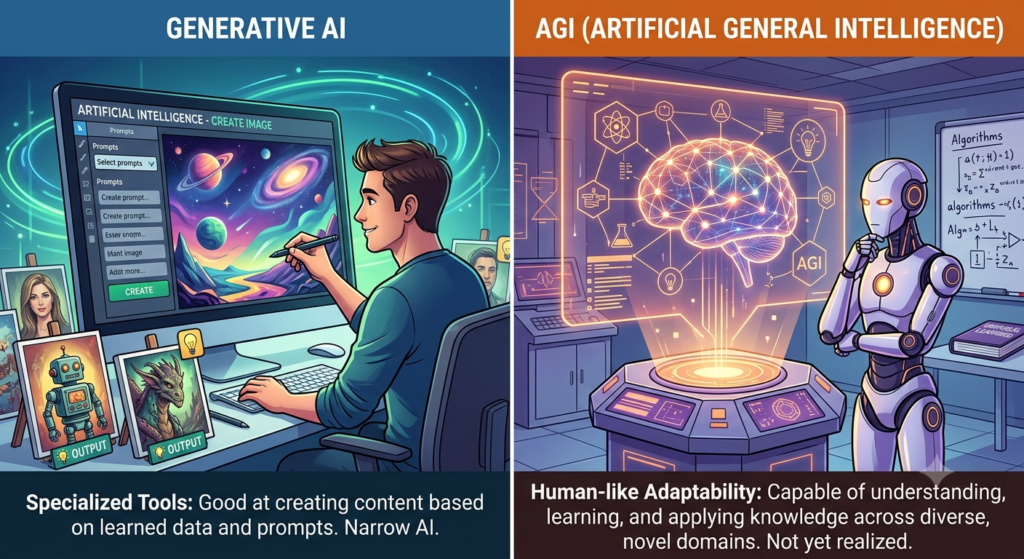
Generative AI can create text, images, music, videos, and computer code. Artificial General Intelligence, or AGI, refers to a proposed type of AI that could learn, understand, and solve many different kinds of problems at a broad, human-like level.
The main difference is simple: Generative AI focuses on creating content, while AGI aims for broad, flexible intelligence.
Today’s generative AI systems can perform impressive tasks. However, their abilities don’t automatically mean they possess general intelligence. AGI remains a research goal, and there is no universally accepted test that proves a system has achieved it.
Let’s explore these technologies step by step.
1. What Is AGI? Understanding Artificial General Intelligence
Artificial General Intelligence (AGI) is a proposed form of artificial intelligence that could learn, reason, and solve many different types of problems instead of being limited to a narrow set of tasks. The word general is important here. It means the system could apply what it learns in one area to another area.
For example, imagine an AI system that learns basic mathematics. Later, it uses that knowledge to understand engineering problems, analyze business data, and help solve scientific questions. It can also learn new skills when it faces unfamiliar situations.
This ability to adapt across different tasks is central to the idea of AGI.
Current AI systems can already perform many different tasks. However, they may still struggle with reliable reasoning, unfamiliar situations, long-term planning, and learning from limited experience. These gaps make it difficult to determine whether a system has the general abilities associated with AGI.
Key Characteristics of AGI
A system that meets a strong definition of AGI would be expected to demonstrate several abilities.
- General learning: Learn new skills across different subjects.
- Reasoning: Analyze information and work through complex problems.
- Adaptability: Respond to unfamiliar situations without needing a complete redesign.
- Knowledge transfer: Apply lessons from one task to another.
- Planning: Organize steps to reach a goal.
- Problem-solving: Explore different solutions when the first attempt fails.
These characteristics describe the goal of AGI research. They shouldn’t be treated as proof that today’s AI systems can reliably perform all these functions.
AGI Examples: What Could AGI Do?
AGI examples are mainly hypothetical because researchers have not established that a system has achieved general intelligence. Consider these possible scenarios.
Example 1: A personal learning assistant
An AGI-like system could identify a student’s learning gaps, develop a personalized study plan, teach difficult concepts, and adjust its approach based on the student’s progress.
Example 2: A scientific research assistant
Such a system could study scientific papers, suggest experiments, analyze results, and revise its ideas when evidence contradicts its original assumptions.
Example 3: A flexible workplace assistant
It could help a company analyze finances, understand customer needs, plan projects, and learn unfamiliar tasks as business requirements change.
These examples illustrate the possible scope of AGI. They don’t mean current AI tools can perform every task at human-level reliability.
Potential AGI Applications
If AGI becomes possible, its applications could extend across many industries.
| Industry | Potential Application |
| Education | Personalized learning across multiple subjects |
| Healthcare | Supporting complex research and clinical reasoning |
| Science | Exploring research questions and testing hypotheses |
| Business | Coordinating planning, analysis, and operations |
| Engineering | Helping design, test, and improve complex systems |
| Environmental research | Studying interconnected climate and resource problems |
AGI could offer major benefits, but it would also raise important questions about safety, human oversight, employment, privacy, and accountability.
2. What Is Generative AI? A Simple Explanation
Generative AI
Generative AI is a type of artificial intelligence that creates new content based on patterns learned from training data. It can generate text, images, audio, video, software code, and other forms of content.
For example, you can ask a generative AI tool to write a product description, explain a science concept, create an illustration, or suggest code for a website. The system processes your request and produces an output based on its learned patterns and design.
Unlike a simple search engine, which mainly helps you find existing information, generative AI can produce a new response for your particular request. However, generated content isn’t always accurate. A system may produce incorrect facts, misleading explanations, or code that contains errors. Human review remains important.
How Does Generative AI Work?
Generative AI uses different machine learning methods to learn patterns from data. Many modern systems use deep learning and large neural networks.
A simplified process looks like this:
- Training: The model learns patterns from a large collection of data.
- Prompt processing: The system interprets the user’s instructions.
- Generation: The model produces content based on the prompt and learned patterns.
- Review: The user checks the result and requests changes if needed.
For instance, suppose you ask an AI assistant to write an article about renewable energy. It uses its learned language patterns to create an organized explanation with headings, examples, and a conclusion.
It doesn’t need to copy an entire existing article to produce a response. However, the originality and accuracy of its output still depend on the model, prompt, training, and safeguards.
Generative AI Examples
Many familiar AI applications use generative technology.
- Text generation: Drafting emails, reports, summaries, and articles.
- Image generation: Creating illustrations, designs, and concept art.
- Code generation: Suggesting functions, tests, and code improvements.
- Audio generation: Producing speech, sound, or music.
- Video generation: Creating short video clips from instructions.
- Document assistance: Summarizing documents and answering questions about their contents.
Popular examples include ChatGPT, Google Gemini, Adobe Firefly and GitHub Copilot. Their features vary, and not every feature is purely generative.
Generative AI Applications in Everyday Life
Generative AI is useful because people can access it without needing advanced programming skills. A student can ask for a simple explanation of a difficult topic. A teacher can prepare lesson ideas. A marketer can draft campaign messages. A developer can request code suggestions. A small business owner can create product descriptions.
Generative AI in education is especially useful for creating practice questions, explaining concepts at different reading levels, and helping students brainstorm ideas.
Still, users should verify important facts, protect private information, and follow school or workplace rules.
3. AGI vs Generative AI: 7 Key Differences
Understanding AGI vs Generative AI becomes easier when the two concepts are compared directly.
| Comparison Factor | AGI | Generative AI |
| Meaning | Broad, general intelligence | Technology that generates content |
| Main goal | Learn and solve many kinds of problems | Produce new outputs from learned patterns |
| Current status | Research goal; achievement remains unconfirmed | Widely available and actively used |
| Learning | Ideally adapts across unfamiliar tasks | Capabilities depend on model design and training |
| Flexibility | Intended to be broadly adaptable | May be strong in some tasks and weak in others |
| Examples | Mostly hypothetical systems | Text, image, audio, video, and code generators |
| Main challenges | Safety, control, general reasoning, and reliability | Accuracy, bias, privacy, and output quality |
Purpose and Main Goal
The first difference is the purpose of each technology.
Generative AI is designed to produce content. Its output may be a paragraph, an image, a computer program, or a video. AGI, by contrast, describes a broader goal: building an AI system that can learn and solve many types of problems.
For example, a generative AI system may write a business plan when prompted. An AGI-like system would ideally be able to understand the broader business goal, learn missing information, compare possible strategies, and adapt its plan as circumstances change. Some current AI systems can perform parts of this process. The distinction is that AGI implies a much broader and more reliable ability across different tasks.
Learning and Adaptability
Generative AI models learn patterns during training. Some can also use additional context, external tools, or updated information to handle new requests.
However, responding to a new prompt isn’t the same as learning a completely new skill from experience. AGI is expected to demonstrate stronger general learning and adaptability. It would ideally use past experience to handle unfamiliar tasks and transfer knowledge between different areas.
For example, a generative AI assistant might explain a programming concept but struggle when asked to apply it to an unusual engineering problem. A system with AGI-level abilities would ideally learn the relevant concepts and adapt its approach to solve that new problem.
Scope of Intelligence
Generative AI can support multiple tasks, but its performance varies by task and context.
A text model may write well, summarize documents, and generate code. However, it may struggle with precise calculations, real-world planning, or tasks requiring information it doesn’t have.
AGI aims to address this limitation through more general intelligence.
The goal isn’t simply to add more features. It’s to create a system that can understand and learn across a broad range of challenges.
Reasoning and Problem-Solving
Generative AI systems can solve many problems, including mathematical questions, coding challenges, and logical puzzles.
Yet their answers can be inconsistent. A system may solve one problem correctly and fail on a similar one. It may also provide a convincing explanation for an incorrect answer.
AGI is expected to show more dependable reasoning across different situations.
This doesn’t mean that AGI would never make mistakes. Rather, the goal is flexible, reliable problem-solving that can be applied to unfamiliar tasks.
Real-World Examples
Generative AI has practical examples today.
A designer can create an image from a text prompt. A student can generate revision questions. A developer can use AI to suggest code.
AGI examples are different because they describe capabilities that have not been conclusively demonstrated by an established AGI system.
For instance, a hypothetical AGI might learn to operate in a new professional field, develop a plan, assess its results, and improve its performance with limited guidance.
This difference between existing products and a research goal is essential when reading about artificial intelligence.
Limitations and Risks
Generative AI can produce false information, reflect biases, expose sensitive data through poor handling, or create misleading media.
AGI could introduce these risks and additional ones if it had broader abilities to plan, act, and use tools.
A highly capable system could cause harm if its goals were poorly defined, its actions were not monitored, or its access to important systems was not controlled. Researchers therefore study AI alignment, evaluation, cybersecurity, human oversight, and ways to limit harmful behavior.
Future Potential
Generative AI already helps people complete practical tasks. Its future development may improve accuracy, personalization, multimodal understanding, and integration with other software. AGI represents a more ambitious possibility. If developed successfully, it could transform research, education, engineering, and many other fields.
However, the timeline and feasibility of AGI remain uncertain. It’s better to distinguish current capabilities from future expectations than to assume that AGI is guaranteed to arrive soon.
4. AGI vs AI, Machine Learning, and Deep Learning
To understand the difference between AGI and Generative AI, it’s useful to understand the wider AI landscape.
AGI vs AI
Artificial intelligence is the broad field of building computer systems that perform tasks associated with intelligent behavior.
These tasks include recognizing speech, classifying images, making predictions, planning routes, and generating content.
AGI is one proposed form of AI with a much broader scope than systems built for specific tasks.
In simple terms, AI is the wider field, while AGI is a goal within that field.
AGI vs Machine Learning
Machine learning is a branch of AI that allows systems to learn patterns from data.
For example, a machine learning model might predict customer demand, detect unusual transactions, or classify emails as spam.
Generative AI also relies on machine learning, often using deep neural networks.
AGI, however, is not a single machine learning algorithm. It describes a broader set of capabilities that researchers aim to achieve. Machine learning methods may contribute to AGI research, but machine learning alone doesn’t prove that a system has general intelligence.
AGI vs Deep Learning
Deep learning is a type of machine learning that uses neural networks with multiple layers.
It powers many modern systems, including image recognition tools, speech systems, and large language models.
Generative AI often uses deep learning to create content based on learned patterns.
AGI research may also use deep learning, potentially combined with memory, planning, tool use, and other methods. The relationship is about the methods used and the capabilities sought, not two competing technologies.
Generative AI vs Traditional AI
Traditional AI often focuses on prediction, classification, recommendation, or decision support.
For example, a fraud detection system identifies transactions that may be suspicious. A recommendation system suggests products based on user behavior.
Generative AI creates new content, such as a product description or a personalized explanation.
These categories can overlap. Some systems combine predictive models with generative models to deliver more useful results.
| AI Type | Main Function | Example |
| Traditional predictive AI | Predict outcomes | Sales forecasting |
| Machine learning | Learn patterns from data | Customer churn prediction |
| Deep learning | Learn complex patterns using neural networks | Speech recognition |
| Generative AI | Create content | Generate an image or article |
| AGI | Broad, adaptable intelligence | A hypothetical general-purpose problem solver |
5. AGI vs GPT and LLMs: What Is the Difference?
Large language models (LLMs) are AI models trained to process and generate language. They can answer questions, summarize documents, explain concepts, and assist with coding.
GPT refers to a family of generative pre-trained transformer models. The name is associated with a model architecture and training approach used in language generation.
AGI vs LLM
An LLM can be powerful without meeting the definition of AGI.
It may answer questions about science, help draft a report, or explain a software error. However, it may also struggle with complex tasks, changing conditions, reliable memory, or unfamiliar real-world problems. AGI aims for more general capabilities, including learning and adapting across a broad range of tasks.
The difference between AGI and LLM is that an LLM is a type of model, while AGI describes a proposed level or breadth of intelligence.
AGI vs GPT
GPT-based systems can generate language and may support other tasks through tools and additional capabilities.
Yet a system’s ability to communicate fluently doesn’t prove that it has achieved general intelligence.
A GPT-based system may be part of a larger application that uses search, databases, code execution, or external software. Those additions can make the application more capable, but they don’t automatically establish AGI.
Generative AI vs Large Language Models
Generative AI is the broader category. LLMs are one important part of it.
Other generative models can create images, audio, music, and video without being language models.
For example, a text-to-image model generates visual content, while an LLM mainly processes and generates language. Some multimodal systems combine these capabilities.
This distinction helps explain why not every generative AI tool is an LLM and why not every powerful LLM should be called AGI.
6. AGI vs Generative AI in Real-World Applications
Generative AI is already used in many practical settings. AGI applications remain potential future uses rather than established capabilities of a confirmed AGI system.
AGI vs Generative AI in Education
Generative AI can help students understand difficult topics, create practice tests, summarize notes, and receive feedback on writing.
For example, a student learning mathematics can request a step-by-step explanation of fractions. A language learner can practice conversations or ask for grammar corrections.
A future AGI-like system might offer broader learning support. It could potentially identify knowledge gaps across subjects, develop long-term learning plans, and adapt to a student’s changing needs.
However, students should still think critically and verify information. AI-generated answers may contain errors, and using AI to complete assignments without learning the material can weaken understanding.
AGI vs Generative AI in Coding
Generative AI coding assistants can suggest code, explain errors, draft tests, and help developers understand unfamiliar programming concepts.
They can save time, especially when users provide clear instructions and review the output carefully.
A hypothetical AGI system might go further by learning an unfamiliar codebase, understanding business requirements, comparing possible designs, testing solutions, and adapting when requirements change.
Current AI agents can already perform some multistep coding tasks. Nevertheless, they may still make mistakes, miss security issues, or require human supervision.
AGI vs Generative AI in Business
Businesses use generative AI for marketing content, customer support drafts, document summaries, product descriptions, and internal knowledge assistance.
For example, a small company can use AI to prepare email campaigns and brainstorm social media ideas.
A future AGI-like system might coordinate more complex activities across sales, finance, operations, and research. It could potentially adapt plans based on new information.
Even so, business decisions require accountability. Human managers should check important recommendations, especially when decisions affect money, employees, customers, or legal obligations.
AGI vs Generative AI in Research
Generative AI can summarize papers, help researchers organize ideas, explain technical concepts, and assist with code for data analysis.
Researchers must still verify references, methods, and findings. A generated summary can omit important limitations or misinterpret a result.
A future AGI-like system could potentially help design experiments, connect findings across disciplines, and revise research plans based on new evidence.
Such capabilities would need rigorous testing before researchers could safely rely on them.
AGI vs Generative AI in Daily Life
Generative AI can help people plan meals, draft messages, organize travel ideas, and understand unfamiliar topics.
An AGI-like assistant might eventually manage a wider set of tasks, adapt to changing goals, and learn new activities with less instruction.
For now, users should treat AI assistants as tools rather than infallible decision-makers. Verify important information and take care when granting access to accounts, files, or personal data.
7. Benefits and Challenges of AGI and Generative AI
Both technologies could create opportunities, but their benefits and risks differ.
Benefits of Generative AI
Generative AI can make everyday work easier in several ways.
- Faster content creation: Draft articles, emails, presentations, and reports.
- Learning support: Explain difficult concepts in simpler language.
- Creative assistance: Generate ideas, images, and design concepts.
- Developer support: Suggest code and help troubleshoot problems.
- Personalization: Adapt explanations and content to different needs.
- Productivity: Reduce time spent on repetitive writing and drafting.
These benefits depend on how well a tool fits the task. Human review remains important for quality, accuracy, and originality.
Potential Benefits of AGI
If AGI becomes possible and can be developed safely, it could offer broader benefits.
It might help researchers explore complex scientific questions, support learning across subjects, improve engineering design, and coordinate difficult projects.
It could also help people tackle problems that require knowledge from several fields.
However, these are potential outcomes, not guaranteed results. The technology’s practical abilities and social effects would depend on its design, cost, safety, and how people choose to use it.
Key Challenges
| Challenge | Generative AI | Potential AGI |
| Accuracy | Can generate false claims | Could make broader or more consequential mistakes |
| Bias | May reproduce patterns in training data | Could inherit or amplify biases |
| Privacy | Prompts may contain sensitive information | Broader access could increase privacy risks |
| Security | Can assist harmful activity if misused | Greater autonomy could increase potential impact |
| Human oversight | Outputs need review | Complex actions may require stronger controls |
| Accountability | Responsibility can be unclear | Responsibility may become harder to assign |
How Can These Risks Be Reduced?
Responsible AI use requires more than choosing a powerful model.
Organizations should evaluate outputs, protect sensitive information, restrict access to important systems, and maintain human oversight for high-impact decisions.
Developers should test AI systems against realistic situations and monitor their performance after release.
Users should verify important claims rather than assuming that a fluent answer is a correct one.
For broader background, see the National Institute of Standards and Technology’s AI Risk Management Framework, which provides guidance for managing risks associated with AI systems.
8. AGI vs Generative AI: What Does the Future Look Like?
The future of AI may include more capable generative systems, AI agents, robotics, and new approaches to general intelligence.
However, these developments shouldn’t be treated as the same thing.
The Future of Generative AI
Generative AI tools may become more useful in several areas.
First, models may improve at working with different types of information, including text, images, audio, and video.
Second, AI applications may connect more effectively with software tools and company data. This could help people complete multistep tasks instead of generating a single response.
Third, systems may offer better personalization and more efficient workflows.
Still, improvements in speed or content quality don’t automatically mean a model has achieved AGI.
The Future of AGI
AGI research explores how to build systems that can learn and reason across many types of tasks.
Important questions remain. Researchers need to understand how to measure general intelligence, test reliable learning, improve reasoning, and keep increasingly capable systems under appropriate control.
There is no universally agreed timeline for achieving AGI. Predictions vary, and claims about its arrival should be treated carefully.
Will Generative AI Become AGI?
Generative AI may contribute to the development of AGI, but the outcome isn’t certain.
Researchers may combine generative models with memory, planning, feedback, external tools, and other capabilities. These additions could improve performance on complex tasks.
However, combining more features doesn’t guarantee general intelligence. A system would need to demonstrate broad, reliable abilities under careful evaluation.
Which Is Better: AGI or Generative AI?
The answer depends on what you’re trying to achieve.
Generative AI is the practical choice for many current tasks, such as writing, image creation, summarization, and coding assistance.
AGI isn’t a generally available, confirmed technology that people can choose instead. It describes a research goal involving broader intelligence.
For students, beginners, and businesses, the most useful approach today is to understand the capabilities and limitations of existing AI tools while following developments in AGI research.
Understanding AGI vs Generative AI
The comparison of AGI vs Generative AI helps explain two important ideas in artificial intelligence. Generative AI is already changing how people create content, learn new skills, write code, and complete everyday tasks. It offers practical benefits, but its output still needs review.
AGI represents a broader research goal: developing AI that can learn, reason, and adapt across many different types of problems. Although current systems demonstrate impressive abilities, achieving AGI has not been conclusively established. The most important distinction is this: Generative AI describes a way AI systems create content, while AGI describes a goal of broad, adaptable intelligence.
As AI technology develops, learning these differences can help students, professionals, and businesses make informed decisions. By understanding what current systems can do—and where their limitations remain. we can use AI more responsibly and prepare for future developments.
Know More :
”FAQs”
1. What is the difference between AGI and Generative AI?
AGI refers to a proposed form of AI that could learn and solve many different types of problems. Generative AI creates content such as text, images, audio, video, and code. Generative AI exists today, while achieving AGI remains an open research challenge.
2. Is Generative AI the same as AGI?
No. Generative AI and AGI describe different concepts. Generative AI focuses on producing content, while AGI aims for broad, flexible intelligence. A generative model can perform many tasks without necessarily meeting the requirements for AGI.
3. Is ChatGPT an example of AGI?
ChatGPT is a generative AI assistant. It can answer questions, write content, help with coding, and perform other tasks. However, these abilities don't establish that it has achieved AGI.
4. What are some examples of AGI vs Generative AI?
Generative AI examples include tools that create articles, images, music, and code. AGI examples are hypothetical and include systems that could learn unfamiliar skills, transfer knowledge between fields, and solve a wide variety of problems with broad adaptability.
5. How is AGI different from machine learning?
Machine learning is a branch of AI that learns patterns from data. AGI describes a proposed level of general intelligence. Machine learning may help researchers develop AGI, but using machine learning doesn't automatically make a system generally intelligent.
6. What is the difference between AGI and an LLM?
An LLM is a model designed to process and generate language. AGI refers to a broader form of intelligence that could work across many different tasks. An LLM can be highly capable without meeting the definition of AGI.
7. How can students use Generative AI?
Students can use generative AI to explain difficult topics, create practice questions, summarize notes, brainstorm projects, and improve their writing. They should verify information, follow academic rules, and use the technology to support learning rather than replace it.
8. Will AGI replace Generative AI in the future?
It's too early to know. Generative AI may remain an important part of future AI systems, including systems that become more generally capable. AGI research doesn't necessarily mean that generative AI tools will disappear.