

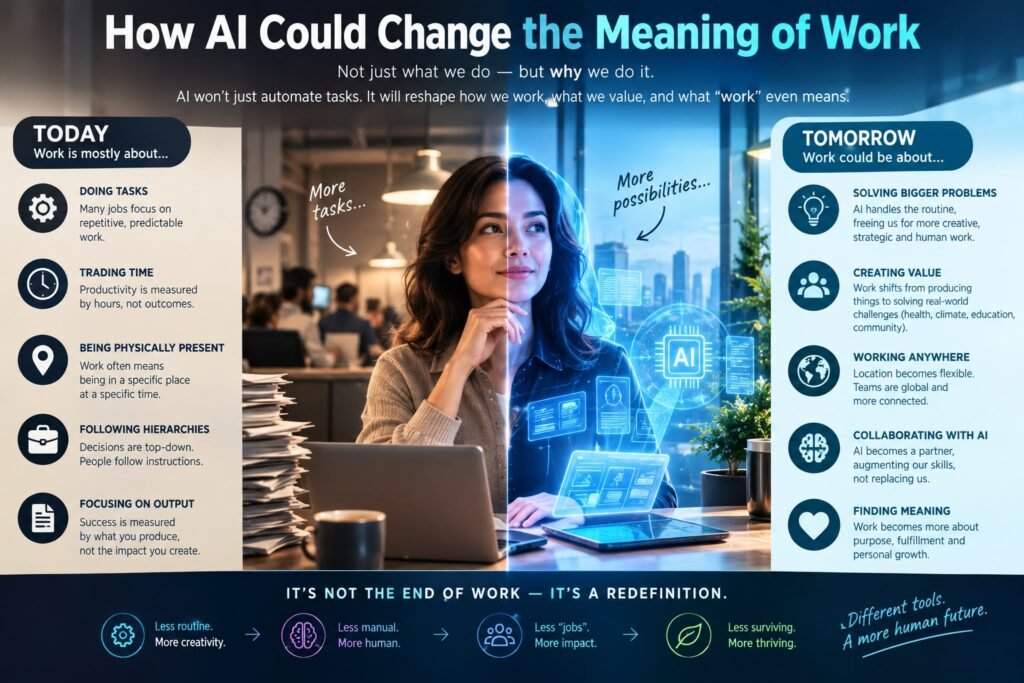
Beyond Job Replacement: How AI Could Change the Meaning of Work, Skills, and Human Purpose
Why the Future of Work Is About More Than Jobs
Artificial intelligence is changing the world of work. It can write reports, analyze data, create images, answer questions, and help people solve complex problems. As these tools improve, workers and students are asking an important question: what will work mean in the future?
The discussion about AI and the future of work often focuses on job losses. Some people fear that machines will replace human workers. Others believe AI will create new jobs and make existing work easier. Both views have some truth, but neither tells the whole story.
The bigger question is how artificial intelligence may change our skills, goals, and sense of purpose.
For many people, work provides more than a salary. It offers social contact, personal growth, independence, and a sense of achievement. A teacher helps students grow. A doctor supports patients. An engineer solves problems. A small business owner serves a community.
If AI takes over some of these tasks, people may need to rethink what makes their work valuable.
The future of work in the age of AI will depend on how people, businesses, schools, and governments respond to change. Technology can support human progress, but its benefits aren’t automatic. People need access to education, fair opportunities, and time to develop new skills.
This article explores how AI may reshape employment, why human skills still matter, and how students and professionals can prepare for the future. Most importantly, it examines how people can find meaningful work in a world where machines can do more than ever before.
1. AI and the Future of Work
Artificial intelligence refers to computer systems that can perform tasks that usually require human intelligence. These tasks include recognizing patterns, understanding language, making predictions, and generating new content.
Generative AI has made these abilities easier to access. People can now use AI tools to draft emails, summarize documents, create computer code, and brainstorm ideas.
This change is already affecting many industries. However, AI doesn’t affect every job in the same way.
How AI Is Changing Daily Tasks
In the past, workers often spent hours on repetitive tasks. They might enter data, prepare standard reports, sort records, or answer common customer questions.
AI can now help with many of these activities.
For example:
- Marketing teams can use AI to analyze customer feedback.
- Teachers can create practice questions and lesson outlines.
- Accountants can use automation to organize financial records.
- Software developers can use AI assistants to review and explain code.
- Customer support teams can use chatbots to answer basic questions.
These examples show how AI automation and employment are connected. Technology can reduce routine work and give people more time for tasks that require judgment.
However, automation doesn’t always remove an entire job. It may change only a few parts of it.
A teacher may spend less time preparing worksheets but more time helping students understand difficult ideas. A marketing specialist may use AI to study data but still need to choose the right message for an audience.
The result depends on the task, the organization, and the quality of the technology.
Job Replacement vs. Job Transformation
AI job replacement happens when technology takes over work that people previously performed. Job transformation happens when technology changes the duties, tools, or skills required for a role.
These outcomes can occur together.
| Workplace example | Possible AI impact | Continuing human role |
| Customer support | Answers common questions | Handles sensitive cases |
| Education | Generates practice material | Guides and motivates students |
| Marketing | Studies data and drafts content | Develops strategy and checks accuracy |
| Healthcare | Supports image analysis | Makes clinical decisions and cares for patients |
| Software development | Suggests code | Designs systems and tests results |
| Recruitment | Sorts applications | Evaluates people fairly and conducts interviews |
The impact of AI on jobs will vary across occupations. Some tasks may become highly automated, while others will still need people.
The International Labour Organization offers research on generative AI and jobs. Its work can help readers understand how technology may affect different occupations and working conditions.
The key lesson is simple: workers shouldn’t prepare only for jobs that exist today. They should also prepare to learn new tools and adapt as their responsibilities change.
2. How AI Could Change the Meaning of Work
The discussion about artificial intelligence often begins with productivity. Can a company produce more in less time? Can a worker complete more tasks? Can a business reduce costs?
These questions matter, but they leave out an important issue: what makes work meaningful?
For many people, work gives structure to daily life. It creates goals, builds relationships, and helps people feel useful. It can also provide a sense of pride.
As AI takes over more routine tasks, people may have new opportunities to focus on activities that feel meaningful. At the same time, some may struggle if their jobs disappear or their skills lose value.
Work Beyond Earning Money
Money is one of the main reasons people work. It pays for food, housing, education, healthcare, and other needs.
Yet people often want more than income from their careers.They may want to solve problems, help others, express creativity, or make a difference in their communities. These goals can give work a deeper meaning.
Imagine a graphic designer who spends most of the day resizing images and preparing simple layouts. An AI tool might handle much of that routine work. The designer could then spend more time understanding clients, developing creative concepts, and building a strong visual identity.
This is one possible way AI could improve working life.
But the outcome isn’t guaranteed. A company might instead use automation to reduce staff and increase workloads for the remaining workers.
The effect depends on how employers share the benefits of technology.
If businesses use AI responsibly, workers may gain more time for learning, creative work, and personal development. If they focus only on cutting costs, workers may face greater pressure and less security.
The AI and the meaning of work debate is therefore also about fairness, freedom, and the quality of working life.
Human Identity and Professional Life
People often connect their identity to their jobs.
Someone may introduce themselves as a nurse, teacher, designer, researcher, or business owner. These roles can shape how people see themselves and how others see them.
What happens when AI changes a profession?
A worker may worry that years of training will become less valuable. A young graduate may wonder whether a chosen career will still exist in ten years.
These concerns are understandable. However, a person’s value isn’t limited to the tasks they perform at work.
A nurse’s value includes compassion and trust. A teacher’s value includes guidance and encouragement. An engineer’s value includes responsibility for how a solution affects people.
AI may help with parts of these jobs, but professional identity can continue to grow as responsibilities change.
People may also find purpose outside paid employment. Caring for family members, volunteering, learning, creating art, and supporting local communities can all contribute to a meaningful life.
This doesn’t mean that job security is unimportant. A stable income remains essential for most people. Rather, it means that human purpose is broader than a job title.
In an AI-driven world, society may need to think more carefully about how people gain dignity, security, and a sense of belonging.
3. Human Skills in the Age of AI
As AI becomes more capable, workers will need a mix of technical knowledge and human abilities.
Knowing how to use software will matter. So will knowing when to question its results.
A strong future workforce will need people who can understand problems, communicate clearly, make responsible decisions, and work well with others.
Creativity, Judgment, and Critical Thinking
AI can generate many ideas in seconds. However, generating options isn’t the same as deciding which option is useful.
Human creativity involves understanding people, culture, emotions, and real-world needs. It also involves asking questions that lead to new possibilities.
Consider a company that wants to launch a product for students. AI might analyze market trends and suggest product features. A human team must still decide which needs matter most, whether the product is affordable, and how it could improve students’ lives.
Critical thinking helps people test claims instead of accepting every answer they receive.
This is especially important because AI systems can produce incorrect, outdated, or misleading information. Their answers may sound confident even when the evidence is weak.
Workers should learn to:
- Check important facts against reliable sources.
- Compare different solutions before choosing one.
- Identify gaps in an argument.
- Recognize assumptions and possible bias.
- Consider the long-term effects of decisions.
- Take responsibility for the final result.
Problem-solving skills are also essential. Real problems often have unclear goals, limited resources, and competing needs. People must decide which questions to ask and how to balance different priorities.
These abilities help explain why human creativity vs. artificial intelligence shouldn’t be treated as a simple contest. In many situations, the strongest results will come from people using AI to expand their thinking while applying their own judgment.
Emotional Intelligence and Communication
Emotional intelligence means recognizing emotions and responding to them thoughtfully.
This ability matters in workplaces because people don’t always agree. Teams face pressure, customers may feel frustrated, and employees sometimes need support during difficult changes.
AI can analyze words and suggest responses, but human relationships involve more than language. They require trust, empathy, timing, and an understanding of personal circumstances.
For example, a manager may use AI to summarize employee feedback. Yet the manager still needs to listen carefully, recognize concerns, and take fair action.
Communication is another valuable skill. Workers need to explain ideas, ask clear questions, provide feedback, and work with people from different backgrounds.
Other important human skills include:
| Skill | Why it matters |
| Critical thinking | Helps people question AI-generated answers |
| Creativity | Supports new ideas and original solutions |
| Emotional intelligence | Builds trust and stronger relationships |
| Communication | Makes teamwork and problem-solving easier |
| Adaptability | Helps workers respond to changing roles |
| Ethical judgment | Supports fair and responsible decisions |
| Leadership | Helps teams make choices and manage change |
Digital literacy and AI literacy should support these skills, not replace them.
Workers who combine technical understanding with human judgment may be better prepared for changing roles. The goal isn’t to compete with machines at every task. It’s to develop strengths that help people use technology wisely.
4. Future Careers in the AI Era
The future of careers will include both change and uncertainty. Some existing roles may shrink, while others may grow or develop new responsibilities.
New opportunities may appear in AI development, data management, cybersecurity, healthcare technology, automation, and AI governance.
At the same time, many established careers will continue to need people who can work with technology.
Jobs AI Cannot Easily Replace
No job is completely guaranteed to remain unchanged. Even work that requires human contact may use AI for scheduling, documentation, or analysis.
Still, jobs that involve complex human relationships, physical adaptability, or high-stakes judgment may be harder to automate fully.
Examples include:
- Healthcare professionals: Provide patient care, explain treatment choices, and respond to changing needs.
- Teachers and mentors: Support learning, understand student difficulties, and encourage progress.
- Skilled tradespeople: Repair equipment and handle physical problems in unpredictable environments.
- Counsellors and social workers: Help people manage personal challenges and access support.
- Creative directors: Set artistic goals and decide what ideas suit an audience or brand.
- Community leaders: Build relationships and respond to local needs.
- Research professionals: Develop questions, test evidence, and interpret findings.
These are examples of work that may retain important human responsibilities, not promises that these occupations are immune to automation.
The risk depends on which tasks are involved and how quickly technology develops.
Emerging AI-Related Careers
AI also creates demand for people who can develop, maintain, evaluate, and manage technology.
Potential career paths include:
| Career path | Main responsibilities | Useful skills |
| AI engineer | Builds AI-powered systems | Programming, mathematics |
| Data analyst | Studies data and identifies patterns | Statistics, critical thinking |
| AI product manager | Connects user needs with technical solutions | Planning, communication |
| AI safety specialist | Evaluates risks and system behavior | Research, ethics |
| AI governance specialist | Supports policies and responsible use | Law, risk management |
| Automation consultant | Improves business processes | Systems thinking, business knowledge |
| AI content specialist | Develops and reviews AI-supported content | Writing, research, fact-checking |
| Cybersecurity analyst | Protects systems and information | Security knowledge, problem-solving |
Not every career requires advanced programming. Some roles need a combination of industry knowledge, communication, and practical AI literacy.
For example, a teacher who understands AI tools may help a school improve lesson planning. A marketing professional may use AI to study customer behavior. A finance graduate may apply automation to reporting and analysis.
The future careers in the AI era will likely reward people who understand both their field and the tools changing it.
Instead of searching for one perfect, future-proof job, workers should build a flexible set of skills that can transfer across different roles.
5. AI and the Changing Workplace
The workplace of the future may look different from today’s office. AI assistants could help organize meetings, draft documents, analyze information, and coordinate routine processes.
Some teams may become smaller but more productive. Others may grow because AI makes new services possible.
The important question is how people and organizations manage this transformation.
Human-AI Collaboration
Human-AI collaboration means people and AI systems working together to complete tasks.
In this model, AI handles activities where it can provide speed or useful pattern recognition. People set goals, check results, manage relationships, and make decisions that require context.
For example, a marketing team might ask AI to summarize customer reviews. Team members can then identify common problems, speak with customers, and design a better product experience.
A software team might use AI to generate code suggestions. Developers still need to test security, evaluate performance, and ensure that the software meets user needs.
A teacher may use AI to prepare learning exercises but still guide students through confusion and encourage independent thought.
Good collaboration requires clear responsibilities. People should know which tasks AI can handle, where human review is required, and who is accountable when something goes wrong.
Organizations also need training and reliable systems. Giving employees access to AI without explaining its limits can create mistakes rather than improve productivity.
Ethical AI and Responsible Leadership
AI can introduce new risks into the workplace.
A recruitment system might favor certain applicants because of biased training data. An automated monitoring tool might collect more employee information than necessary. An AI-generated report might contain errors that affect an important decision.
Responsible organizations should take several steps:
- Protect privacy. Collect only the information needed for a clear purpose.
- Check for bias. Test systems to identify unfair outcomes.
- Keep human oversight. Review important decisions, especially those affecting people’s rights or livelihoods.
- Explain decisions. Give workers and customers understandable information about how AI is used.
- Train employees. Teach people how to use AI safely and verify its output.
- Share the benefits. Consider how productivity gains can improve pay, working conditions, and opportunities.
Leadership will matter because technology doesn’t decide what a workplace should value. People make those choices.
Businesses that treat workers as partners in change may be better positioned to build trust and use AI effectively.
The goal should be a workplace where technology supports human potential instead of treating people as costs to remove.
6. How Students Can Prepare for an AI-Driven Future
Students face a special challenge. They must prepare for careers in a world where the tools, tasks, and expectations of many jobs are still changing.
Traditional education remains important, but students also need practical experience, digital literacy, and the ability to keep learning.
AI Skills for College Students
Students don’t need to become AI researchers to benefit from AI literacy.
They should understand what common AI tools can do, where these tools fail, and how to use them responsibly.
Useful AI skills for college students include:
- Writing clear prompts and explaining goals.
- Checking AI-generated facts and references.
- Understanding basic data privacy.
- Recognizing bias and misinformation.
- Using digital tools to solve real problems.
- Knowing when a task requires independent work.
- Following academic rules about AI assistance.
Students should also build strong foundations in their chosen subjects. AI is more useful when people understand the field in which they are applying it.
A biology student needs scientific knowledge to evaluate AI-generated explanations. A business student needs to understand customers and markets. A law student needs to interpret legal rules and evidence.
AI tools can support learning, but relying on them for every assignment can weaken the very skills students need.
Students should practice writing without assistance, solving problems independently, and explaining concepts in their own words.
Reskilling and Lifelong Learning
A degree is an important starting point, not a guarantee that a person will never need further training.
Lifelong learning helps people respond to new tools, changing industries, and unexpected career opportunities.
Students and graduates can begin with a simple plan:
Step 1: Learn the basics. Understand AI, data, online safety, and digital tools.
Step 2: Choose a field. Identify the knowledge and skills employers value in that area.
Step 3: Practice with real projects. Use AI to help create a portfolio, analyze a dataset, build an application, or solve a practical problem.
Step 4: Develop human skills. Improve communication, teamwork, creativity, and critical thinking.
Step 5: Seek feedback. Ask teachers, mentors, and professionals to review your work.
Step 6: Keep updating your knowledge. Follow trustworthy industry sources and learn new tools when they become relevant.
Students should also gain experience through internships, volunteering, research, or part-time work. These activities teach them how to handle real responsibilities.
AI and Higher Education
Colleges and universities have a major role in preparing the future workforce.
They should teach students how to understand and evaluate AI, not just how to operate individual tools.
Courses can include real-world projects, ethical questions, teamwork, and practical problem-solving. Teachers can also help students understand when AI assistance is appropriate and when independent work is essential.
Career services can provide information about changing occupations, emerging skills, and opportunities for further training.
For young people, the best career plan combines subject knowledge, AI literacy, and the ability to adapt.
The aim isn’t to predict every future job. It’s to help students develop the confidence and skills to respond when the world changes.
7. Challenges of AI and Workforce Transformation
AI may create new opportunities, but its benefits and risks won’t be shared equally.
Some workers may gain higher productivity and better career options. Others may face reduced demand for their skills, lower wages, or difficulty finding new employment.
These challenges require careful planning.
Job Displacement and Economic Inequality
AI job displacement occurs when workers lose jobs or income because technology reduces the need for their work.
Workers who perform repetitive digital tasks may face significant changes. Administrative support, routine content production, and basic data processing are examples of areas where automation may affect duties.
However, exposure to AI doesn’t automatically mean a job will disappear. Technology may automate only some tasks, and actual outcomes depend on business decisions, costs, regulations, and customer needs.
People may face greater risks when they lack access to training or cannot easily move to another occupation.
Small businesses may also struggle to afford training and technology. If only large organizations benefit, economic inequality could increase.
Governments, employers, and educational institutions can help by supporting:
- Affordable training and reskilling programs.
- Career guidance for workers in changing industries.
- Fair hiring and workplace policies.
- Financial support during career transitions.
- Access to digital tools for smaller businesses.
- Clear information about changing skill requirements.
Workers should have opportunities to learn before their current roles disappear, not only after they lose their jobs.
Protecting Human Value at Work
A workplace should measure more than the number of tasks completed each hour.
Speed matters, but so do quality, safety, trust, creativity, and customer satisfaction.
For example, a support team may answer more questions with AI. Yet if customers receive inaccurate responses or cannot reach a human when they need one, the service may become worse.
Similarly, an organization may reduce staffing costs through automation but lose valuable experience and team knowledge.
Companies should evaluate whether AI improves outcomes for workers and customers, rather than focusing only on short-term savings.
Workers also need a voice in decisions that affect their careers. Clear communication, fair performance reviews, and access to training can help employees manage change.
The AI and workforce transformation process should include people from the beginning. Employees often understand the practical problems in their work better than the people selecting new software.
When workers help design new processes, organizations may identify better uses for AI and avoid preventable mistakes.
The wider goal is to ensure that technological progress supports a fair and productive society.
8. Building a Future-Ready Career
No career can be guaranteed to remain unchanged as technology advances. However, people can improve their ability to respond to change.
Building a future-ready career means developing skills that remain useful across different tools, industries, and job titles.
A Practical Career Development Plan
Start by reviewing your current skills. Identify what you do well, which tasks take the most time, and where AI could help.
Next, consider the direction of your industry. Look for tasks that are becoming automated and skills that are becoming more important.
Then, choose one or two areas to develop rather than trying to learn every new AI tool.
For example, a content writer might learn AI-assisted research, fact-checking, audience analysis, and content strategy. An accountant might develop data analysis and automation skills. A student might combine subject knowledge with practical AI projects.
A useful plan includes four areas:
| Development area | Action | Expected benefit |
| Technical skills | Learn relevant AI and digital tools | Greater efficiency |
| Human skills | Practice communication and problem-solving | Better teamwork and judgment |
| Practical experience | Build projects and seek feedback | Stronger evidence of ability |
| Career adaptability | Review goals and learn regularly | Better preparation for change |
Keep a record of your progress. Save projects, document improvements, and note how you used AI to solve a problem.
A portfolio can help employers understand your abilities more clearly than a list of tools alone.
Finding Purpose in a Changing World
Career development isn’t only about staying employable. It’s also about deciding what kind of working life you want.
Ask yourself a few questions:
- Which problems do I enjoy solving?
- What skills do other people value in me?
- Which activities make me feel useful?
- How can technology help me do better work?
- What responsibilities should remain under my control?
- What would I like to learn over the next year?
These questions can help connect career planning with personal values.
People may change occupations several times during their working lives. A flexible mindset can make these changes easier to manage.
AI may also give people more ways to start businesses, learn independently, and create services for smaller groups of customers. Yet these opportunities still require effort, sound judgment, and an understanding of real needs.
The future of meaningful work in an automated world will depend on more than technical progress. It will depend on whether people can access opportunities, build useful skills, and find roles that support both economic security and personal fulfillment.
Ultimately, the goal is not to make humans more like machines. It’s to use machines in ways that help people make better choices, solve important problems, and live more meaningful lives.
The Future of Work Should Put People First
The future of work isn’t simply a story about humans losing jobs to machines. It’s a story about how society chooses to use increasingly powerful technology. AI can automate routine tasks, support better decisions, and create new opportunities. It can also disrupt careers, increase inequality, and challenge people’s sense of professional identity.
The outcome will depend on the choices made by businesses, governments, educators, and workers.
People will need technical knowledge, AI literacy, creativity, critical thinking, emotional intelligence, and a willingness to keep learning. Students will need to prepare for changing careers, while experienced workers will need access to fair opportunities for reskilling.
At the same time, society must recognize that human value goes beyond productivity. People contribute through care, trust, judgment, relationships, and the ability to understand what matters to others.
The meaning of work may evolve as AI becomes more common. Some tasks will disappear, some professions will change, and new opportunities will emerge. Yet the need for purpose, dignity, and human connection will remain.
”FAQs”
1. What is the future of work with AI?
The future of work with AI will likely involve greater automation, new job opportunities, and changes in the skills many occupations require. AI may handle routine tasks while people focus more on judgment, creativity, communication, and complex problem-solving. The exact impact will vary by industry and occupation.
2. Will AI replace jobs or create new opportunities?
AI can do both. Some jobs may shrink or disappear as tasks become automated, while new roles may develop in AI engineering, cybersecurity, data analysis, and AI governance. Many existing jobs may also change instead of disappearing completely.
3. How does AI change human purpose?
AI may change how people find meaning in their work by taking over some routine activities and creating new ways to learn and contribute. However, work remains an important source of income, identity, and social connection. Human purpose can also come from relationships, creativity, caring for others, and community involvement.
4. What skills should students develop in the age of AI?
Students should develop AI literacy, digital literacy, critical thinking, creativity, communication, emotional intelligence, and problem-solving skills. Strong subject knowledge is equally important because it helps students evaluate AI-generated information and apply tools effectively.
5. Which jobs are least likely to be fully automated by AI?
Jobs that involve complex human relationships, unpredictable physical environments, nuanced judgment, and significant personal responsibility may be harder to automate fully. Examples include nursing, skilled trades, teaching, counselling, and certain leadership roles. However, AI may still change tasks within these professions.
6. How can workers prepare for AI-related job displacement?
Workers can identify which parts of their jobs are becoming automated, learn relevant tools, and develop transferable skills. Practical projects, professional training, mentoring, and career guidance can help. Employers should also offer opportunities for reskilling before major workplace changes occur.
7. How can humans and AI work together effectively?
People and AI can work together by assigning suitable tasks to technology while keeping human oversight for important decisions. AI may help with research, drafting, and data analysis, while people check accuracy, understand context, and take responsibility for the final result.
8. Can AI make work more meaningful?
AI could make work more meaningful if it reduces repetitive tasks and gives people more time for creative, social, and challenging activities. But this depends on how organizations use the technology. If automation leads to excessive workloads or insecurity, workers may experience the opposite effect.
9. How can graduates build a future-proof career in the age of AI?
Graduates can build a more adaptable career by combining subject expertise, AI literacy, communication, and practical experience. They should continue learning, build a portfolio, and monitor changes in their chosen field. No career is completely future-proof, but transferable skills can improve adaptability.
10. What is the role of human judgment in an AI-driven workplace?
Human judgment helps people evaluate AI output, recognize ethical concerns, understand individual needs, and make decisions that account for real-world consequences. It is especially important when decisions affect people's health, safety, rights, or livelihoods.