

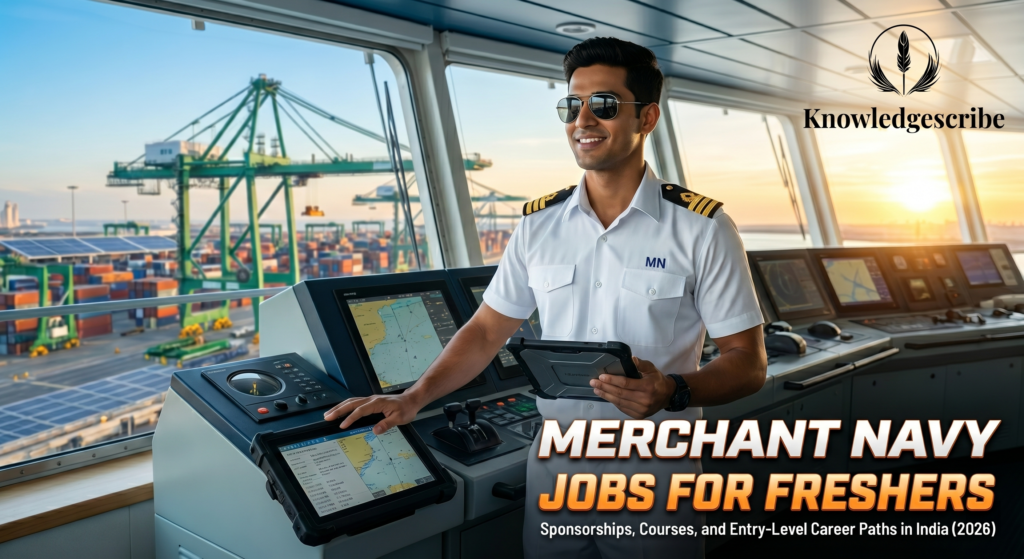
Introduction to Merchant Navy Careers
Merchant navy jobs in 2026 offer high salaries, global travel opportunities, and a structured career path. With increasing global trade and advanced maritime technologies, the demand for skilled seafarers continues to rise, especially in India.
Why Choose Merchant Navy in 2026
If you’ve ever dreamed of traveling across oceans while earning a solid income, merchant navy jobs might be exactly what you’re looking for. Unlike conventional 9-to-5 jobs, this career throws you into a world where every day feels different. One week you’re docking in Singapore, and the next you’re sailing across the Atlantic.
In 2026, the maritime industry is expanding rapidly. According to global shipping reports, over 90% of world trade is carried by sea. That means there’s constant demand for trained professionals. Countries like India are producing a large number of seafarers, making merchant navy jobs in India highly competitive yet rewarding.
What makes this career even more attractive is its structured growth path. You don’t just join and stay stagnant. You climb ranks—from cadet to captain or chief engineer—based on experience, exams, and certifications.
Another big factor? Tax benefits. Many seafarers qualify for tax-free income under certain conditions, making the take-home salary significantly higher than land-based jobs. Add to that the adventure, discipline, and global exposure—it’s not just a job, it’s a lifestyle.
Benefits: Travel, Salary, Lifestyle
Let’s talk real-life perks. Imagine getting paid while exploring different countries. Sounds unreal, right? That’s the everyday reality for those in merchant navy jobs. The travel aspect is unmatched—you see the world not as a tourist, but as part of a global workforce.
Financially, it’s one of the most rewarding careers for young individuals. Even freshers can earn between $300 to $800 per month, and this grows significantly with experience. Senior officers can earn upwards of $10,000 monthly, depending on the vessel and company.
The lifestyle is unique. You work in rotations—typically 6 months onboard and 3 months off. That means extended vacations where you can relax, study, or even pursue other interests. It’s intense while onboard, but the time off balances it out.
There’s also a sense of pride. Being part of the global supply chain, ensuring goods move across continents, gives a strong sense of purpose. However, it’s not all glamorous—you need discipline, adaptability, and mental strength to handle long periods away from home.
Eligibility Criteria for Merchant Navy Jobs
Eligibility for merchant navy jobs depends on education level. 10th pass candidates can apply for GP Rating courses, while 12th pass students with PCM can pursue DNS or B.Sc Nautical Science through DG Shipping-approved institutes.
Merchant Navy Jobs for 10th Pass (GP Rating)
If you think merchant navy careers are only for highly educated candidates, think again. One of the most accessible entry points is through GP Rating (General Purpose Rating) courses, designed specifically for 10th pass students.
This pathway is ideal for those who want to start early and gain hands-on experience. GP Ratings work in both deck and engine departments, assisting officers in daily operations. The course usually lasts 6 months, followed by onboard training.
To qualify, candidates must:
- Be at least 17.5 years old
- Pass a medical fitness test
- Enroll in a DG Shipping approved institute
After completing the course, you receive STCW certification, which is mandatory for all seafarers. You’ll also need a Continuous Discharge Certificate (CDC)—your official record of sea service.
The starting salary might seem modest, but don’t underestimate the growth potential. With experience and additional certifications, GP Ratings can move into specialized roles and significantly increase their earnings.
Merchant Navy 12th Pass Jobs (DNS & B.Sc Nautical Science)
For students who have completed 12th with Physics, Chemistry, and Mathematics, the doors open much wider. You can apply for Deck Cadet programs like Diploma in Nautical Science (DNS) or B.Sc Nautical Science.
These programs are more advanced and lead to officer-level positions. The IMU-CET 2026 exam is usually required for admission into top maritime institutes.
DNS is a one-year course followed by sea training, while B.Sc Nautical Science is a 3-year degree program. Both paths eventually lead to becoming a Navigating Officer.
Requirements include:
- Minimum 60% in PCM
- Good English proficiency
- Medical fitness as per maritime standards
These roles offer better starting salaries and faster promotions compared to GP Rating jobs. If you’re serious about long-term growth in merchant navy jobs, this is the route to consider.
Step-by-Step Recruitment Process
To secure merchant navy jobs, candidates must clear IMU-CET, join a DG Shipping-approved course, complete STCW training, obtain a CDC, and secure onboard placement through ship management companies or RPSL agencies.
IMU-CET 2026 Explained
The Indian Maritime University Common Entrance Test (IMU-CET 2026) is your gateway into top maritime institutes. Think of it as the foundation step—without clearing this, most reputed colleges won’t consider your application.
The exam tests your knowledge in Physics, Chemistry, Mathematics, English, and General Aptitude. It’s not extremely difficult, but it requires focused preparation. Many candidates underestimate it and miss out on good institutes.
Once you clear IMU-CET, you can apply to colleges offering DNS or B.Sc programs. Some institutes also provide sponsorship programs, which means a shipping company guarantees you a job after training.
Certifications: STCW & CDC
After admission, the next critical step is certification. The STCW (Standards of Training, Certification, and Watchkeeping) is mandatory for all seafarers worldwide. It ensures you’re trained in safety, survival, firefighting, and first aid.
Then comes the Continuous Discharge Certificate (CDC). This document is like your passport in the maritime world. It records your sea service and is required for boarding any ship.
Without these, you simply cannot work at sea. That’s why choosing a DG Shipping approved institute is non-negotiable—they ensure all certifications are valid and globally recognized.
Merchant Navy Departments Overview
Merchant navy jobs are divided into two main departments: Deck and Engine. The Deck department handles navigation and cargo operations, while the Engine department manages machinery and technical systems onboard ships.
Deck Department Roles
If you imagine a ship as a floating city, the Deck Department is responsible for steering it in the right direction—literally and figuratively. This department handles navigation, cargo management, and overall vessel operations. It’s where leadership meets precision, and decisions can impact not just the ship, but millions worth of cargo.
The journey typically starts as a Deck Cadet, where you learn the ropes—sometimes quite literally. You assist officers, observe navigation practices, and get hands-on experience with equipment. After gaining sufficient sea time and passing exams, you move up to Third Officer, then Second Officer, Chief Officer, and eventually Captain.
Each rank comes with increased responsibility. For example, a Second Officer is usually in charge of navigation charts and route planning, while the Chief Officer oversees cargo operations and crew management. The Captain, of course, is the ultimate authority onboard.
What makes this path appealing is the blend of technical knowledge and leadership. You’re not just operating systems—you’re making strategic decisions. It’s ideal for individuals who enjoy responsibility and can stay calm under pressure.
Engine Department Roles
While the deck crew navigates the ship, the Engine Department ensures it keeps moving. This team is responsible for maintaining and operating all mechanical and electrical systems onboard. Without them, the ship simply wouldn’t function.
Entry-level roles begin as Trainee Marine Engineers or Engine Cadets. Over time, you progress to Fourth Engineer, Third Engineer, Second Engineer, and finally Chief Engineer.
Each role focuses on specific systems. For instance, the Fourth Engineer may handle boilers and auxiliary engines, while the Second Engineer oversees daily engine operations. The Chief Engineer is the backbone of the vessel’s technical performance.
This department is perfect for those with a passion for mechanics and problem-solving. It’s less about navigation and more about ensuring everything runs smoothly behind the scenes. And trust me, when something breaks in the middle of the ocean, it’s the engine team that saves the day.
Salary Structure in 2026
Merchant navy salaries in 2026 vary by rank and department. Freshers earn $300–$800 monthly, while experienced officers can earn over $10,000. Salaries are often tax-free and include additional onboard benefits.
Salary Comparison Table (Deck vs Engine)
Let’s get straight to what most people are curious about—money. Merchant navy jobs are among the highest-paying careers for young professionals, especially when you consider the tax advantages and minimal living expenses onboard.
Here’s a clear comparison of salaries between Deck and Engine departments:
| Rank | Deck Department (USD) | Engine Department (USD) | Approx INR (Monthly) |
|---|---|---|---|
| Trainee/Cadet | $300 – $800 | $400 – $900 | ₹25,000 – ₹75,000 |
| Junior Officer | $1,500 – $3,000 | $2,000 – $3,500 | ₹1.2L – ₹3L |
| Mid-Level Officer | $4,000 – $7,000 | $5,000 – $8,000 | ₹3L – ₹6.5L |
| Senior Officer | $8,000 – $15,000 | $9,000 – $16,000 | ₹6.5L – ₹13L |
Now here’s the interesting part—your expenses onboard are almost zero. Food, accommodation, and travel are covered by the company. So most of your salary becomes savings.
Another factor is contract duration. You’re typically paid monthly during your time onboard, which can range from 4 to 9 months. Some companies also offer bonuses and insurance benefits.
Compared to land-based jobs, the financial growth here is significantly faster. Within a decade, many seafarers achieve financial stability that would take much longer in traditional careers.
Merchant Navy Jobs for Freshers
Freshers can secure merchant navy jobs by obtaining sponsorships from shipping companies, completing approved courses, and applying through verified RPSL agencies while avoiding scams and fraudulent job offers.
How to Get Sponsorship
Landing your first job in the merchant navy can feel like cracking a secret code. The keyword here is “sponsorship.” This is essentially a pre-placement agreement with a shipping company that guarantees onboard training after your course.
Many reputed institutes offer sponsorship programs. However, you can also apply directly to Ship Management Companies. These companies conduct interviews, written tests, and sometimes psychometric evaluations before offering sponsorships.
Here’s what improves your chances:
- Strong academic background
- Good communication skills
- Medical fitness
- Confidence during interviews
Networking also plays a role. Connecting with alumni or professionals already working in the industry can open unexpected doors.
Avoiding Scams & Fake Agencies
Let’s be real—where there’s opportunity, there are scams. The maritime industry is no exception. Many fake agencies promise merchant navy job vacancies in exchange for hefty fees.
Here’s how to stay safe:
- Always verify if the agency is RPSL (Recruitment and Placement Services License) registered
- Avoid paying large upfront fees
- Check company reviews and official websites
- Never trust “guaranteed job” promises without proper documentation
Authentic companies follow a structured hiring process. If something feels too easy or too good to be true, it probably is.
Latest Merchant Navy Vacancy Trends
Merchant navy vacancy trends in 2026 show increased demand for skilled seafarers, especially in tanker and container ships, with hiring primarily conducted through RPSL agencies and verified maritime job portals.
RPSL Agencies & Ship Companies
When searching for merchant navy jobs in India, your safest route is through RPSL-approved agencies. These are government-authorized recruiters that connect seafarers with shipping companies.
Major Ship Management Companies include:
- Anglo-Eastern
- Synergy Marine
- Fleet Management
- Scorpio Marine
These companies regularly publish merchant navy job vacancies and conduct recruitment drives. Staying updated with their official websites can give you an edge.
Best Job Portals for Vacancies
In 2026, digital platforms have made job hunting easier than ever. Some reliable portals include:
- DG Shipping official website
- Maritime Union of India
- Company career pages
These platforms list verified openings and provide application guidelines. Avoid random WhatsApp messages or unofficial listings—they’re often traps.
Career Growth & Shore Jobs
Merchant navy careers offer structured promotions from cadet to captain or chief engineer, with opportunities to transition into shore-based roles like port management, training, and maritime consultancy after years of sea experience.
Promotions & Rank Progression
Growth in the merchant navy is not random—it’s systematic. Each promotion requires a combination of sea time, exams, and performance. It’s like leveling up in a game, but with real-world stakes.
For example, a Deck Cadet becomes a Third Officer after completing required sea service and passing competency exams. This continues until you reach the rank of Captain.
The same applies to the Engine Department. The journey from Trainee Engineer to Chief Engineer is demanding but highly rewarding.
Shore-Based Opportunities
After years at sea, many professionals transition to land-based roles. These include:
- Port Manager
- Marine Surveyor
- Maritime Trainer
- Shipping Company Executive
These roles offer stability while leveraging your sea experience. It’s like bringing the ocean’s knowledge back to land.
Role of AI in Maritime & Digital Recruitment
Artificial Intelligence is transforming merchant navy jobs by optimizing ship operations, predictive maintenance, and revolutionizing recruitment through AI-driven job matching, digital marketing, and automated hiring processes.
AI in Shipping Industry
AI is no longer futuristic—it’s already reshaping the maritime world. Ships are becoming smarter, with systems that predict maintenance needs and optimize fuel consumption.
This means fewer breakdowns, safer journeys, and more efficient operations. For seafarers, it also means learning new digital skills.
AI in Digital Marketing for Jobs
Recruitment has also evolved. Companies now use AI to filter applications, match candidates, and even conduct initial interviews.
Digital marketing plays a huge role here. Job listings are optimized for search engines, making it easier for candidates to find merchant navy job vacancies online.
Merchant navy jobs in 2026 offer a powerful combination of adventure, financial growth, and global exposure. Whether you’re a 10th pass student or a 12th graduate, there’s a clear pathway into this industry. With proper training, verified applications, and persistence, you can build a career that literally takes you around the world.
”FAQs”
1. What is the minimum qualification for merchant navy jobs?
You can start with 10th pass (GP Rating) or 12th pass with PCM for officer-level roles.
2. Is IMU-CET mandatory in 2026?
Yes, for most reputed institutes and courses like DNS and B.Sc Nautical Science.
3. Are merchant navy salaries tax-free?
In many cases, yes, if you meet the NRI criteria based on days spent outside India.
4. How long are contracts in merchant navy jobs?
Typically 4 to 9 months onboard, followed by leave periods.
5. Is merchant navy a safe career?
Yes, with proper training and certifications, it is a structured and secure profession.